El Niño 2026-2027 Climate Forecast: Diagnostic Analysis and Global Prospects
The global climate system is undergoing a fundamental state transition toward a significant El Niño event in 2026, with profound implications for 2027.
# The 2026-2027 El Niño-Southern Oscillation Transition: Diagnostic Analysis, Continental Prospects, and Global Feedback Amplification
The global climate system in the first quarter of 2026 is undergoing a fundamental state transition, moving from a protracted and weakening La Niña phase toward an anticipated warming episode of the El Niño-Southern Oscillation (ENSO) in the latter half of the year. This shift is occurring against a backdrop of unprecedented global thermal stress, with recent years consistently setting new benchmarks for atmospheric and oceanic heat content. As of March 2026, diagnostic metrics from the National Oceanic and Atmospheric Administration (NOAA) and the World Meteorological Organization (WMO) indicate that the coupled ocean-atmosphere system is poised for a significant reshuffling of energy and moisture distribution.
The significance of the 2026 prospect is not merely localized to the tropical Pacific; the emerging El Niño is projected to act as a powerful catalyst, potentially pushing 2027 to become the warmest year in recorded history. This report provides a high-level expert analysis of the current data trends, probabilistic modeling for the 2026-2027 window, and the multi-scalar impacts expected across the world's continents, with a particular focus on the positive feedback loops that threaten to amplify current warming trajectories.
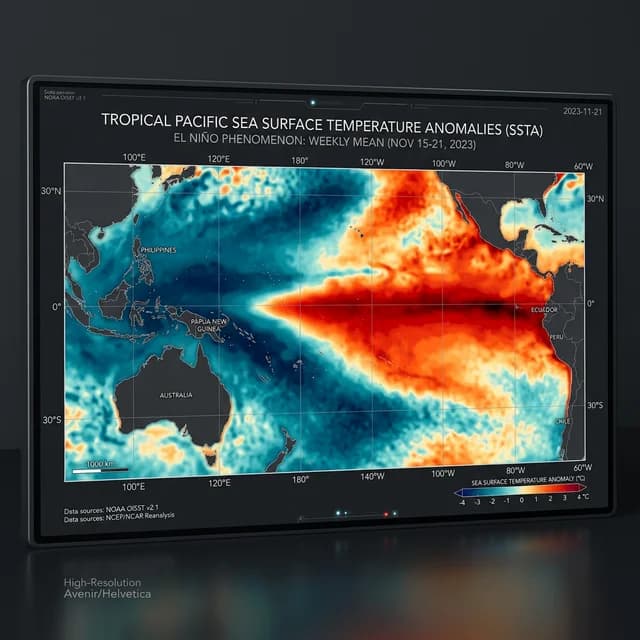
Current Diagnostic Status: The Dissipation of La Niña and the Emergence of Neutrality
The diagnostic discussion issued by the Climate Prediction Center on March 12, 2026, confirms that the weak La Niña event which persisted through the boreal winter of 2025-2026 is officially in a state of decay. February 2026 was characterized by below-average sea surface temperatures (SSTs) in the east-central equatorial Pacific, yet these anomalies have begun to contract in both spatial extent and magnitude. The Niño-3.4 index, a critical metric for monitoring ENSO phases, recorded a weekly value of -0.5°C, placing it at the very threshold of La Niña conditions.
Evolution of Sea Surface Temperature and Regional Indices
The spatial distribution of surface warming indicates a transition toward ENSO-neutrality. While the central Pacific (Niño-4) remains slightly cool, the far eastern Pacific (Niño-1+2) has already transitioned to positive anomalies, reaching +0.4°C.
| Niño Region | SST Anomaly (Mid-March 2026) | State Classification | | :--- | :--- | :--- | | Niño 4 | -0.4°C | ENSO-Neutral | | Niño 3.4 | -0.5°C | Weak La Niña / Neutralizing | | Niño 3 | -0.3°C | ENSO-Neutral | | Niño 1+2 | +0.4°C | Developing El Niño Signature |
The evolution of these indices suggests a rapid move toward a neutral state, which is favored to persist through the May-July 2026 period with a 55% to 60% probability. However, the relative stability of the surface hides a more volatile subsurface reality that serves as a leading indicator for the second half of 2026.
Subsurface Heat Content and Kelvin Wave Dynamics
A critical factor in the 2026 outlook is the "immense" heat accumulation in the eastern equatorial Pacific subsurface. Throughout February 2026, the equatorial subsurface temperature index continued to increase, reflecting the strengthening of above-average temperatures at depth. This heat is being transported eastward by downwelling Kelvin waves, which were initiated in December 2025 and January 2026. These waves act to deepen the thermocline in the central and eastern Pacific, suppressing the upwelling of cold water and preparing the surface for a rapid transition to El Niño once atmospheric trade winds weaken.
The diagnostic data shows that while the surface still exhibits some La Niña-like fingerprints, the subsurface heat reservoir is comparable to that of previous strong El Niño events. This subsurface warming is considered a highly reliable predictor of upcoming El Niño conditions, provided the atmosphere couples with the ocean in the coming months.
Prospects for 2026: The Onset of a Major El Niño Event
Forecast ensembles from the WMO Global Producing Centres and the North American Multi-Model Ensemble (NMME) converge on the emergence of El Niño by the boreal summer of 2026. While there is a consensus on the *likelihood* of the event, its *intensity* remains a subject of intense scientific scrutiny, partially due to the boreal spring predictability barrier—a period where atmospheric noise makes long-term forecasting inherently uncertain.
Probabilistic Modeling and Strength Forecasts
The probability of El Niño development increases steadily through 2026. The WMO indicates a 40% chance by May-July 2026, which jumps to a 62% chance for the June-August period according to NOAA. By the fourth quarter of 2026 (October-December), El Niño is expected to be the dominant phase, with some models suggesting a 1-in-3 chance of it becoming a "strong" event, characterized by Niño-3.4 anomalies exceeding +1.5°C.
| Forecast Period (2026) | ENSO-Neutral Probability | El Niño Probability | | :--- | :--- | :--- | | March–May | 60% | 10% | | April–June | 70% | 30% | | May–July | 60% | 40% | | June–August | 37% | 62% | | October–December | 35% | 65% |
The transition is expected to be relatively swift, with El Niño potentially reaching its mature phase by November 2026. The duration of this event is projected to span the entirety of late 2026, with significant implications for the global temperature trajectory in 2027.
Continental Prospects for 2026 and 2027: A Reshuffling of Global Weather
As the El Niño event matures in late 2026, its teleconnections will dictate the climate anomalies across different continents. These patterns are historically well-understood but are now taking place in a world with significantly higher average temperatures, which may intensify their impacts.
North America: Hydrological Volatility and Temperature Extremes
For North America, the 2026-2027 El Niño is expected to bring a distinctive split in weather patterns. During a typical El Niño winter, the Pacific jet stream extends and shifts southward, bringing wetter and cooler conditions to the southern tier of the United States. This could provide critical relief to regions facing multi-year droughts, although the risk of catastrophic flooding and landslides in California becomes a primary concern.
In contrast, the northern United States and Canada are projected to experience a warmer-than-average winter in 2026-2027. Drier conditions are typically observed in the Pacific Northwest and the Ohio Valley. A significant concern is the Colorado River crisis; while El Niño might bring more snow to the headwaters, the cumulative water deficit from six years of drought is so immense that a single wet year is unlikely to refill reservoirs.
| Region | Expected 2026-2027 Winter Impact | Agricultural/Economic Risk | | :--- | :--- | :--- | | Southern U.S. | Wetter and Colder | Flooding, infrastructure damage | | Northern U.S. | Warmer and Drier | Reduced snowpack, lower heating demand | | California | Heavy Precipitation | Mudslides, reservoir recharge | | Ohio Valley | Drier than Normal | Potential drought development |
South America: Amazonian Drought and Coastal Deluge
The impacts on South America are often the most immediate and severe. El Niño traditionally brings torrential rains to the coasts of Peru and Ecuador, which can devastate fisheries and infrastructure. Simultaneously, the interior of the continent, particularly the Amazon basin and northeastern Brazil, faces an increased risk of severe drought.
Positive Feedback Loops: Mechanisms of Climate Amplification
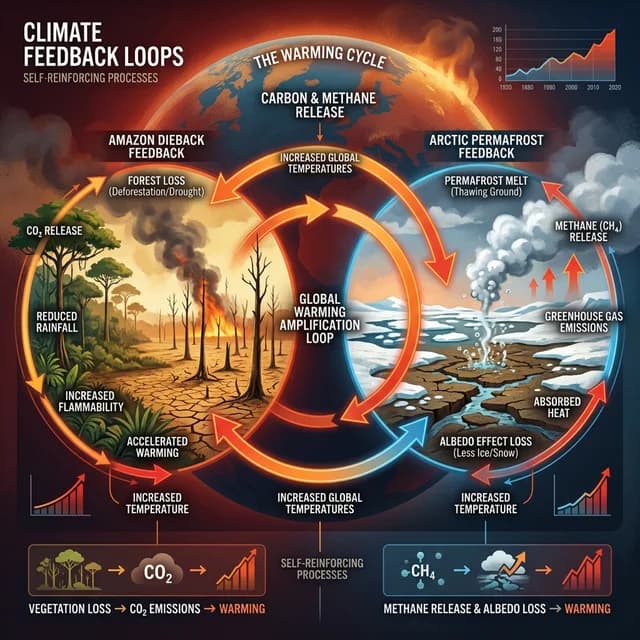
The 2026-2027 period is of particular interest to climatologists because of several positive feedback loops that could be triggered or further intensified by an El Niño event.
The Bjerknes Feedback Loop
The fundamental mechanism driving the development of El Niño is the Bjerknes feedback. In this cycle, a weakening of the easterly trade winds results in a surge of warm surface waters to the eastern Pacific and reduced upwelling of cold water. This warming reducesthe temperature gradient across the equator, which in turn further weakens the trade winds.
The Amazon Carbon Sink Feedback
During an El Niño-induced drought, the forest's ability to act as a carbon sink is compromised. Research indicates that moisture limitation leads to a decline in carbon uptake. The 2023-2024 episode already saw a record-breaking switch where the forest released significant CO2. A strong 2026 event could accelerate a dangerous climate feedback loop.
Arctic Methane and Permafrost Thaw
Perhaps the most alarming feedback loop involves the thawing of Arctic permafrost. The 2026-2027 El Niño, by boosting global average temperatures, could accelerate the formation of "taliks" (unfrozen layers). This process creates a vicious cycle: warming leads to permafrost thaw, which releases methane, leading to further warming.
Global Temperature Record Prospects for 2027
A major concern among climate scientists is that the 2026 El Niño will push global temperatures to record-breaking levels in 2027. While 2024 set the previous record, the peak thermal response to El Niño is often felt in the year following the event's onset.
| Year | Expected Climate Context | Global Temperature Projection | | :--- | :--- | :--- | | 2024 | Peak of previous strong El Niño | Previous Record Warmth | | 2025 | Transition to La Niña | Top 3 warmest years | | 2026 | Neutral transitioning to El Niño | Building heat; possible record | | 2027 | Full maturity of new El Niño | High probability of new record |
Socioeconomic Impacts: Food, Energy, and Global Grain Yields
The climatic shifts of 2026-2027 will have direct and profound effects on global agricultural markets. The transition away from La Niña is expected to increase rainfall in Argentina but reduce it in north-central Brazil and Southeast Asia.
| Commodity | Vulnerable Region (2026-2027) | Expected Outcome | | :--- | :--- | :--- | | Maize | Southern Africa | Severe deficit and regional price spikes | | Rice | Southeast Asia / India | Reduced yields; potential export bans | | Wheat | Australia / U.S. Great Plains | Yield risks; drought in SE Australia | | Mangoes | India | Production volatility; price inflation |
Synthesis and Strategic Outlook
The data as of March 2026 presents a compelling case for a major El Niño emergence by late 2026, followed by a potential record-breaking global temperature year in 2027. While the "weak" La Niña is fading, the immense subsurface heat reservoir in the equatorial Pacific acts as a "ticking timebomb" for a transition into a warming phase.
The ability of international humanitarian and economic systems to adapt to these rapid climate reversals will be a critical test of global resilience in the face of an accelerating climate crisis.