Scénario d'échange nucléaire et aperçu des mesures de survie.
Analyse approfondie des phénomènes liés aux explosions nucléaires, des dangers radiologiques et des cadres de survie systémiques.
L'étude scientifique de la guerre nucléaire nécessite une compréhension multidimensionnelle de la physique, de la chimie atmosphérique, de la radiobiologie et de l'ingénierie civile. Une détonation nucléaire représente une perturbation sans précédent des systèmes terrestres, libérant de l'énergie par une reconfiguration rapide des noyaux atomiques. Cette énergie se manifeste sous forme d'une cascade de phénomènes physiques, commençant par une impulsion de rayonnement ionisant à l'échelle de la microseconde et culminant avec des changements climatiques à l'échelle décennale.
L'analyse suivante explore les mécanismes déterministes des explosions nucléaires, les conséquences radiologiques qui en résultent, les effets environnementaux plus larges et les stratégies fondées sur des preuves visant à assurer la résilience humaine et systémique dans l'environnement post-conflit.
Physique Déterministe de la Détonation Nucléaire
L'énergie libérée lors d'une explosion nucléaire provient soit de la fission de noyaux lourds, tels que l'uranium-235 ou le plutonium-239, soit de la fusion d'isotopes légers comme le deutérium et le tritium. Contrairement aux explosifs conventionnels, qui reposent sur des réactions chimiques entre des molécules, les réactions nucléaires opèrent au niveau du noyau atomique, produisant des densités d'énergie des millions de fois supérieures par unité de masse. Cette libération massive d'énergie se produit en une fraction de microseconde, ce qui porte la température des résidus de l'arme à plusieurs dizaines de millions de degrés Kelvin et génère des pressions internes dépassant un million de fois la pression atmosphérique.
Formation de la sphère de feu et dynamique des impulsions thermiques
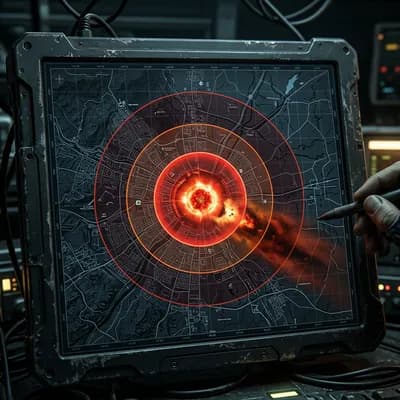
La phase initiale d'une explosion nucléaire atmosphérique est dominée par l'émission de rayons X. Étant donné que l'air au niveau de la mer est relativement opaque à ces photons de haute énergie, les rayons X sont absorbés sur une distance de quelques mètres du point d'explosion, ce qui chauffe l'air environnant jusqu'à le transformer en une masse sphérique incandescente, connue sous le nom de sphère de feu. En moins d'une milliseconde, la sphère de feu d'un dispositif d'une mégaton (Mt) s'étend sur un diamètre de 440 pieds ; en 10 secondes, elle atteint un diamètre maximal d'environ 5 700 pieds (plus d'un mile) et commence à s'élever comme un ballon à air chaud à des vitesses de 250 à 350 pieds par seconde.
Le rayonnement thermique représente environ 35 pour cent de l'énergie totale libérée. Lors d'une explosion atmosphérique, ce rayonnement est émis en deux impulsions. La première impulsion est extrêmement brève et se compose principalement de lumière ultraviolette. La deuxième impulsion, qui transporte la majeure partie de l'énergie thermique, dure plusieurs secondes et est responsable des incendies généralisés et des dommages biologiques. L'éclat de la sphère de feu est tel qu'il peut être vu sur des centaines de miles ; des explosions de mégatonnes en haute altitude ont été observées à des distances de 700 miles.
La couleur de la boule de feu et du nuage en forme de champignon qui en résulte subit une évolution chimique. Initialement, le nuage peut apparaître rouge ou rougeâtre en raison de la formation d'oxydes d'azote ($NO_2$, $N_2O_4$) résultant de l'interaction à haute température de l'azote et de l'oxygène dans l'atmosphère. Au fur et à mesure que le nuage se refroidit, la vapeur d'eau se condense en gouttelettes, ce qui provoque une transition du nuage vers une apparence blanche, semblable à du chou-fleur, qui est la forme caractéristique en "champignon" qui atteint sa stabilisation environ 10 minutes après l'explosion.
| Paramètre d'effet thermique | Mesure/Valeur pour une explosion de 1 Mt | | :--- | :--- | | Temps pour atteindre le diamètre maximal | 10 secondes | | Diamètre maximal de la boule de feu | ~5 700 pieds | | Température initiale | > 10 000 000 K | | Vitesse de montée (initiale) | 250–350 pieds/seconde | | Répartition de l'énergie (thermique) | 35 % | | Distance de visibilité (haute altitude) | ~700 miles |
Propagation de l'onde de choc hydrodynamique et de l'onde de pression.
Environ 50 % de l'énergie d'une arme nucléaire est libérée sous forme d'onde de choc et d'impact mécanique. Cela commence comme une onde de choc à haute pression qui se propage vers l'extérieur à partir de la sphère de feu. Dans le cas d'une explosion en altitude – une détonation qui se produit à une altitude conçue pour maximiser les dégâts causés par l'onde de choc – l'onde de choc frappe le sol et se réfléchit vers le haut. L'interaction entre l'onde de choc primaire (incident) et l'onde réfléchie crée une "onde de Mach", un front d'onde vertical qui se déplace horizontalement sur la surface avec une pression et un potentiel destructeur considérablement accrus.
La principale mesure des dégâts causés par l'onde de choc est la surpression, c'est-à-dire la pression au-dessus des niveaux atmosphériques standard (14,7 psi). Les dommages structurels sont déterminés par la surpression maximale et la durée de la phase de pression positive. Les bâtiments résidentiels sont généralement vulnérables aux faibles niveaux de surpression ; par exemple, une maison modeste dont le mur avant fait 50 000 pouces carrés subit une force de 25 tonnes, même avec une simple surpression de 1 psi.
| Surpression maximale (psi) | Dégâts attendus aux structures | | :--- | :--- | | 1.0 | Les vitres se brisent ; les portes deviennent difficiles à manipuler | | 5.0 | Destruction complète de la plupart des bâtiments résidentiels non renforcés | | 10.0 | Effondrement des bâtiments commerciaux et des usines en briques | | 20.0 | Destruction des structures en béton armé | | 100.0 | Destruction des bunkers de stockage nucléaire blindés | | 500.0 | Effondrement des silos de missiles et des centres de commandement |
Bien que le corps humain soit remarquablement résistant aux surpressions directes, survivant souvent à des pressions allant jusqu'à 30 psi sans blessures internes mortelles, les effets secondaires et tertiaires de l'explosion sont mortels. Ceux-ci comprennent l'effondrement de bâtiments sur leurs occupants, l'impact de débris à grande vitesse (comme des éclats de verre se déplaçant à des centaines de kilomètres par heure), et le déplacement physique de personnes vers des objets solides.
Incendies de masse et tempête de feu urbaine
La chaleur intense provoque l'inflammation de matériaux inflammables, tels que le papier, la végétation sèche et les tissus fins, sur une vaste zone. Pour un grand dispositif thermonucléaire, cette zone d'inflammation peut s'étendre jusqu'à 20 miles du point zéro. Si la densité de ces incendies est suffisamment élevée, ils peuvent fusionner pour former une tempête de feu. Ce phénomène est caractérisé par un "effet de cheminée", où la libération massive de chaleur provoque une montée rapide de l'air, entraînant des vents de surface provenant de la périphérie à des vitesses proches de celles d'un ouragan. Ces vents entrants empêchent le feu de se propager vers l'extérieur, mais le font brûler avec une intensité extrême, consommant l'oxygène disponible et produisant des concentrations mortelles de monoxyde de carbone. Les survivants abrités dans une zone de tempête de feu peuvent succomber à l'asphyxie ou à la chaleur, même si l'abri reste structurellement intact.
Phénoménologie radiologique
Les radiations nucléaires sont divisées en radiations instantanées (initiales) et résiduelles (différées). Les radiations instantanées se produisent pendant la première minute de la détonation et consistent principalement en des rayons gamma et des neutrons produits par les réactions nucléaires elles-mêmes ou par la capture de neutrons par les noyaux atmosphériques. Les radiations résiduelles, ou retombées, font référence à la désintégration des isotopes radioactifs sur des heures, des jours et des années.
Mécanismes d'ionisation : Alpha, bêta et gamma
Les dangers des radiations nucléaires sont définis par le type de particule émise lors de la désintégration radioactive. Les particules alpha sont des amas lourds, chargés positivement, composés de deux protons et de deux neutrons. Bien qu'elles soient très énergétiques, elles ont une courte portée (quelques centimètres dans l'air) et ne peuvent pénétrer la couche externe de la peau humaine. Cependant, si des émetteurs alpha sont inhalés, avalés ou pénètrent par une plaie, ils provoquent de graves dommages localisés aux tissus sensibles et à l'ADN.
Les particules bêta sont des électrons ou des positrons de déplacement rapide. Elles sont plus pénétrantes que les particules alpha et peuvent provoquer des "brûlures bêta" sur la peau, mais elles sont les plus dangereuses lorsqu'elles sont internalisées. Le rayonnement gamma est constitué de photons de haute énergie (radiations électromagnétiques) qui sont très pénétrants. Les rayons gamma peuvent parcourir des distances importantes dans l'air et nécessitent un blindage dense, comme du plomb, du béton ou une épaisse couche de terre, pour atténuer leur intensité.
Les mécanismes des retombées radioactives.
La formation des retombées dépend fortement de la hauteur de l'explosion. Dans une explosion aérienne, le foyer de l'explosion ne touche pas le sol, et les résidus radioactifs de l'arme se condensent en particules extrêmement fines qui sont projetées dans la stratosphère. Ces particules peuvent rester en suspension dans l'air pendant des années, contribuant éventuellement à la radioactivité de fond globale, mais ne représentant qu'une faible menace locale immédiate.
Lors d'une explosion à la surface, le foyer de l'explosion vaporise et entraîne de grandes quantités de sol et de débris. Les isotopes radioactifs se condensent sur ces particules plus grosses et plus lourdes, qui retombent rapidement sur Terre, créant une zone de "retombées locales" intenses en aval du point de l'explosion. Les retombées les plus importantes se produisent près du point de l'explosion, mais des niveaux dangereux peuvent s'étendre sur 10 à 20 miles, voire plus, en fonction de la vitesse du vent et du rendement.
La règle des 7:10 de la décroissance radioactive
La radioactivité des retombées est dominée par des isotopes de courte durée de vie qui se désintègrent rapidement. La règle empirique des 7:10 fournit un modèle généralisé pour cette décroissance : pour chaque augmentation de sept fois du temps après l'explosion, le taux d'exposition aux radiations diminue d'un facteur dix.
| Temps après l'explosion | Niveau de radiation (par rapport à 1 heure) | | :--- | :--- | | 1 heure | 100 % (par exemple, 1 000 R/h) | | 7 heures | 10 % (100 R/h) | | 49 heures (environ 2 jours) | 1 % (10 R/h) | | 343 heures (environ 2 semaines) | 0,1 % (1 R/h) | | 2 401 heures (environ 14 semaines) | 0,01 % (0,1 R/h) |
Cette dégradation rapide souligne l'importance cruciale de rester abrité pendant les 48 premières heures. À la fin du premier jour, le risque d'exposition a déjà diminué d'environ 80 %, et à la fin du deuxième jour, le danger est réduit de 99 %.
Conséquences environnementales et climatiques à long terme
Un échange nucléaire à grande échelle provoquerait des changements environnementaux beaucoup plus durables que l'explosion et les retombées immédiates. Ces effets sont principalement dus à l'injection de carbone noir (suie) dans la haute atmosphère.
L'hiver nucléaire et le paradigme du refroidissement global
La combustion des villes modernes et des complexes industriels libérerait des millions de tonnes de suie dans la stratosphère. Contrairement à la cendre volcanique ou à la fumée troposphérique, la suie stratosphérique est "auto-ascendante" : elle absorbe l'énergie solaire, réchauffe l'air environnant et monte encore plus haut dans l'atmosphère, où elle est protégée de l'élimination par la pluie. Cette couche de suie agit comme un voile, bloquant la lumière du soleil et refroidissant la surface de la Terre.
Les modèles actuels du système terrestre (ESM) suggèrent qu'un conflit mondial entre les États-Unis et la Russie pourrait injecter 150 téagrammes (Tg) de suie, ce qui entraînerait une chute des températures de surface de plus de 20 degrés Celsius dans les principales régions agricoles. La récupération du climat mondial prendrait au moins 15 ans. Même un conflit régional limité (par exemple, entre l'Inde et le Pakistan), qui injecterait 5 Tg de suie, provoquerait un refroidissement mondial important et perturberait les régimes de précipitations, mettant en danger la sécurité alimentaire de plusieurs milliards de personnes.
Appauvrissement de l'ozone stratosphérique et rayonnement UV-B
La même suie qui refroidit la surface réchauffe la stratosphère, atteignant des températures nettement supérieures à la normale. Ce réchauffement, combiné à l'injection d'oxydes d'azote ($NO_x$) produits par la chaleur extrême de l'explosion, déclenche des cycles catalytiques qui détruisent la couche d'ozone.
Pendant les premières années, la fumée elle-même protégerait la surface des rayons ultraviolets. Cependant, lorsque la fumée se dissipe après 3 à 8 ans, la couche d'ozone, dont l'épaisseur globale pourrait être réduite de jusqu'à 75 %, permettrait à des niveaux extrêmes de rayonnements UV-B et UV-A d'atteindre la surface. Les valeurs de l'indice UV pourraient dépasser 35 dans les régions tropicales et 45 dans les régions polaires. Ces niveaux sont dangereux pour toute forme de vie, causant de graves coups de soleil en quelques minutes, augmentant le risque de cancer de la peau et de cataractes, et endommageant l'ADN des plantes et des organismes marins.
| Paramètre Atmosphérique | Conflit Mondial (150 Tg de suie) | Conflit Régional (5 Tg de suie) | | :--- | :--- | :--- | | Perte d'ozone globale | ~75% (apogée) | ~25% (apogée) | | Temps de récupération | ~15 ans | ~12 ans | | Indice UV (zones tropicales) | > 35 (années 4 à 8) | Élevé dans les 12 mois | | Danger principal | Dommages à l'ADN induits par les UV | Réduction de la productivité primaire nette (NPP) induite par les UV |
Stratégies de survie et d'atténuation : les jours qui suivent
La survie dans l'immédiat après une détonation nucléaire repose sur l'application de trois principes fondamentaux de radioprotection : le temps, la distance et le blindage.
Réponse tactique immédiate
Si une attaque imminente est prévue, les individus doivent se réfugier dans le bâtiment le plus proche, en s'éloignant des fenêtres pour éviter les blessures causées par la chaleur et les éclats de verre. Si une explosion est observée, se coucher face contre terre permet de protéger la peau de la chaleur et d'éviter que le corps ne soit projeté par l'onde de choc. Après le passage de l'onde de choc, il existe une "fenêtre d'opportunité" d'environ 10 à 15 minutes avant que les retombées ne commencent à se déposer depuis le nuage. Ce temps doit être utilisé pour atteindre le meilleur abri possible.
Blindage et facteurs de protection (FP)
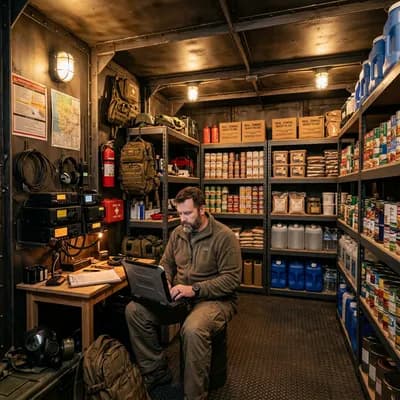
L'efficacité d'un abri est mesurée par son Facteur de Protection (PF), qui représente le rapport entre la dose de rayonnement reçue à l'extérieur et la dose reçue à l'intérieur. Un PF de 10 réduit la dose à un dixième. Les matériaux denses sont les meilleurs blindages. L'épaisseur d'un matériau nécessaire pour réduire le rayonnement gamma de 50 pour cent est sa "Couche de Demi-Valeur" (CDV); l'épaisseur nécessaire pour le réduire de 90 pour cent est la "Couche de Dixième-Valeur" (CD10).
| Matériau | Densité (g/cm3) | Couche de Demi-Valeur (cm) | Couche de Dixième-Valeur (cm) | | :--- | :--- | :--- | :--- | | Plomb | 11,3 | 0,7 | 2,1 | | Acier (Fer) | 7,8 | 1,6 | 5,3 | | Béton | 2,25–2,35 | 4,8 | 15,7 | | Terre (Sol) | ~1,5 | ~7,5 | ~25,0 | | Eau | 1,0 | ~10,0 | ~33,0 |
Un sous-sol dans une maison à ossature bois offre généralement un PF de 10, tandis que le centre d'un grand bâtiment en briques ou en béton, sur plusieurs étages, peut offrir un PF de 100 ou plus. Les personnes abritées doivent rester le plus loin possible des murs extérieurs et des toits, où les particules de retombées s'accumulent.
Décontamination et hygiène
Les personnes qui se trouvaient à l'extérieur lorsque les retombées sont arrivées doivent subir une décontamination avant d'entrer dans la zone de refuge principale. Le retrait de la couche extérieure de vêtements permet d'éliminer jusqu'à 90 % de la matière radioactive. La peau et les cheveux doivent être lavés avec du savon et de l'eau, ou essuyés avec un chiffon humide si l'eau est rare. Il est essentiel de ne pas utiliser d'après-shampooing, car il peut fixer les particules radioactives aux fibres capillaires.
La sécurité de l'eau et des aliments est primordiale. Les récipients hermétiques contenant de la nourriture et de l'eau stockés à l'intérieur d'un bâtiment sont sûrs pour la consommation. Si les récipients étaient à l'extérieur, ils doivent être nettoyés avec un chiffon humide avant d'être ouverts. Il faut éviter les sources d'eau non protégées, telles que les barils de récupération d'eau de pluie ou les lacs, jusqu'à ce qu'elles aient été testées.
Gestion médicale des blessures radiologiques
L'exposition aux radiations ionisantes provoque le syndrome aigu de radiation (SAR), également connu sous le nom de maladie de la radiation. La gravité du SAR dépend de la dose totale absorbée, mesurée en grays (Gy) ou en sieverts (Sv).
Le SAR progresse en trois phases distinctes :
- 01.Phase prodromale : Se produit dans les minutes à quelques jours suivant l'exposition. Les symptômes comprennent nausées, vomissements et diarrhée.
- 02.Phase latente : Une période de récupération apparente qui dure de quelques jours à quelques semaines, selon la dose.
- 03.Phase de maladie manifeste : Le retour des symptômes, lorsque les dommages sous-jacents à la moelle osseuse, au tube digestif ou au système nerveux central deviennent apparents.
| Dose (Gy) | Syndrome | Début des symptômes prodromiques | Survie (sans soins médicaux) | | :--- | :--- | :--- | :--- | | 1–2 | Hématopoétique | 2–6 heures | ~95 % | | 2–6 | Hématopoétique | 1–2 heures | 5 %–95 % (dépend de la dose) | | 6–10 | Gastro-intestinal | 10–60 minutes | < 5 % | | > 20 | Neurovasculaire | Minutes | 0 % |
Protocoles d'administration d'iodure de potassium (KI)
L'iode radioactif (I-131) est un composant principal des retombées initiales et est facilement absorbé par la glande thyroïde. Pour prévenir cela, on administre de l'iodure de potassium (KI) pour saturer la thyroïde avec de l'iode stable. Le KI doit être pris dans une fenêtre de temps étroite, idéalement avant ou dans les quelques heures suivant l'exposition, pour être efficace.
| Groupe d'âge | Dose (mg) | Exigence de délai | | :--- | :--- | :--- | | Adultes (>18 ans) | 130 | < 24 heures avant / < 8 heures après | | Femmes enceintes/allattantes | 130 | < 24 heures avant / < 8 heures après | | Enfants (3–18 ans) | 65 | < 24 heures avant / < 8 heures après | | Nourrissons (1 mois–3 ans) | 32 | < 24 heures avant / < 8 heures après | | Nouveau-nés (<1 mois) | 16 | < 24 heures avant / < 8 heures après |
Il est important de noter que le KI protège uniquement la thyroïde et ne protège pas le reste du corps contre les radiations gamma externes ou contre d'autres isotopes tels que le césium-137 ou le strontium-90.
Purification de l'eau et résilience alimentaire
Alors que la menace immédiate des retombées diminue, l'attention se porte sur la survie à long terme dans un environnement contaminé par des isotopes radioactifs. Les trois isotopes les plus dangereux présents dans l'eau et dans le sol sont l'iode-131 (demi-vie : 8 jours), le strontium-90 (demi-vie : 29 ans) et le césium-137 (demi-vie : 30 ans).
Méthodes de décontamination de l'eau
Les filtres mécaniques standard (par exemple, les filtres à café, les filtres à sable) peuvent éliminer les grosses particules de retombées, mais ils sont inefficaces contre les radionucléides dissous. Pour une purification efficace, les méthodes avancées suivantes sont nécessaires :
- Osmose inverse (OI) : Force l'eau à travers une membrane semi-perméable, éliminant jusqu'à 99 pour cent des contaminants radioactifs.
- Échange d'ions : Utilise des résines pour échanger les ions radioactifs (comme $Sr^{2+}$ et $Cs^+$) contre des ions inoffensifs. Ceci est similaire au processus utilisé dans les adoucisseurs d'eau domestiques.
- Distillation : L'ébullition de l'eau et la condensation de la vapeur permettent d'éliminer efficacement les minéraux et les isotopes radioactifs. Bien que cette méthode consomme beaucoup d'énergie, elle est infaillible pour obtenir de l'eau pure.
- Charbon actif : Efficace pour adsorber certains isotopes et gaz radioactifs comme le radon, bien qu'il doit être utilisé en conjonction avec d'autres méthodes.
Remédiation agricole et gestion des sols.
Pour reprendre la production agricole, le sol doit être décontaminé. Les radionucléides ont tendance à s'accumuler dans la couche supérieure du sol (jusqu'à 40 cm). Les stratégies de décontamination comprennent :
- Labour profond : Retourner la terre pour enfouir la couche contaminée à une profondeur de 90 cm, plaçant ainsi efficacement la couche contaminée en dessous de la zone des racines de nombreuses cultures.
- Phytoremédiation : Planter des espèces hyperaccumulatrices comme les tournesols, qui extraient le strontium et le césium du sol. Les plantes sont ensuite récoltées et éliminées comme déchets radioactifs.
- Amendements du sol : Ajouter de la chaux (calcium) pour concurrencer l'absorption du strontium-90, ou un engrais potassique pour concurrencer le césium-137.
- Enlèvement : Retirer physiquement la couche supérieure du sol, bien que cela soit difficile à grande échelle.
| Méthode de remédiation | Isotopes ciblés | Efficacité/Mécanisme | | :--- | :--- | :--- | | Labour profond | Tous | Enfouissement en dessous de la zone des racines | | Tournesols | Sr-90, Cs-137 | Bio-accumulation dans la biomasse | | Chaux (Ca) | Sr-90 | Concurrence chimique au niveau des racines | | Potassium (K) | Cs-137 | Concurrence chimique au niveau des racines | | Enlèvement | Tous | Retrait physique des 5 à 10 premiers cm |
Vulnérabilité régionale : Europe centrale et Slovénie
Le contexte géopolitique de l'Europe centrale en fait une région à haut risque en cas d'échange nucléaire, en particulier en raison de la présence d'actifs de partage nucléaire de l'OTAN et d'installations nucléaires nationales.
Analyse des cibles stratégiques et des courants de vent
Dans le nord-est de l'Italie, les bases aériennes d'Aviano et de Ghedi stockent environ 60 à 70 bombes nucléaires B61, faisant partie de la dissuasion nucléaire de l'OTAN. En cas d'attaque sur ces bases, la trajectoire des retombées pour la Slovénie voisine serait déterminée par les vents dominants. Le vent de "Bora" – un vent descendant fort et venant du nord-est – est une caractéristique importante de la région, surtout en hiver. Un épisode de Bora pourrait soit atténuer les retombées, soit les transporter dans l'Adriatique, tandis qu'une "Bora sombre" cyclonique pourrait provoquer des précipitations, entraînant potentiellement un "lavage", où les particules radioactives seraient éliminées de l'air et concentrées au sol.
Les vents de haute altitude en Europe centrale se propagent généralement de la sud-ouest à la nord-est, suivant le jet stream. Cela signifie qu'une explosion en Italie ou en Europe occidentale entraînerait probablement des retombées vers la Slovénie, la Hongrie et la région de la Baltique.
Infrastructure nucléaire nationale : Centrale nucléaire de Krško
La centrale nucléaire de Krško, en Slovénie, co-détenue avec la Croatie, représente un risque localisé important. Bien que la centrale dispose de procédures d'urgence rigoureuses, un accident grave résultant d'attaques conventionnelles ou nucléaires pourrait libérer une quantité de matières similaires au scénario PWR-1A WASH-1400. Les plans d'évacuation actuels prévoient un mouvement radiale de la population dans un rayon de 8 km et une évacuation dirigée par le vent dans un rayon de 16 km. L'administration slovène de la protection civile et de la gestion des catastrophes (ACPDR) coordonne ces plans, qui sont régulièrement examinés par l'AIEA.
| Installation / Lieu | Type d'actif | Risque pour la Slovénie | | :--- | :--- | :--- | | Base aérienne d'Aviano (Italie) | Stockage nucléaire de l'OTAN | Élevé (Trajectoire de retombées) | | Base aérienne de Ghedi (Italie) | Stockage nucléaire de l'OTAN | Élevé (Trajectoire de retombées) | | Centrale nucléaire de Krško | Réacteur de production d'électricité | Élevé (Source de contamination/Contamination locale) | | Centre de Podgorica | Réacteur de recherche/Déchets | Modéré (Contamination locale) |
Résilience socio-économique et relance mondiale
La survie ultime de la civilisation humaine après une guerre nucléaire repose sur la capacité de passer d'une économie mondialisée et industrielle à des systèmes localisés et résilients. La perte immédiate du réseau électrique due à une impulsion électromagnétique (IEM) serait le principal obstacle à la coordination. L'IEM résulte de l'interaction des rayons gamma avec l'atmosphère, créant des champs électromagnétiques intenses qui peuvent endommager les équipements électroniques et les infrastructures électriques sur des milliers de kilomètres.
Solutions alimentaires résilientes
En l'absence de l'agriculture traditionnelle basée sur la lumière du soleil pendant un hiver nucléaire, l'humanité doit développer des sources de nourriture alternatives. Les recherches mettent en évidence plusieurs technologies prometteuses :
- Culture d'algues: Les algues se développent rapidement dans des conditions de faible luminosité et sont résistantes au refroidissement.
- Protéines unicellulaires (SCP): Microorganismes cultivés dans des bioréacteurs en utilisant du gaz naturel (méthane) ou de la biomasse ligneuse comme substrat.
- Agriculture fongique: Les champignons et autres espèces fongiques peuvent décomposer les grandes quantités de biomasse morte (arbres, cultures) détruites par le refroidissement soudain.
- Déplacement des serres: Déplacer la production agricole vers les régions équatoriales où les températures pourraient rester au-dessus du point de congélation.
Le principal défi n'est pas le manque de sources de nourriture physiques, mais la rupture du commerce et de la coopération. Sans expéditions internationales de céréales, des pays comme la Slovénie, qui ne sont pas autosuffisants en production alimentaire, seraient confrontés à de graves pénuries, même sans attaques nucléaires directes.
Synthèse des conclusions et conclusions stratégiques
L'analyse des impacts de la guerre nucléaire révèle une hiérarchie d'effets qui se traduisent de la physique de la microseconde à l'écologie de la décennie. La survie immédiate d'un échange nucléaire dépend de la sensibilisation tactique et de la discipline radiologique : comprendre le calendrier des retombées et la physique du blindage. Cependant, la survie à long terme de l'espèce dépend de la résilience systémique mondiale.
Les éléments clés pour assurer une stabilité après un échange nucléaire comprennent :
- Priorité à la protection : Les 48 premières heures sont les plus dangereuses. Un facteur de protection de 10 à 100 peut faire la différence entre la survie et un syndrome d'irradiation aiguë mortel.
- Gestion des isotopes : Une attention particulière doit être accordée à l'iode-131 pendant le premier mois, suivie d'une gestion à long terme du strontium-90 et du césium-137 dans les aliments et l'eau.
- Bifurcation climatique : Les survivants doivent se préparer à une période initiale de froid et d'obscurité extrêmes, suivie d'une crise secondaire de rayonnement UV extrême.
- Reprise décentralisée : La perte du réseau électrique (EMP) et du commerce mondial nécessite le développement de systèmes localisés et redondants pour la purification de l'eau, la production alimentaire et les communications.
Les conséquences environnementales et sociétales d'un conflit nucléaire sont si profondes qu'elles dépassent les objectifs militaires traditionnels d'une attaque initiale. Les modèles suggèrent que le "vainqueur" d'un échange nucléaire subirait probablement un effondrement total de ses propres systèmes agricoles en quelques années, en raison de l'hiver nucléaire et de la perte de la couche d'ozone. Cette réalité scientifique souligne l'impératif géopolitique de la prévention, tout en renforçant la nécessité de cadres solides de protection civile pour les survivants de cet événement catastrophique.