Building a Faraday Cage

Most DIY Faraday cage tutorials get basic electromagnetic physics dangerously wrong—turning lids into slot antennas or shorting out stored radios. Here is how to shield critical off-grid gear against EMP and solar surges properly.
# Building a Faraday Cage: Protecting Electronics in a High-Risk World
Few survival projects attract more confident bad advice online than building a Faraday cage. Scroll through prepper forums for five minutes and you will find people sealing steel ammo cans tightly with rubber gaskets, caulking foil seams with non-conductive silicone, dropping bare smartphones inside metal trash cans to "test" them, or wiring their shields directly into household wall outlets for grounding. Almost every one of those shortcuts defeats the enclosure when an actual Black Sky electromagnetic grid collapse arrives.
Separating real electrical engineering from garage folklore matters because modern off-grid survival leans heavily on solid-state semiconductors: MPPT solar charge controllers, pure-sine inverters, handheld VHF/HF emergency radios, rugged laptops holding offline survival and medical libraries, and diagnostic tools. Protecting those backups is straightforward and inexpensive—provided you respect how electromagnetic fields actually penetrate metal seams.
Understanding the Threat: HEMP Pulses vs. Solar Storms
Not all electromagnetic threats behave alike, and confusing them leads to wasted effort, a distinction emphasized in CISA electromagnetic pulse resilience guidance and DHS Science and Technology Directorate shielding research:
- High-Altitude Nuclear EMP (`HEMP`): A nuclear detonation 30 to 400 kilometers above the atmosphere generates three sequential energy waves:
- Carrington-Class Solar Storms (`CME / Geomagnetic Storms`): Massive coronal mass ejections—monitored live by the NOAA Space Weather Prediction Center and tracked on our planetary hazard radar—primarily mirror E3, inductively saturating long electrical transmission grids and pipelines tracked by U.S. Department of Energy CESER resilience programs. Unplugged handheld flashlights or laptops sitting on a kitchen table generally survive a solar storm unharmed, though anything plugged into grid wiring can still suffer severe utility switching surges when transformers fail catastrophically.
A properly constructed Faraday enclosure protects your backup electronics cleanly against E1 and E2 radiation while keeping them physically unplugged from grid wires exposed to E3 surges.
Why Most DIY Faraday Cages Fail: Seam Continuity and Dielectric Gaps
A Faraday cage works because an external electric field redistributes free electrons across a continuous conductive outer shell, generating an opposing internal field that cancels out the incoming wave inside the cavity.
Two engineering rules govern every successful build:
- 01.Continuous 360-Degree Metal-to-Metal Contact: Electromagnetic waves do not care how thick your steel wall is if there is an unbridged insulated gap around the lid. A rubber waterproofing gasket on a surplus military ammo can—or a coat of lacquer, enamel paint, or silicone sealant between a lid and container rim—acts as a slot antenna, allowing high-frequency E1 pulses to couple straight into the interior cavity. Every millimeter of lid seam must make clean bare-metal contact or be bridged continuously with conductive copper/aluminum EMI tape or metal mesh gaskets.
- 02.Total Interior Dielectric Isolation: Never let stored radios or bare circuit boards touch the conductive metal wall of your cage directly! An external strike induces heavy skin currents along the outside shell; touching metal inside risks arc-over or conductive coupling straight into your device chassis. Line the entire interior cleanly with thick corrugated cardboard, closed-cell EVA foam, or dry wooden panels.
- 03.Do NOT Ground Your Faraday Cage to Household Wiring: Connecting a protective shield to your home's electrical ground rod turns the house ground wire into a giant receiving antenna that channels surge voltages straight toward your box—exactly the opposite of shielding. Keep standalone storage enclosures completely isolated from external wires and pipes.
Two Proven, Low-Cost Faraday Enclosure Builds
You do not need laboratory-grade welded copper rooms to achieve 60 to 80+ decibels of attenuation on household gear. Use nested layers combining rigid outer steel with clean conductive inner wraps.
Build 1: The Galvanized Steel Trash Can (For Bulk Power & Solar Gear)
A heavy-gauge 20-to-30-gallon galvanized steel trash can (never plastic cans lined loosely with thin foil) protects spare solar charge controllers, inverters, ham transceivers, and laptops:
- Prep the Rim: Inspect the top lip and lid rim. If clear anti-rust lacquer coats the steel, scour both mating surfaces lightly with 120-grit sandpaper until bare zinc shines continuously around the rim.
- Build the Dielectric Liner: Line the bottom, cylindrical wall, and underside of the lid completely with double-walled cardboard or closed-cell foam pads (
zero bare metal exposed inside).
- Individually Nest Critical Electronics: Place each device inside an antistatic ESD bag or dry paper/plastic pouch, then wrap tightly in two overlapping layers of heavy-duty aluminum foil alongside silica-gel desiccant packets.
- Seal the Lid Seam: Press the lid shut and tape the outer lid-to-body seam completely around its circumference using conductive-adhesive aluminum HVAC tape or copper EMI tape (
verify adhesive conductivity with a multimeter), then clamp mechanically with steel spring clips.
Build 2: Modified Surplus Steel Ammo Cans (For Radios & Portable Kits)
Fifty-caliber or Fat-50 steel ammo cans offer rugged crush protection only if you defeat the insulating rubber lid seal:
- Peel out the black rubber gasket and sand paint off both the rim lip and lid channel so steel clamps tightly onto bare steel—or pack continuous braided copper flat strap or fine bronze wool along the mating rim so the latch crushes metal-to-metal contact all the way around.
- Line all six interior faces with cardboard or craft foam before packing handheld GMRS/ham radios (
antennas detached), spare lithium power banks (raw alkaline cells aren't EMP-sensitive, though smart BMS packs contain vulnerable MOSFET chips), spare vehicle sensors, and encrypted microSD archives.
Forget the "Cell Phone Ring Test" Myth
Almost every amateur video tests a Faraday box by putting a smartphone inside, dialing it, and celebrating when it fails to ring. That test proves almost nothing. Cellular signals run around 700 MHz to 2.6 GHz at weak receiver thresholds—easily blocked by loose foil or an unsealed cookie tin that still leaks lethal E1 energy at lower VHF frequencies (10–300 MHz) and fast nanosecond rise times. Tuning a portable AM/FM radio to a strong local station offers a harsher check, yet real confidence comes from mechanical verification: bare metal-to-metal perimeter contact, zero unsealed gaps, dry dielectric lining, and nested inner foil wraps.
Once sealed and labeled externally with a contents manifest so you never break EMI tape needlessly, store the enclosure in a dry interior closet away from exterior walls and plumbing. Shielding backup electronics—paired with broader analog countermeasures and digital blackout doctrine and Ready.gov power outage preparedness guidelines—takes one afternoon and ensures your communication and solar gear wakes up intact if the grid fails.
Authoritative Sources & Further Reading
Real-time geospatial feed aggregating USGS M5.0+ earthquakes, NASA EONET wildfires, volcanoes, severe storms, UN/EC GDACS alerts, and NOAA geomagnetic status.
Related Reports & In-Depth Intel
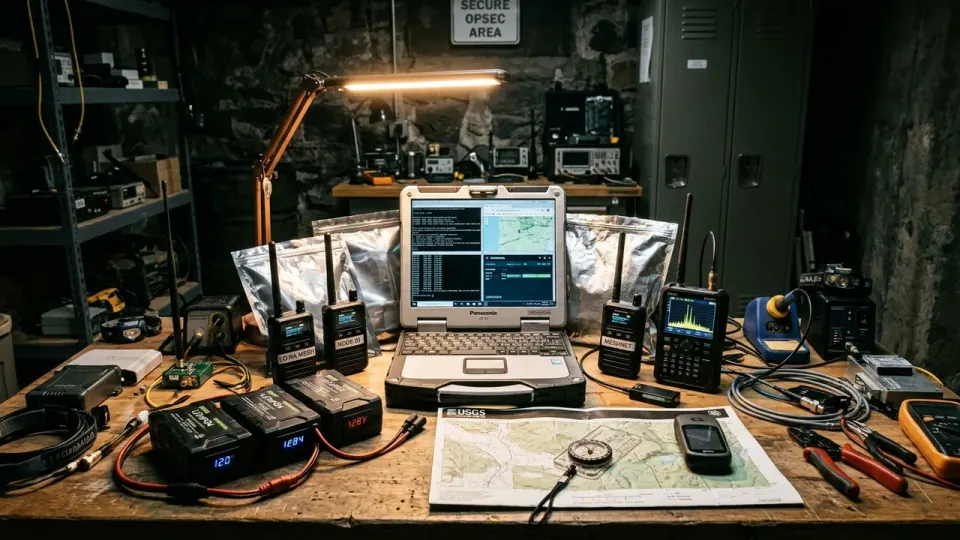
The Analog Firewall Manual
In the wake of FBI warning FLASH-20261113-001 (ARTEX), European cold-chain controller hacks, and $2.58 TCP/IP zero-days, physical resilience demands isolating critical inverters, wells, and refrigeration equipment onto offline LANs backed by hard electromechanical failsafes.
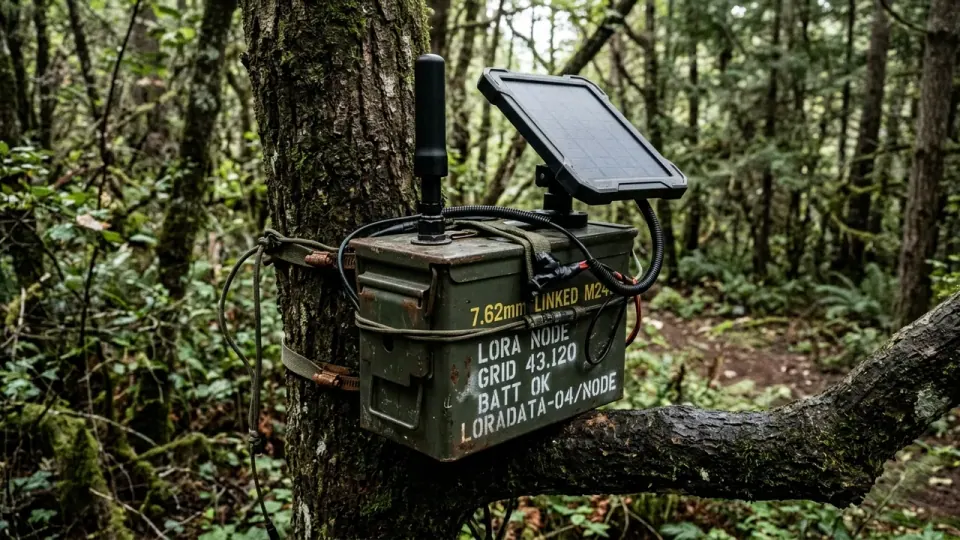
Tactical Communications Field Manual
A technical field manual for establishing resilient off-grid communications networks using Near-Vertical Incidence Skywave (NVIS) HF radio antennas and solar-buffered, AES-256 encrypted LoRa mesh topologies during electronic jamming and grid-down blackouts.
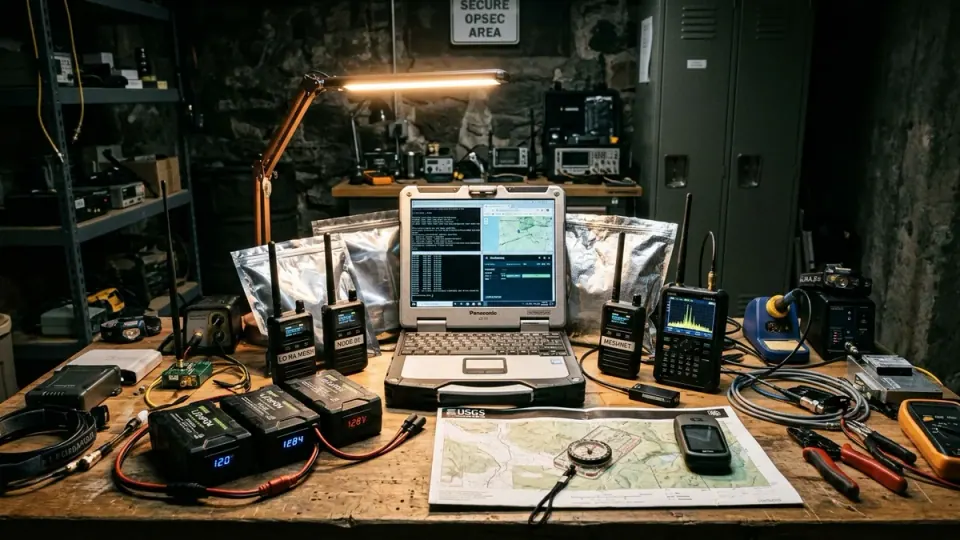
Analog Countermeasures & Digital Blackout Guide
A practical, field-tested operational security manual for establishing personal and family digital sovereignty. We detail hardware Faraday defenses, off-grid air-gapped cryptographic vaults, biometric evasion, voice cloning countermeasures, and decentralized LoRa mesh networking.
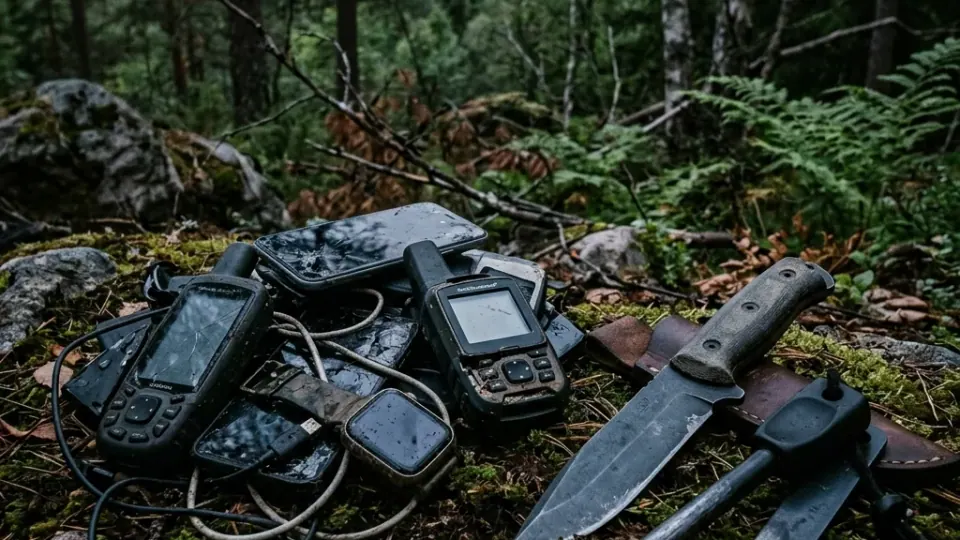
High tech tools are not the best survival
Analyzing why mechanical simplicity, physical durability, and manual skills outperform electronic gadgets in long term survival scenarios.