Tactical Communications Field Manual
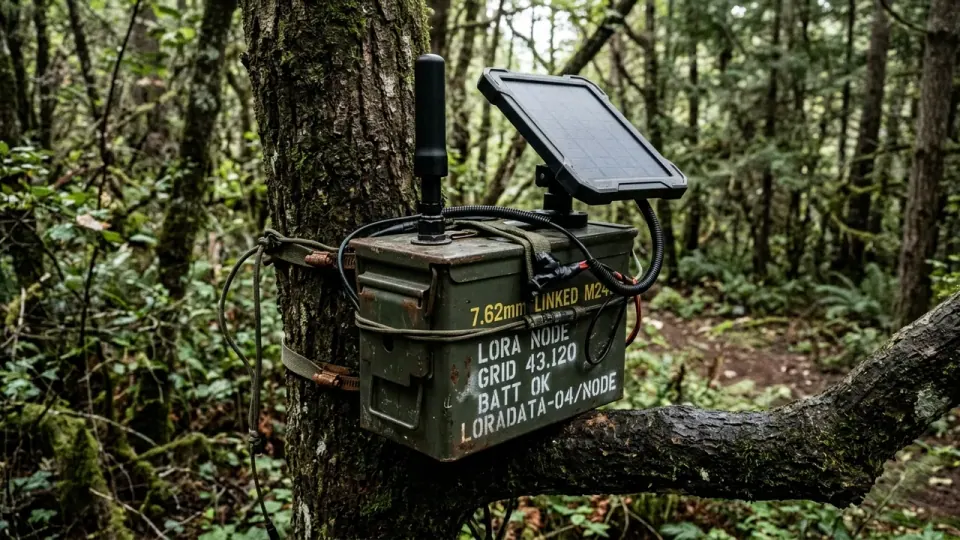
A technical field manual for establishing resilient off-grid communications networks using Near-Vertical Incidence Skywave (NVIS) HF radio antennas and solar-buffered, AES-256 encrypted LoRa mesh topologies during electronic jamming and grid-down blackouts.
When modern regional conflict or nationwide critical infrastructure failure occurs, the first casualty is the electromagnetic spectrum. Civilian cellular telecommunications networks, fiber-optic internet exchanges, and commercial satellite constellations are engineered for high-bandwidth commercial convenience, not survivability in contested electronic warfare (EW) environments—a vulnerability reinforced by CISA SAFECOM emergency communications interoperability planning and explored in our primer on staying connected when the grid goes down. Cell towers rely on fragile terrestrial fiber backhauls and have fewer than four to eight hours of local diesel-generator or battery reserve before collapsing into silence. Furthermore, in active kinetic or civil unrest theaters, state and non-state actors deploy high-power directional radio-frequency (RF) jammers, cellular IMSI-catchers, and software-defined radio (SDR) sniffers to geolocate and intercept civilian communications.
To survive and maintain tactical situational awareness when the digital panopticon goes dark, prepared individuals, homestead mutual-aid groups, and regional resilience teams must master two complementary, off-grid radio doctrines: Near-Vertical Incidence Skywave (NVIS) High-Frequency (HF) radio propagation—a core method practiced across ARRL amateur emergency communications—for regional multi-hundred-kilometer strategic coordination, and hardened, decentralized Long Range (LoRa) mesh topologies for localized, encrypted tactical telemetry and messaging.
This technical manual details the exact hardware parameters, antenna construction blueprints, RF stealth protocols (EMCON), and cryptographic hygiene required to establish and operate an un-jammable, off-grid survival communications network.
Understanding NVIS: Defeating the Terrain and the Jammers
Standard High-Frequency (HF) radio communication typically relies on ground waves (which attenuate rapidly over rough terrain, dense forests, and mountains within 15 to 30 kilometers) or low-angle skywave skip propagation (which bounces off the ionosphere and returns to Earth hundreds or thousands of kilometers away). This leaves a fatal tactical blind spot: the skip zone—an area between 30 and 400 kilometers from your transmitter where standard radio signals cannot be received.
Near-Vertical Incidence Skywave (NVIS) is an advanced tactical propagation technique engineered specifically to eliminate this skip zone. By transmitting HF radio waves almost vertically (angles between 70 and 90 degrees) into the ionosphere's F2 layer, the signals refract directly back down to Earth in an inverted cone or "showerhead" pattern, completely blanketing a regional radius of 0 to 450 kilometers with reliable, crystal-clear signal coverage regardless of deep mountain valleys, dense urban concrete canyons, or heavy forest canopies.
The Physics and Frequency Selection of NVIS
NVIS operation is governed strictly by the Critical Frequency (foF2) of the ionosphere—the highest frequency at which vertically incident radio waves are reflected back to Earth rather than escaping into space:
- Daytime Operation: Typically between 4.5 MHz and 7.5 MHz (the 60-meter and 40-meter amateur and military bands).
- Nighttime Operation: As solar ionization diminishes, the critical frequency drops. Operators must shift down to 2.0 MHz to 4.0 MHz (the 80-meter and 160-meter bands).
- Operating Above Critical Frequency: If an operator attempts NVIS transmission above the live foF2 threshold, the signal penetrates the ionosphere and disappears into deep space, resulting in total link failure. Operators must monitor regional ionosonde data via the NOAA Space Weather Prediction Center and geomagnetic storm alerts on our planetary hazard radar—or establish pre-scheduled beacon schedules—to verify live atmospheric reflectivity.
| Parameter | Target Specification | Tactical Rationale |
|---|---|---|
| Operating Frequencies | 3.5 MHz - 7.2 MHz (Band-Dep.) | Matches Ionospheric foF2 |
| Radiating Element | Low Horizontal Dipole Wire | Maximizes Vertical Lobes |
| Antenna Height (AGL) | 0.1 to 0.2 Wavelengths (3-6m) | Suppresses Low Ground Wave |
| Ground Reflector Wire | Parallel Wire on Ground (+5%) | +3dB Gain, Reduces Ground |
| Polarization | Pure Horizontal Polarization | 15dB Rejection of Vert. RFI |
Constructing the Covert NVIS Dipole Wire Array
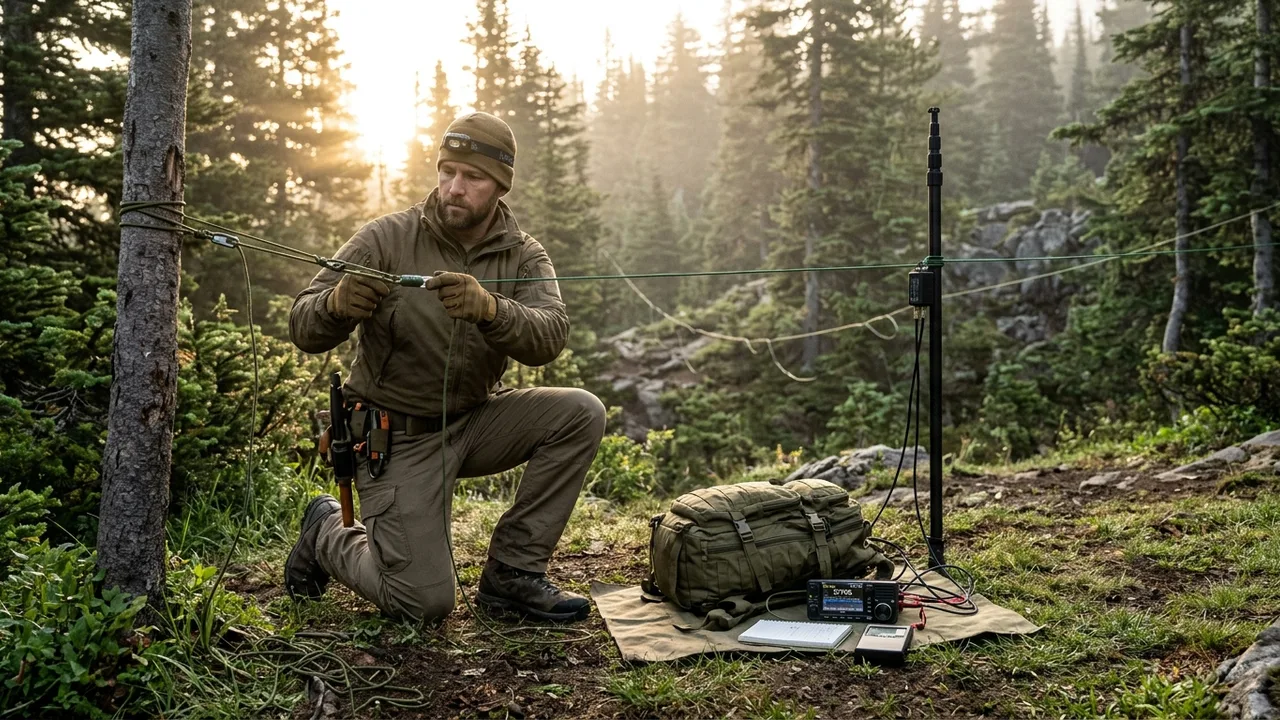
A major tactical advantage of an NVIS antenna is its low physical profile. While standard DX radio operators erect massive 20-meter aluminum towers that attract immediate visual attention and drone targeting, an NVIS dipole wire is erected only three to six meters above the ground:
- 01.Wire Selection: Use 14 AWG or 16 AWG stranded copper wire coated in matte-black or olive-drab insulation to eliminate sunlight glint and visual detection from aerial drones.
- 02.Cutting Dimensions: Calculate element length using the standard formula:
Length (meters) = 142.5 / Frequency (MHz). For a 5.35 MHz emergency channel, each dipole leg should measure approximately 13.3 meters.
- 03.The Ground Reflector Wire: Lay a secondary uninsulated copper wire directly on the ground surface immediately beneath the suspended dipole, cut approximately five percent longer than the radiating wire. This ground wire acts as a passive RF mirror, reflecting downward radiation back into the sky and increasing your radiated signal efficiency by up to 3 dB.
- 04.Feedline and Balun: Connect the dipole center with a 1:1 current balun housed in a sealed PVC conduit box, feeding high-quality RG-8X or RG-58 coaxial cable into your portable transceiver.
Because the antenna is slung low between trees or camouflaged fiberglass fence posts, it is virtually invisible from the air and completely protected from severe storm winds that topple commercial communications towers.
Local Tactical Mesh: Deploying Hardened LoRa Meshtastic Nodes
While HF-NVIS secures regional coordination across hundreds of kilometers, localized tactical teams require decentralized, silent, peer-to-peer data connectivity that does not rely on cellular networks, SIM cards, or centralized internet gateways. This is achieved through the open-source Meshtastic platform and LoRa (Long Range) mesh networks, detailed alongside packet radio protocols in our hardened off-grid mesh networking field guide.
Operating on license-free ISM bands (915 MHz in the Americas, 868 MHz in Europe, 433 MHz in Asia) governed under FCC Personal Radio Services regulations and regional equivalents, LoRa utilizes Chirp Spread Spectrum (CSS) modulation. This mathematical encoding allows signals to be detected and decoded well below the background thermal noise floor (negative Signal-to-Noise Ratios down to -20 dB), providing extraordinary range with milliwatt transmit power.
Engineering a Resilient Solar-Buffered Tactical Node
To construct an off-grid LoRa relay node capable of autonomous continuous operation in the wilderness or on an urban rooftop:
- Hardware Core: Select an ultra-low-power microcontroller board based on the Nordic nRF52840 SoC (such as the RAK Wireless WisBlock 4631 or LilyGO T-Echo). These boards consume under 12 milliamps during idle listening mode—a tiny fraction of power-hungry ESP32-based alternatives.
- RF Filtering and Antenna: Discard the tiny stock rubber-duck antennas. Install a tuned, fiberglass-encased collinear omnidirectional antenna (+3 dBi to +5.8 dBi gain) connected via low-loss LMR-200 coaxial cable. In high-RF environments near urban areas, insert a passive surface acoustic wave (SAW) bandpass filter to prevent frontend receiver desensitization from nearby cellular base stations.
- Power Autonomy: Pair the node with a single 3.7V 3500mAh 18650 or 21700 lithium-iron-phosphate (LiFePO4) battery cell, which offers superior thermal stability in freezing winter temperatures (-20°C to +60°C). Charge the cell via an integrated MPPT solar controller fed by a ruggedized 5-watt or 10-watt monocrystalline solar panel.
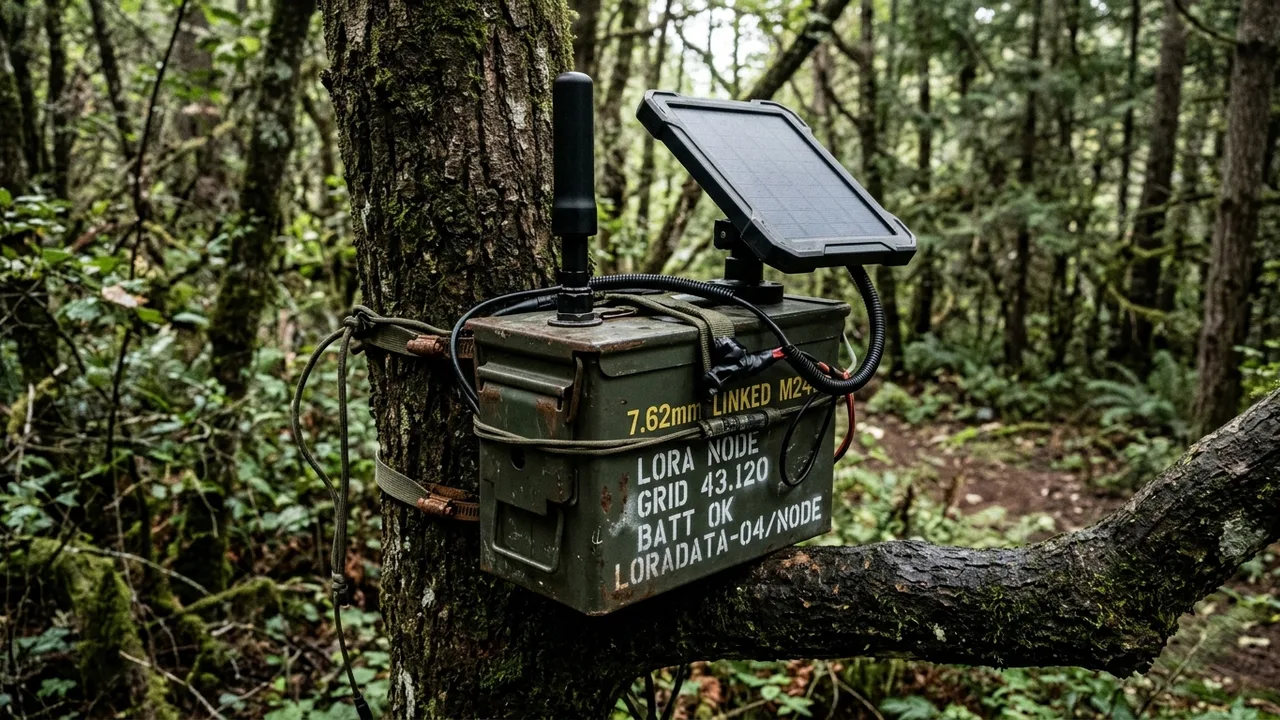
- Enclosure: House the assembly inside a surplus military steel 30-caliber ammo can or IP67-rated polycarbonate junction box, fitted with waterproof cable glands, Gore-Tex pressure vents, and internal silica gel desiccant packs to eliminate condensation.
Cryptographic Hygiene and Tactical Mesh Topology
The foundational vulnerability of amateur radio networks is that civilian transmissions on amateur bands are legally prohibited from being encrypted. In a civil breakdown or kinetic warfare scenario, unencrypted communications are a death sentence, broadcasting your location, resources, and tactical plans directly to adversarial eavesdroppers.
Meshtastic resolves this vulnerability by supporting native, hardware-accelerated AES-256-CTR symmetric encryption:
- 01.Pre-Shared Key (PSK) Security: Generate a cryptographically secure 256-bit hexadecimal key offline using a random hardware number generator. Distribute this key exclusively via physical air-gapped QR codes or encrypted USB drives to verified members of your tactical team before operations commence.
- 02.Channel Cloaking: Rename the broadcast channel from the default
LongFastto a custom name, and disable public telemetry and location broadcasting on external channels.
- 03.Mesh Relaying Without Decryption: In a Meshtastic topology, every node acts as an automated packet router. Intermediate nodes relay encrypted packets across mountain ridges and building walls across multiple hops (up to 7 hops by default) without ever being able to read the encrypted packet contents.
Emission Control (EMCON) and Electronic Warfare Evasion
The most critical operational discipline for radio survival is Emission Control (EMCON). Modern military and paramilitary adversaries utilize direction-finding (DF) radio receiver arrays mounted on aerial reconnaissance drones and surveillance vehicles. If you transmit continuously, your exact physical coordinates can be calculated via Time Difference of Arrival (TDOA) within seconds, inviting artillery, drone strikes, or armed assault.
To survive in an active EW environment, adhere strictly to these operational security protocols:
- Strict Radio Silence as Default: Maintain 99.9 percent passive listening mode. Radio transmissions should be restricted to brief, pre-formatted, urgent operational bursts lasting under three seconds.
- Power Minimization: Always use the absolute minimum RF power necessary to close the communications link. If a LoRa packet can reach the next relay node at 10 dBm (10 milliwatts), never transmit at 22 dBm (160 milliwatts).
- Directional Antenna Masking: When communicating between two fixed homestead outposts, replace omnidirectional antennas with high-gain directional Yagi-Uda or log-periodic antennas, directing your RF energy exclusively toward your receiver while casting deep signal nulls in the direction of suspected adversary positions.
- Frequency Hopping and One-Time Pads: For strategic HF-NVIS voice communications, utilize digital voice modes (such as FreeDV) paired with physical paper One-Time Pads (OTP) for absolute mathematical unbreakability that supercomputers cannot decrypt.
The electromagnetic spectrum is an invisible, lethal battlespace. By deploying hardened NVIS wire arrays and encrypted LoRa mesh topologies while maintaining ruthless signal discipline—paired with the wider outage protocols in our black sky grid and comms collapse manual and the radio frequency directories curated in our useful survival websites index—your community will possess the ultimate survival asset: the ability to see, coordinate, and act in the dark when the rest of civilization is rendered deaf, dumb, and blind.
Real-time geospatial feed aggregating USGS M5.0+ earthquakes, NASA EONET wildfires, volcanoes, severe storms, UN/EC GDACS alerts, and NOAA geomagnetic status.
Related Reports & In-Depth Intel
The Analog Firewall Manual
In the wake of FBI warning FLASH-20261113-001 (ARTEX), European cold-chain controller hacks, and $2.58 TCP/IP zero-days, physical resilience demands isolating critical inverters, wells, and refrigeration equipment onto offline LANs backed by hard electromechanical failsafes.
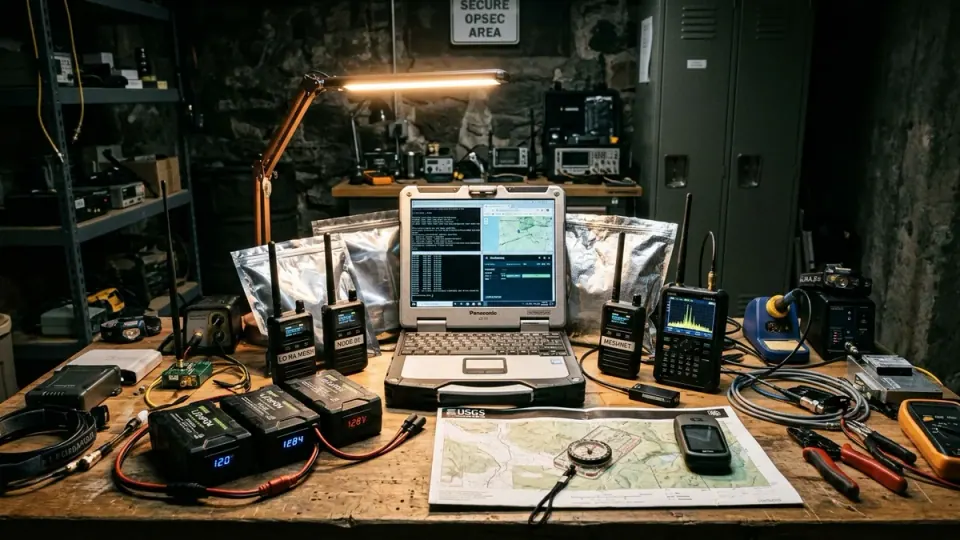
Analog Countermeasures & Digital Blackout Guide
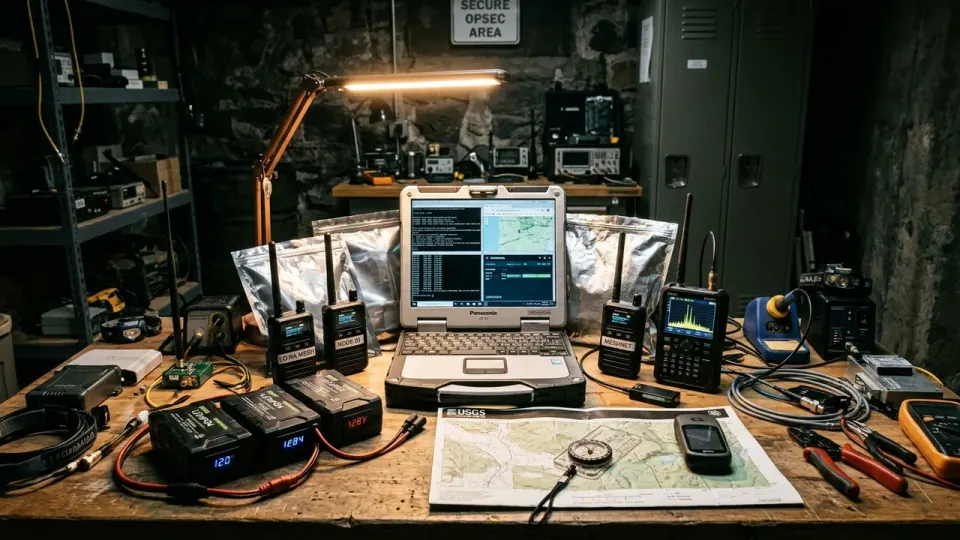
A practical, field-tested operational security manual for establishing personal and family digital sovereignty. We detail hardware Faraday defenses, off-grid air-gapped cryptographic vaults, biometric evasion, voice cloning countermeasures, and decentralized LoRa mesh networking.
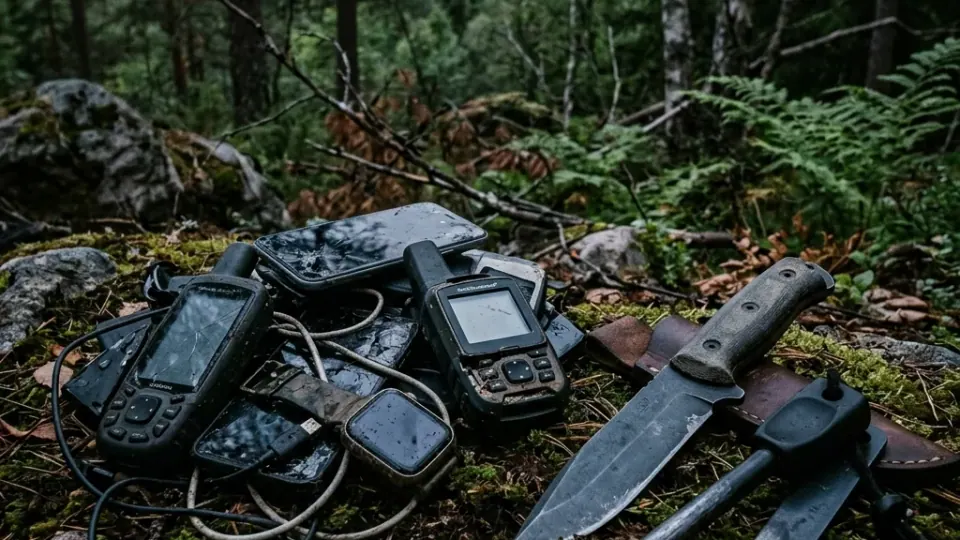
High tech tools are not the best survival
Analyzing why mechanical simplicity, physical durability, and manual skills outperform electronic gadgets in long term survival scenarios.

Building a Faraday Cage
Most DIY Faraday cage tutorials get basic electromagnetic physics dangerously wrong—turning lids into slot antennas or shorting out stored radios. Here is how to shield critical off-grid gear against EMP and solar surges properly.