Agricultural Survival: Adapting to El Niño Cycles and Fertilizer Supply Chain Shocks
As extreme weather patterns collide with global fertilizer shortages, we detail the exact agricultural adjustments needed to secure local food production.
The Double Threat to Food Security
The global agricultural system is currently facing a double crisis that threatens to destabilize local food security. On one hand, the emerging "super El Niño" event of late 2026 is reshuffling global weather patterns, bringing severe droughts to some agricultural regions and torrential rains to others. On the other hand, the global supply chains for synthetic fertilizers (Nitrogen, Phosphorus, and Potassium, or NPK) are experiencing unprecedented disruptions due to rising energy costs, export restrictions, and geopolitical conflicts.
For the modern gardener, homesteader, or small-scale farmer, this combination represents a significant challenge. The high-yield gardening techniques of the past half-century have relied heavily on two factors: consistent weather and cheap, oil-based chemical inputs. When both are compromised, standard farming methods can fail. To survive this shift, we must adapt our agricultural systems. We need to transition from chemical-dependent, water-intensive practices to resilient, biological models that can withstand weather volatility and operate without commercial inputs. This survival guide outlines the practical steps required to build a resilient food production system.
---
The Chemical Trap: The Vulnerability of Industrial NPK Agriculture
To build a resilient agricultural system, one must first understand the vulnerability of modern farming. Current agriculture is essentially an industrial process that converts fossil fuels into food. The three primary macro-nutrients required for plant growth are Nitrogen (N), Phosphorus (P), and Potassium (K):
- 01.Nitrogen (N): Synthetic nitrogen fertilizer is produced via the Haber-Bosch process, which combines atmospheric nitrogen with hydrogen derived from natural gas under high temperatures and pressures. Consequently, nitrogen fertilizer prices are directly linked to natural gas prices.
- 02.Phosphorus (P): Agricultural phosphorus is derived from mined rock phosphate. Global reserves are concentrated in a few countries (primarily Morocco, China, and the US). Peak Phosphorus—the point at which mining output begins to decline—is projected to occur within the next few decades, leading to long-term supply constraints.
- 03.Potassium (K): Potash is mined from ancient evaporite deposits, with the vast majority of global production controlled by Canada, Belarus, and Russia. Geopolitical conflicts and trade sanctions have repeatedly disrupted these exports.
When a homeowner buys a bag of synthetic 10-10-10 fertilizer, they are purchasing a highly soluble, chemical salt. While these inputs provide a rapid growth boost, they bypass the soil's natural biology. Over time, synthetic fertilizers degrade the soil structure, destroy beneficial mycorrhizal fungi, and kill earthworms. The soil becomes a sterile medium that serves only to hold the plant upright while it is fed chemical inputs. When these fertilizers become unavailable or too expensive, crops grown in depleted soil will quickly fail.
Furthermore, plants grown on synthetic fertilizers are structurally weaker. The rapid, nitrogen-fueled growth results in thin cell walls, making the plants more vulnerable to drought, pests, and disease. In the face of a super-El Niño, a chemical-dependent garden is at high risk of failure.
---
Soil Rehabilitation: Releasing Locked-Up Soil Nutrients
The solution to fertilizer scarcity is not to find alternative chemical inputs, but to reactivate the natural biological systems of the soil. Healthy soil is a complex ecosystem containing billions of bacteria, fungi, protozoa, and nematodes. This soil food web is capable of cycling nutrients and making them available to plants without synthetic inputs.
1. Releasing Locked-Up Phosphorus
A key geological fact is that most soils contain large reserves of phosphorus. However, over 95% of this phosphorus is chemically locked up, bound to iron, aluminum, or calcium molecules, making it inaccessible to plants.
To unlock this resource, we must introduce mycorrhizal fungi:
- The Symbiotic Loop: Mycorrhizal fungi form a network of microscopic threads (hyphae) that integrate with plant roots. These fungi secrete organic acids that break the chemical bonds holding soil phosphorus, absorbing the mineral and transporting it directly to the plant. In exchange, the plant provides the fungi with carbon sugars produced via photosynthesis.
- Inoculation: If your soil has been treated with chemicals, you can reintroduce these beneficial organisms by applying high-quality compost, compost teas, or commercial mycorrhizal inoculants directly to the roots of transplants.
2. Biological Nitrogen Fixation
Instead of relying on synthetic urea, we can harness atmospheric nitrogen (which makes up 78% of the air) using nitrogen-fixing plants:
- Leguminous Cover Crops: Plants such as clover, vetch, field peas, and alfalfa form partnerships with *Rhizobium* bacteria in the soil. These bacteria draw nitrogen gas from the air and convert it into plant-usable ammonium.
- Chop-and-Drop: Grow these cover crops in rotation with your food crops. Before planting your vegetables, cut the cover crops at the soil surface and leave the organic matter to decay. As the roots rot, they release stored nitrogen directly into the root zone of your food crops.
3. Biochar: The Soil's Permanent Nutrient Battery
In addition to cover cropping and fungal inoculation, biochar offers a permanent solution to nutrient and moisture storage. Biochar is high-carbon charcoal produced through pyrolysis (heating organic waste like wood or corn stalks in the absence of oxygen). In its raw state, biochar is highly porous and behaves like a dry sponge.
To use biochar effectively, it must first be "charged" or inoculated. Mixing raw biochar with active compost, liquid worm castings, or compost tea fills its microscopic pores with billions of beneficial microorganisms and soluble nutrients. Once added to the soil, this charged biochar acts as a permanent nutrient battery. Unlike compost, which decays and must be replenished annually, biochar remains in the soil for hundreds of years. It holds onto nutrients, preventing them from leaching away during torrential El Niño rainstorms, and slowly releases them to plant roots as needed.
| Nutrient | Industrial Source | Biological Alternative | Action Plan | | :--- | :--- | :--- | :--- | | Nitrogen (N) | Haber-Bosch (Natural Gas) | Nitrogen-fixing bacteria & legumes | Plant cover crops (clover, vetch, peas) | | Phosphorus (P) | Rock Phosphate Mining | Mycorrhizal fungi & organic acids | Apply active compost, inoculate roots | | Potassium (K) | Potash Mining | Accumulator plants & wood ash | Grow comfrey, apply moderate wood ash | | Micros | Synthetic chelates | Kelp, rock dust, compost | Broad-spectrum rock dust application |
---
Hydrological Resilience: Designing for Drought and Deluge
An El Niño event brings weather extremes. Depending on your region, you may face severe droughts or intense rainstorms. A resilient agricultural system must be designed to handle both: storing excess water during wet periods and conserving moisture during dry spells.
1. Permaculture Swales and Keyline Design
For larger plots or sloped land, earthworks are the most effective way to manage water:
- Swales: A swale is a ditch dug along the contour line of a slope, with the excavated soil piled on the downhill side (the berm). During heavy rains, runoff is captured in the ditch, where it slowly sinks into the soil over several days, creating a deep reservoir of subsoil moisture. Trees and perennial crops are planted on the berm to access this water during dry periods.
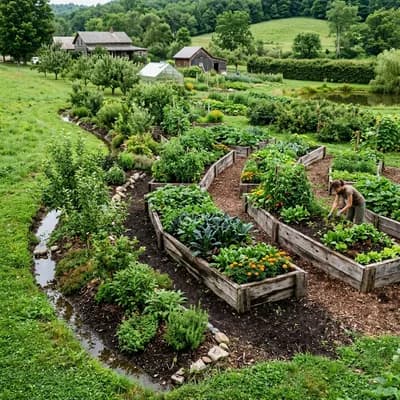
- Raised Beds: In flat areas prone to flooding, build raised beds to keep plant roots above waterlogged soil, preventing root rot.
2. Deep Mulching and Soil Organic Matter
The most cost-effective water storage tool is organic matter in the soil:
- The Organic Sponge: Every 1% increase in Soil Organic Matter (SOM) allows the soil to hold an additional 20,000 gallons of water per acre. You can build SOM by regularly adding compost, rotted manure, and biochar.
- Mulching: Keep the soil surface covered. Apply a 3-to-6-inch layer of organic mulch (straw, wood chips, shredded leaves, or grass clippings) around your plants. Mulch reduces soil evaporation by up to 70%, lowers soil temperature during heatwaves, and suppresses weeds.
---
Resilient Cultivation: Crop Selection and Thermal Protection
To secure your food supply during a super-El Niño, you must adapt your crop selection and planting strategies:
1. Cultivating Resilient Crop Varieties
- Drought-Tolerant Staple Crops: Focus on crops that produce reliable yields under heat and water stress. These include sweet potatoes, cowpeas (black-eyed peas), okra, amaranth, sorghum, and tepary beans.
- Root Crops: Potatoes, carrots, and beets are naturally insulated from extreme air temperatures and can survive short heatwaves better than leafy greens.
- Heirloom Seeds: Select heirloom seeds that have been adapted to your local climate over generations, rather than hybrid seeds bred for uniform industrial conditions.
2. Implementing Passive Cooling and Thermal Protection
When temperatures exceed 35°C (95°F), many crops enter a survival state, halting growth and dropping blossoms. To mitigate this:
- Shade Cloths: Install temporary structures using 30% to 50% shade cloth over sensitive crops like tomatoes, peppers, and greens during peak summer heat.
- Windbreaks: Plant rows of tall, resilient plants (such as sunflowers, sunchokes, or vetiver grass) on the windward side of your garden. These blocks dry winds that accelerate evaporation.
- Guild Planting: Group plants together in mutually beneficial arrangements (similar to the traditional Three Sisters: corn, beans, and squash). The tall corn provides shade, the beans fix nitrogen, and the low-growing squash leaves act as a living mulch, shading the soil.
By understanding the biology of your soil and implementing these water-management and crop-adaptation strategies, you can insulate your food production from the volatile effects of El Niño and fertilizer scarcity. Begin building your soil health and water retention systems today, ensuring your household's resilience in the face of coming climate and supply chain challenges.