Off-Grid Fuel Sovereignty: Designing and Building a DIY Biogas Generator from Organic Waste
When propane and natural gas lines fail, a home-scale biogas digester can convert food scraps and animal manure into clean, cooking-grade methane. Here is the complete step-by-step engineering plan.
In any long-term grid-down scenario, fuel is one of the first commodities to disappear. Propane tanks run dry, gasoline degrades within months, and firewood requires immense physical labor and exposes your location through smoke signatures. True energy independence requires a fuel source that is renewable, simple to produce, and constructed from readily available materials.
Biogas generation fits these requirements perfectly. By utilizing the natural process of anaerobic digestion, you can convert common organic waste—such as kitchen scraps, garden weeds, and animal manure—into a clean-burning gas composed primarily of methane ($CH_4$) and carbon dioxide ($CO_2$). This gas can be piped directly into standard cooking stoves, space heaters, or even modified gasoline generators, providing a continuous supply of fuel using only the daily wastes generated by your homestead.
This guide provides a comprehensive, step-by-step engineering plan to build, commission, and safely operate a continuous-flow, home-scale biogas digester using common hardware store components.
---
The Science of Anaerobic Digestion
Before assembling the hardware, one must understand the biological processes occurring inside the system. Anaerobic digestion is the breakdown of organic matter by specialized bacteria in an environment devoid of oxygen.
This process occurs in four distinct chemical phases:
- 01.Hydrolysis: Complex organic polymers (proteins, carbohydrates, fats) are broken down into simple soluble molecules like sugars and amino acids.
- 02.Acidogenesis: Acidogenic bacteria convert the products of hydrolysis into volatile fatty acids (VFAs), along with ammonia, carbon dioxide, and hydrogen sulfide.
- 03.Acetogenesis: Acetogenic bacteria convert these organic acids into acetic acid, carbon dioxide, and hydrogen.
- 04.Methanogenesis: Finally, methanogenic archaea (methanogens) consume the acetic acid and hydrogen, producing methane gas as a byproduct.
Methanogens are highly sensitive microorganisms. To keep them alive and producing gas, you must maintain several key environmental parameters:
- Temperature: Methanogens thrive in the mesophilic range ($30^\circ\text{C}$ to $40^\circ\text{C}$ / $86^\circ\text{F}$ to $104^\circ\text{F}$). If the temperature drops below $20^\circ\text{C}$ ($68^\circ\text{F}$), gas production slows to a crawl. In cold climates, the digester tank must be insulated and heated.
- pH Balance: The optimal pH inside the digester is between 6.8 and 7.4. If you feed the system too many acidic kitchen wastes (like citrus peels) too quickly, the acid-producing bacteria will overwhelm the methanogens, causing the pH to drop. This is known as "sour digester" syndrome, and it will kill the biological culture.
- Carbon-to-Nitrogen (C:N) Ratio: The ideal feed mixture should have a C:N ratio of approximately 25:1 to 30:1. Animal manure is rich in nitrogen, while dry leaves and paper are rich in carbon. Mixing these materials ensures optimal bacterial growth.
---
Bill of Materials (BOM)
To build a standard 200-liter (55-gallon) continuous-flow digester, you will need the following materials. All of these can be scavenged or purchased at standard hardware stores:
| Component | Quantity | Description | | :--- | :--- | :--- | | Digester Tank | 1 | 200L (55-gallon) heavy-duty HDPE plastic barrel with a tight-sealing lid. | | Gas Collector Tank | 1 | 200L HDPE barrel (open top) or a heavy-duty vinyl gas storage bag. | | Inlet Pipe | 1 | 3-inch PVC pipe (approx. 1 meter long). | | Outlet/Slurry Pipe | 1 | 2-inch PVC pipe (approx. 1.2 meters long). | | Gas Output Fitting | 1 | 1/2-inch brass bulkhead fitting or bulkhead tank connector. | | Valves & Tubing | 1 | 1/2-inch brass ball valve, flexible gas-rated PVC tubing (approx. 5 meters). | | Sealants | 2 | Marine-grade polyurethane sealant (e.g., 3M 5200) or high-grade silicone sealant. | | Submersible Heater | 1 | (Optional) 100W aquarium heater with thermostat, for cold climate operation. |
---
Step-by-Step Construction Guide
Follow these steps carefully to ensure a leak-proof, highly efficient digester system.
#### Step 1: Preparing the Digester Tank
- 01.Lay the 200-liter HDPE barrel vertically. Mark two entry holes on the top lid: one for the 3-inch inlet pipe (feedstock) and one for the 1/2-inch gas bulkhead fitting.
- 02.Mark a third hole on the upper side of the barrel, approximately 15 centimeters (6 inches) below the top rim, for the 2-inch outlet pipe. This serves as the overflow for the digested slurry (fertilizer).
- 03.Cut the holes carefully using a hole saw or utility knife. The cuts must be clean and circular to ensure a proper airtight seal.
#### Step 2: Installing the Inlet and Outlet Pipes
- 01.Cut the 3-inch PVC inlet pipe at a $45^\circ$ angle on one end. Insert the angled end into the lid hole, sliding it down until it sits approximately 10 centimeters (4 inches) above the bottom of the barrel. The angled cut prevents the pipe from getting blocked by settling solids.
- 02.Cut the 2-inch PVC outlet pipe. Cut a $45^\circ$ angle on one end. Insert it into the side hole, sliding it downwards so that the open end is positioned near the bottom-middle of the tank. This ensures that only fully digested liquid (slurry) is pushed out of the overflow when new feedstock is added, while raw feedstock remains inside to digest.
- 03.Apply generous amounts of marine-grade polyurethane sealant around both sides of all pipe entries. Let the sealant cure for at least 24 hours. The joints must be completely airtight.
#### Step 3: Installing the Gas Line
- 01.Install the 1/2-inch bulkhead fitting into the remaining hole in the lid. Use rubber washers on both sides of the lid before tightening the locknut.
- 02.Apply sealant around the bulkhead threads and washers.
- 03.Thread the 1/2-inch brass ball valve onto the bulkhead. This valve acts as the primary gas shutoff for the digester.
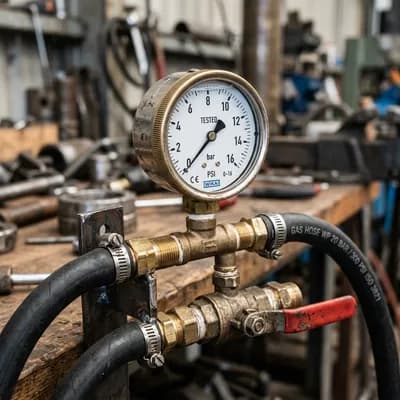
- 04.Attach the flexible gas tubing to the output of the ball valve, securing it with a stainless steel hose clamp.
---
The Gas Storage System
Because a biogas digester produces gas continuously, you need a way to store the gas under constant pressure so it can be fed to a stove.
The easiest off-grid storage system is the floating drum collector:
- 01.Take a second, slightly larger barrel (e.g., 250-liter) and cut off the top. Fill this barrel with water. This serves as the water seal tank.
- 02.Take a standard 200-liter barrel, remove the bottom, and invert it (open end down) into the water seal tank.
- 03.Install a gas inlet fitting on the top lid of the inverted barrel and connect the tubing from the digester.
- 04.As gas is produced, it will flow into the inverted barrel, causing it to float upward in the water. The weight of the barrel provides a constant, low-pressure flow of gas. You can place bricks or stones on top of the floating barrel to increase the gas pressure at the burner.

---
System Commissioning and Inoculation
Once the construction is complete and all sealants have cured, you must start the biological culture:
- 01.The Inoculum: You cannot start a digester with food scraps alone; you need an active source of methanogenic bacteria. The best inoculum is active slurry from an operating biogas digester, or fresh cow/horse manure mixed 1:1 with warm water.
- 02.Initial Fill: Fill the digester tank up to the level of the side outlet pipe (about 85% full) with your inoculum. Do not add food waste yet.
- 03.Purging the System: Seal the lid tightly. Close the main gas valve. Over the first 3 to 7 days, the system will produce primarily carbon dioxide and hydrogen sulfide. Open the valve and vent this initial gas outdoors. Do not attempt to burn it.
- 04.Testing for Methane: Around day 10, the gas will transition to methane. Test this by venting a small amount through a burner nozzle and applying a spark. If it burns with a clean, blue flame, your digester is active and ready for regular feeding.
---
Daily Feeding and Maintenance
Once active, feed the digester daily through the inlet pipe:
- The Feed Ratio: Always mix feedstock with water in a 1:1 ratio to form a fluid slurry before pouring it into the inlet. Thick chunks of food will clog the inlet pipe.
- Daily Feed Rate: For a 200-liter system, the maximum daily feed rate is approximately 2 to 3 kilograms (4 to 6 pounds) of kitchen waste mixed with 2 to 3 liters of water. Overfeeding will overload the methanogens and sour the system.
- The Fertilizer Output: Every time you pour fresh slurry into the inlet, an equal amount of digested liquid will exit the side outlet pipe. Do not throw this away; this is anaerobically digested slurry, an exceptional organic fertilizer rich in bio-available nitrogen, phosphorus, and potassium.
---
Safety and Operation Protocols
Methane is explosive when mixed with air in concentrations between 5% and 15%. Biogas also contains trace amounts of hydrogen sulfide ($H_2S$), which is highly toxic in confined spaces.
Follow these safety rules strictly:
- 01.Outdoor Installation Only: Never operate a biogas digester inside a house, basement, or attached garage. The system must be located outdoors or in a highly ventilated greenhouse.
- 02.Install a Flame Arrester: In the gas line between the storage tank and your stove, install a simple inline flame arrester (a small metal cartridge filled with fine stainless steel wire mesh). This prevents a flame from traveling backward through the tube and exploding the storage tank.
- 03.Avoid Acidic Feedstock: Do not feed large amounts of citrus, onions, grease, or toilet paper into the system. These will corrupt the pH balance. If the pH drops below 6.5, add a small tablespoon of baking soda or agricultural lime to raise the pH.
By utilizing this simple biological reactor, you can convert waste into a reliable, free source of fuel, ensuring your off-grid homestead remains functional when the centralized energy systems collapse.