Nuclear War Exchange Scenario and Survival Overview
Comprehensive Analysis of Nuclear Detonation Phenomenology, Radiological Hazards, and Systemic Survival Frameworks.
The scientific interrogation of nuclear warfare requires a multidimensional understanding of physics, atmospheric chemistry, radiobiology, and civil engineering. A nuclear detonation represents an unparalleled perturbation of terrestrial systems, releasing energy through the rapid reconfiguration of atomic nuclei. This energy manifests in a sequential cascade of physical phenomena, starting with a microsecond-scale burst of ionizing radiation and culminating in decadal-scale climatic shifts.
The following analysis explores the deterministic mechanisms of nuclear explosions, the resulting radiological consequences, the broader environmental fallout, and the evidence-based strategies for ensuring human and systemic resilience in the post-exchange environment.
Deterministic Physics of Nuclear Detonation
The energy released in a nuclear explosion is derived from either the fission of heavy nuclei, such as uranium-235 or plutonium-239, or the fusion of light isotopes like deuterium and tritium. Unlike conventional explosives, which rely on chemical reactions between molecules, nuclear reactions operate at the level of the atomic nucleus, yielding energy densities millions of times greater per unit mass. This massive energy release occurs within a fraction of a microsecond, raising the temperature of the weapon residues to several tens of millions of degrees Kelvin and generating internal pressures exceeding one million times atmospheric pressure.
Fireball Formation and Thermal Pulse Dynamics
The initial phase of an atmospheric nuclear detonation is dominated by the emission of X-rays. Because the air at sea level is relatively opaque to these high-energy photons, the X-rays are absorbed within a few feet of the detonation point, heating the surrounding air into an incandescent, spherical mass known as the fireball. Within less than a millisecond, the fireball of a 1-megaton (Mt) device expands to a diameter of 440 feet; within 10 seconds, it reaches a maximum diameter of approximately 5,700 feet (over one mile) and begins to rise like a hot-air balloon at rates of 250 to 350 feet per second.
Thermal radiation accounts for approximately 35 percent of the total energy yield. In an atmospheric burst, this radiation is emitted in two pulses. The first pulse is extremely brief and consists largely of ultraviolet light. The second pulse, which carries the majority of the thermal energy, lasts for several seconds and is responsible for widespread fires and biological damage. The brilliance of the fireball is such that it can be seen from hundreds of miles away; high-altitude megaton-range bursts have been observed at distances of 700 miles.
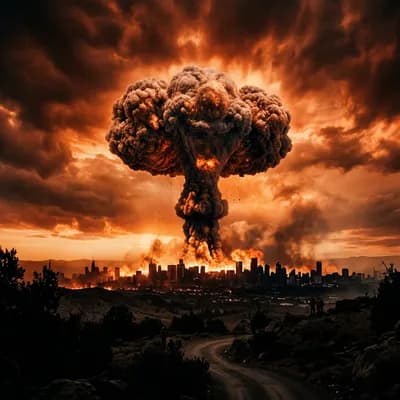
The color of the fireball and the resulting mushroom cloud undergoes a chemical evolution. Initially, the cloud may appear red or reddish-brown due to the formation of nitrogen oxides ($NO_2$, $N_2O_4$) through the high-temperature interaction of nitrogen and oxygen in the atmosphere. As the cloud cools, water vapor condenses into droplets, causing the cloud to transition to a white, cauliflower-like appearance, which is the characteristic "mushroom" shape that reaches stabilization approximately 10 minutes after the blast.
| Thermal Effect Parameter | Measurement/Value for 1 Mt Explosion | | :--- | :--- | | Time to Maximum Diameter | 10 Seconds | | Maximum Fireball Diameter | ~5,700 Feet | | Initial Temperature | > 10,000,000 K | | Rate of Rise (Initial) | 250–350 Feet/Second | | Energy Partition (Thermal) | 35% | | Visibility Distance (High Alt) | ~700 Miles |
Hydrodynamic Shock and Blast Wave Propagation
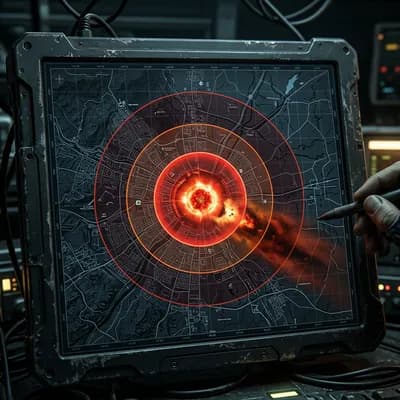
Roughly 50 percent of a nuclear weapon's energy is released as mechanical blast and shock. This begins as a high-pressure shock front that propagates outward from the fireball. In an air burst—a detonation occurring at an altitude designed to maximize blast damage—the shock wave strikes the ground and reflects upward. The interaction between the primary (incident) shock wave and the reflected wave creates a "Mach stem," a vertical wave front that moves horizontally across the surface with significantly increased pressure and destructive potential.
The primary metric for blast damage is overpressure, the pressure above standard atmospheric levels (14.7 psi). Structural damage is determined by the peak overpressure and the duration of the positive pressure phase. Residential structures are generally vulnerable to low levels of overpressure; for instance, a modest house with a front wall of 50,000 square inches experiences 25 tons of force even at a mere 1 psi overpressure.
| Peak Overpressure (psi) | Expected Damage to Structures | | :--- | :--- | | 1.0 | Window glass shatters; doors become difficult to operate | | 5.0 | Complete destruction of most unreinforced residential buildings | | 10.0 | Collapse of brick commercial buildings and factories | | 20.0 | Leveling of reinforced concrete structures | | 100.0 | Destruction of hardened nuclear storage bunkers | | 500.0 | Collapse of missile silos and command centers |
While the human body is remarkably resilient to direct overpressure—often surviving pressures up to 30 psi without fatal internal injury—the secondary and tertiary effects of the blast are lethal. These include the collapse of buildings onto occupants, the impact of high-velocity debris (such as glass shards traveling at hundreds of miles per hour), and the physical displacement of persons into solid objects.
Mass Fires and the Urban Firestorm
The thermal flash ignites flammable materials—paper, dry vegetation, and thin fabrics—over a vast area. For a large thermonuclear device, this ignition zone can extend up to 20 miles from ground zero. If the density of these fires is sufficiently high, they can coalesce into a firestorm. This phenomenon is characterized by a "chimney effect," where the massive heat release causes air to rise rapidly, drawing in surface winds from the periphery at hurricane-force speeds. These inward winds prevent the fire from spreading outward but cause it to burn with extreme intensity, consuming available oxygen and producing lethal concentrations of carbon monoxide. Survivors in shelters within a firestorm zone may succumb to asphyxiation or heat even if the shelter remains structurally intact.
Radiological Phenomenology
Nuclear radiation is divided into prompt (initial) and residual (delayed) radiation. Prompt radiation occurs within the first minute of detonation and consists primarily of gamma rays and neutrons produced by the nuclear reactions themselves or by the capture of neutrons by atmospheric nuclei. Residual radiation, or fallout, refers to the decay of radioactive isotopes over hours, days, and years.
Ionizing Mechanisms: Alpha, Beta, and Gamma
The hazards of nuclear radiation are defined by the type of particle emitted during radioactive decay. Alpha particles are heavy, positively charged clusters of two protons and two neutrons. While highly energetic, they have a short range (a few centimeters in air) and cannot penetrate the outer layer of human skin. However, if alpha-emitters are inhaled, swallowed, or enter through a wound, they cause severe localized damage to sensitive tissues and DNA.
Beta particles are fast-moving electrons or positrons. They are more penetrating than alpha particles and can cause "beta burns" on the skin but are most hazardous when internalized. Gamma radiation consists of high-energy photons (electromagnetic radiation) that are highly penetrating. Gamma rays can travel significant distances through air and require dense shielding, such as lead, concrete, or thick earth, to attenuate their intensity.
The Mechanics of Radioactive Fallout
The formation of fallout depends heavily on the height of burst. In an air burst, the fireball does not touch the ground, and the radioactive weapon residues condense into extremely fine particles that are lofted into the stratosphere. These particles may remain airborne for years, eventually contributing to global background radiation but posing little immediate local threat.
In a surface burst, the fireball vaporizes and entrains vast quantities of soil and debris. The radioactive isotopes condense onto these larger, heavier particles, which fall back to Earth relatively quickly, creating a zone of intense "local fallout" downwind of the detonation. The heaviest fallout occurs near the point of detonation, but dangerous levels can extend 10 to 20 miles or further depending on the wind speed and yield.
The 7:10 Rule of Radioactive Decay
The radioactivity of fallout is dominated by short-lived isotopes that decay rapidly. The 7:10 rule of thumb provides a generalized empirical model for this decay: for every seven-fold increase in time after detonation, the radiation exposure rate decreases by a factor of ten.
| Time Post-Detonation | Radiation Level (Relative to 1 Hour) | | :--- | :--- | | 1 Hour | 100% (e.g., 1,000 R/h) | | 7 Hours | 10% (100 R/h) | | 49 Hours (~2 Days) | 1% (10 R/h) | | 343 Hours (~2 Weeks) | 0.1% (1 R/h) | | 2,401 Hours (~14 Weeks) | 0.01% (0.1 R/h) |
This rapid decay underscores the critical importance of remaining sheltered during the first 48 hours. By the end of the first day, potential exposure has already decreased by approximately 80 percent, and by the end of the second day, the hazard is reduced by 99 percent.
Long-Term Environmental and Climatic Consequences
A large-scale nuclear exchange would initiate environmental shifts far more persistent than the immediate blast and fallout. These effects are primarily driven by the injection of black carbon (soot) into the upper atmosphere.
Nuclear Winter and the Global Cooling Paradigm
The combustion of modern cities and industrial complexes would release millions of tons of soot into the stratosphere. Unlike volcanic ash or tropospheric smoke, stratospheric soot is "self-lofting"—it absorbs solar energy, heats the surrounding air, and rises further into the atmosphere, where it is protected from removal by rain. This soot layer acts as a shroud, blocking incoming sunlight and cooling the Earth's surface.
Current Earth System Models (ESMs) suggest that a global conflict between the United States and Russia could inject 150 teragrams (Tg) of soot, causing surface temperatures to plummet by more than 20 degrees Celsius in key agricultural regions. Recovery of the global climate would take no less than 15 years. Even a limited regional conflict (e.g., India-Pakistan) injecting 5 Tg of soot would cause significant global cooling and disrupt rainfall patterns, endangering food security for billions.
Stratospheric Ozone Depletion and UV-B Radiation
The same soot that cools the surface also heats the stratosphere, reaching temperatures significantly above normal. This heating, combined with the injection of nitrogen oxides ($NO_x$) produced in the fireball's extreme heat, triggers catalytic cycles that destroy the ozone layer.
For the first few years, the smoke itself would shield the surface from ultraviolet radiation. However, as the smoke clears after 3 to 8 years, the thinned ozone layer—predicted to lose up to 75 percent of its global column—would allow extreme levels of UV-B and UV-A radiation to reach the surface. UV Index values could exceed 35 in the tropics and 45 in polar regions. These levels are hazardous to all life, causing severe sunburns in minutes, increasing the risk of skin cancer and cataracts, and damaging the DNA of plants and marine organisms.
| Atmospheric Parameter | Global Conflict (150 Tg Soot) | Regional Conflict (5 Tg Soot) | | :--- | :--- | :--- | | Global Ozone Loss | ~75% Peak | ~25% Peak | | Recovery Time | ~15 Years | ~12 Years | | UV Index (Tropics) | > 35 (Years 4–8) | Elevated within 1 year | | Primary Hazard | UV-induced DNA damage | UV-induced NPP reduction |
Survival and Mitigation Strategies: The Days After
Survival in the immediate aftermath of a nuclear detonation depends on the application of three core radiological protection principles: time, distance, and shielding.
Immediate Tactical Response
If warned of an imminent attack, individuals should seek shelter in the nearest building, moving away from windows to avoid injury from thermal flash and flying glass. If a blast is witnessed, lying face down on the ground helps protect skin from heat and prevents the body from being thrown by the shock wave. Following the passage of the shock wave, there is a "window of opportunity" of approximately 10 to 15 minutes before fallout begins to descend from the mushroom cloud. This time must be used to reach the best available shelter.
Shielding and Protection Factors (PF)
The effectiveness of a shelter is measured by its Protection Factor (PF), which represents the ratio between the radiation dose received outside and the dose received inside. A PF of 10 reduces the dose to one-tenth. Dense materials are the most effective shields. The thickness of a material required to reduce gamma radiation by 50 percent is its Half-Value Layer (HVL); the thickness required to reduce it by 90 percent is the Tenth-Value Layer (TVL).

| Material | Density (g/cm3) | Half-Value Layer (cm) | Tenth-Value Layer (cm) | | :--- | :--- | :--- | :--- | | Lead | 11.3 | 0.7 | 2.1 | | Steel (Iron) | 7.8 | 1.6 | 5.3 | | Concrete | 2.25–2.35 | 4.8 | 15.7 | | Earth (Soil) | ~1.5 | ~7.5 | ~25.0 | | Water | 1.0 | ~10.0 | ~33.0 |
A basement in a wood-frame house typically provides a PF of 10, whereas the center of a large multistory brick or concrete building can provide a PF of 100 or higher. Shelterees should stay as far away as possible from exterior walls and roofs where fallout particles accumulate.
Decontamination and Sanitation
Persons who were outdoors when fallout arrived must undergo decontamination before entering the main shelter area. Removing the outer layer of clothing removes up to 90 percent of radioactive material. Skin and hair should be washed with soap and water or wiped with a damp cloth if water is scarce. It is critical not to use hair conditioner, as it can bind radioactive particles to the hair fibers.
Water and food security are paramount. Sealed containers of food and water stored inside a building are safe for consumption. If containers were outside, they should be wiped clean with a damp towel before opening. Open water sources such as rain barrels or lakes should be avoided until tested.
Medical Management of Radiological Injury
Exposure to ionizing radiation leads to Acute Radiation Syndrome (ARS), also known as radiation sickness. The severity of ARS depends on the total absorbed dose, measured in Grays (Gy) or Sieverts (Sv).
ARS progresses through three distinct phases:
- 01.Prodromal Phase: Occurs within minutes to days after exposure. Symptoms include nausea, vomiting, and diarrhea.
- 02.Latent Phase: A period of apparent recovery lasting from days to weeks, depending on the dose.
- 03.Manifest Illness Phase: The return of symptoms as the underlying damage to the bone marrow, GI tract, or central nervous system becomes evident.
| Dose (Gy) | Syndrome | Onset of Prodromal | Survival (No Medical Care) | | :--- | :--- | :--- | :--- | | 1–2 | Hematopoietic | 2–6 Hours | ~95% | | 2–6 | Hematopoietic | 1–2 Hours | 5%–95% (Dose Dependent) | | 6–10 | Gastrointestinal | 10–60 Minutes | < 5% | | > 20 | Neurovascular | Minutes | 0% |
Potassium Iodide (KI) Protocols
Radioactive iodine (I-131) is a primary component of early fallout and is readily absorbed by the thyroid gland. To prevent this, Potassium Iodide (KI) is administered to saturate the thyroid with stable iodine. KI must be taken within a narrow window—ideally before or within a few hours of exposure—to be effective.
| Age Group | Dose (mg) | Timing Requirement | | :--- | :--- | :--- | | Adults (>18 Years) | 130 | < 24h Before / < 8h After | | Pregnant/Lactating | 130 | < 24h Before / < 8h After | | Children (3–18 Years) | 65 | < 24h Before / < 8h After | | Infants (1mo–3 Years) | 32 | < 24h Before / < 8h After | | Neonates (<1 Month) | 16 | < 24h Before / < 8h After |
It is important to note that KI only protects the thyroid and does not protect the rest of the body from external gamma radiation or other isotopes like Cesium-137 or Strontium-90.
Water Purification and Dietary Resilience
As the immediate threat of fallout subsides, the focus shifts to long-term survival in an environment contaminated by radioactive isotopes. The three most dangerous water-borne and soil-borne isotopes are Iodine-131 (half-life: 8 days), Strontium-90 (half-life: 29 years), and Cesium-137 (half-life: 30 years).
Water Decontamination Methods
Standard mechanical filters (e.g., coffee filters, sand filters) can remove large fallout particles but are ineffective against dissolved radionuclides. For effective purification, the following advanced methods are required:
- Reverse Osmosis (RO): Forces water through a semi-permeable membrane, removing up to 99 percent of radioactive contaminants.
- Ion Exchange: Uses resins to swap radioactive ions (like $Sr^{2+}$ and $Cs^+$) with harmless ions. This is similar to the process used in domestic water softeners.
- Distillation: Boiling water and condensing the steam effectively leaves behind radioactive minerals and isotopes. While energy-intensive, it is a foolproof method for obtaining pure water.
- Activated Carbon: Effective at adsorbing some isotopes and radioactive gases like radon, though it should be used in conjunction with other methods.
Agricultural Remediation and Soil Management
To resume food production, the soil must be decontaminated. Radionuclides tend to accumulate in the top layer of the soil (up to 40 cm). Decontamination strategies include:
- Deep Plowing: Turning the soil to bury the contaminated layer 3 feet deep, effectively placing it below the root zone of many crops.
- Phytoremediation: Planting hyper-accumulator species like sunflowers, which draw Strontium and Cesium out of the soil. The plants are then harvested and disposed of as radioactive waste.
- Soil Amendments: Adding lime (Calcium) to compete with Strontium-90 uptake, or Potassium fertilizer to compete with Cesium-137.
- Removal: Physically scraping and removing the top layer of soil, though this is difficult on a large scale.
| Remediation Method | Targeted Isotope | Effectiveness/Mechanism | | :--- | :--- | :--- | | Deep Plowing | All | Burial below root zone | | Sunflowers | Sr-90, Cs-137 | Bio-accumulation in biomass | | Lime (Ca) | Sr-90 | Chemical competition in roots | | Potassium (K) | Cs-137 | Chemical competition in roots | | Scraping | All | Physical removal of top 5–10 cm |
Regional Vulnerability: Central Europe
The geopolitical context of Central Europe makes it a high-risk region in the event of a nuclear exchange, particularly due to the presence of NATO nuclear sharing assets and domestic nuclear facilities.
Strategic Target Analysis and Wind Patterns
In Northeast Italy, the Aviano and Ghedi air bases store approximately 60 to 70 B61 nuclear bombs as part of NATO's nuclear deterrent. In the event of an attack on these bases, the fallout trajectory for neighboring Slovenia would be determined by the prevailing winds. The "Bora" wind—a strong, north-easterly downslope wind—is a dominant feature of the region, especially in winter. A Bora event could either suppress fallout or carry it into the Adriatic, while a cyclonic "Dark Bora" could bring rainfall, potentially causing "rainout," where radioactive particles are washed out of the air and concentrated on the ground.
Upper-level winds in Central Europe typically propagate from southwest to northeast, following the jet stream. This means that a detonation in Italy or Western Europe would likely carry fallout toward Slovenia, Hungary, and the Baltic region.
Domestic Nuclear Infrastructure: Krško NPP
Slovenia's Krško Nuclear Power Plant, co-owned with Croatia, represents a significant localized risk. While the plant has rigorous emergency procedures, a severe accident resulting from conventional or nuclear strikes could release a source term similar to the PWR-1A WASH-1400 scenario. Current evacuation plans involve radial movement of the population within 8 km and wind-directed evacuation within 16 km. The Slovenian Administration for Civil Protection and Disaster Relief (ACPDR) coordinates these plans, which are regularly reviewed by the IAEA.
| Facility / Location | Type of Asset | Risk to Slovenia | | :--- | :--- | :--- | | Aviano AB (Italy) | NATO Nuclear Storage | High (Fallout trajectory) | | Ghedi AB (Italy) | NATO Nuclear Storage | High (Fallout trajectory) | | Krško NPP | Power Reactor | High (Source term/Local contamination) | | Podgorica Center | Research Reactor/Waste | Moderate (Local contamination) |
Socio-Economic Resilience and Global Recovery
The ultimate survival of human civilization following a nuclear war rests on the ability to transition from a globalized, industrial economy to localized, resilient systems. The immediate loss of the electrical grid due to Electromagnetic Pulse (EMP) would be the most significant barrier to coordination. EMP results from the interaction of gamma rays with the atmosphere, creating intense electromagnetic fields that can damage electronic equipment and power infrastructure over thousands of miles.
Resilient Food Solutions
In the absence of traditional sunlight-based agriculture during a nuclear winter, humanity must scale alternative food sources. Research points to several promising technologies:
- Seaweed Cultivation: Seaweed grows rapidly in low-light conditions and is resistant to cooling.
- Single-Cell Protein (SCP): Microorganisms grown in bioreactors using natural gas (methane) or woody biomass as a substrate.
- Fungal Agriculture: Mushrooms and other fungi can decompose the massive amounts of dead biomass (trees, crops) killed by the sudden cooling.
- Greenhouse Relocation: Moving agricultural production to equatorial regions where temperatures may remain above freezing.
The primary challenge is not a lack of physical food sources but the breakdown of trade and cooperation. Without international grain shipments, countries like Slovenia that are not self-sufficient in food production would face extreme shortages even without direct nuclear strikes.
Synthesis of Findings and Strategic Conclusions
The analysis of nuclear warfare impacts reveals a hierarchy of effects that transition from the physics of the microsecond to the ecology of the decade. The immediate survival of a nuclear exchange is a matter of tactical awareness and radiological discipline—understanding the timing of fallout and the physics of shielding. The long-term survival of the species, however, is a matter of global systemic resilience.
Critical insights for post-exchange stability include:
- Shielding Primacy: The first 48 hours are the most lethal. A Protection Factor of 10–100 can be the difference between survival and fatal ARS.
- Isotope Management: Strategic focus must be placed on Iodine-131 in the first month, followed by long-term management of Strontium-90 and Cesium-137 in food and water.
- Climatic Bifurcation: Survivors must prepare for an initial period of extreme cold and darkness followed by a secondary crisis of extreme UV radiation.
- Decentralized Recovery: The loss of the power grid (EMP) and global trade necessitates the development of localized, redundant systems for water purification, food production, and communication.
The environmental and societal consequences of nuclear conflict are so profound that they transcend the traditional military objectives of a first strike. Modeling suggests that the "winner" of a nuclear exchange would likely suffer a total collapse of their own agricultural systems within years due to nuclear winter and ozone loss. This scientific reality underscores the geopolitical imperative for prevention while reinforcing the necessity of robust civil protection frameworks for the survivors of the catastrophic event.