Runaway Global Warming Analysis with 200 Year Projection
Trajectories of the Earth System: A Global Analysis of Runaway Warming and the 200-Year Climate Horizon.
Introduction: The Anthropocene and the Divergence of Climate Trajectories
The global climate system has entered a period of unprecedented and accelerating destabilization driven by anthropogenic greenhouse gas emissions. Human activities have unequivocally caused global warming, with global surface temperatures already reaching approximately 1.1°C to 1.5°C above the 1850–1900 pre-industrial baseline.1 This warming is not geographically uniform; it is characterized by amplified heating over landmasses and extreme acceleration in the Arctic, which is warming up to four times faster than the global average.1 Despite the adoption of international frameworks such as the Paris Agreement, which aim to limit global average temperature increases to well below 2°C, current global mitigation policies and Nationally Determined Contributions (NDCs) remain grossly inadequate.4 Existing policy trajectories and implemented actions suggest that the world is on a trajectory to experience warming of 2.4°C to 3.0°C by the end of the 21st century.6 Furthermore, the highest emissions scenarios in the scientific literature, which are predicated on rapid economic growth, continued fossil fuel reliance, and pervasive climate policy failures, project global warming exceeding 5°C by 2100 and continuing to rise dramatically in the centuries to follow.5
The scientific consensus increasingly warns that the Earth system is rapidly approaching critical planetary thresholds. The historical behavior of the Earth system during the Late Quaternary period demonstrates a "limit cycle" bounded by specific glacial and interglacial extremes.9 However, the current rate of anthropogenic forcing threatens to eject the planet entirely from this cyclical stability. A dominant and increasingly validated concern in contemporary Earth system science is the "Hothouse Earth" hypothesis.9 This paradigm posits that passing a specific temperature threshold—potentially as low as 2.0°C—could activate a cascade of biogeophysical feedback loops.9 These self-reinforcing feedbacks could propel the Earth into a permanently hotter state, pushing the climate system beyond the capacity of human intervention to reverse or mitigate, even if anthropogenic emissions are subsequently reduced to absolute zero.9
While a true "runaway greenhouse effect"—similar to the hydrodynamic escape of water vapor that historically desiccated the planet Venus—has virtually no chance of being triggered by anthropogenic activities due to the Earth's absorption of longwave radiation and the constraints of the Stefan–Boltzmann law, a "Hothouse Earth" state remains a highly probable and catastrophic outcome.9 Such a state would ultimately stabilize at a global average of 4°C to 5°C higher than pre-industrial temperatures in the near term, with sea levels 10 to 60 meters higher.14 The impacts of this pathway on human societies would be massive, sometimes abrupt, and undoubtedly disruptive, fundamentally challenging the viability of globally integrated civilization.9
To fully understand the magnitude of this existential threat, it is necessary to project the consequences of inadequate action not just to the year 2100, which is an arbitrary temporal boundary, but deep into the future. Evaluating the 200-year horizon—specifically the years 2200 to 2300—under runaway warming scenarios provides a stark visualization of an Earth that has been fundamentally reconfigured. This report provides an exhaustive global analysis of these long-term trajectories. It begins with a comparative assessment of the 2°C and 3°C warming thresholds, explores the complex mechanics of cascading tipping points and Earth system feedbacks, utilizes paleoclimatic analogues to model future states, and culminates in a comprehensive geographical, biological, and socioeconomic projection of the planet in the 23rd century.
The Physical and Thermodynamic Drivers of Near-Term Climate Change
Understanding the trajectory toward a Hothouse Earth requires an analysis of the underlying thermodynamic drivers and the masking effects that currently obscure the full extent of anthropogenic forcing. The primary driver of the current temperature increase is the accumulation of carbon dioxide, methane, nitrous oxide, and chlorofluorocarbons in the atmosphere.15 The long residence time of carbon dioxide means that even if emissions were to cease immediately, the warming already locked into the system would persist for centuries, as the Earth's oceans and atmosphere slowly seek a new thermal equilibrium.16 Models indicate that under scenarios where emissions drop to zero, global temperatures might plateau within a few decades but would remain elevated above historical averages for hundreds of years, cooling by merely half a degree by the year 2300.16
However, the current rate of warming is being artificially suppressed by a hidden "sunshade" effect created by anthropogenic air pollution, specifically sulfur aerosols.18 These aerosols reflect incoming solar radiation back into space, currently reducing global warming by approximately 0.5°C.18 As global initiatives to clean up air pollution—particularly shipping regulations aimed at reducing sulfur emissions—take effect, this protective aerosol cooling is rapidly disappearing.18 The withdrawal of this sunshade effect, combined with underlying greenhouse gas accumulation and reductions in low cloud cover, has contributed to an extreme warming spike observed in the mid-2020s, suggesting that the rate of Earth's warming is accelerating beyond linear projections.18
This acceleration implies that the Earth's equilibrium climate sensitivity (ECS)—the amount of warming expected from a doubling of atmospheric carbon dioxide—may be significantly higher than the traditional median estimates.18 If climate sensitivity is situated at the higher end of the distribution curve, global warming is highly likely to reach the critical 2°C threshold well before 2050, severely compressing the temporal window available for adaptation and radically increasing the probability of triggering irreversible tipping points.18
Diverging Realities: The 2°C Versus 3°C Warming Thresholds
The difference between a global temperature rise of 1.5°C, 2.0°C, and 3.0°C is not merely a linear progression of inconvenience; it represents an exponential amplification of climate risks, systemic vulnerabilities, and structural losses. The Intergovernmental Panel on Climate Change (IPCC) emphasizes that as warming increases, the frequency and intensity of concurrent, cascading hazards will overwhelm the adaptation limits of both human and ecological systems, creating transboundary impacts that are impossible to contain.4 Analyzing the divergence between 2°C and 3°C illuminates the boundary between a severely stressed planet and one entering a state of unmanageable systemic collapse.
Ecological Phase Shifts and the Collapse of Biodiversity
At 2°C of warming, terrestrial and marine ecological systems undergo severe stress, but many maintain a baseline level of functional integrity, albeit in a degraded state. However, even at this "lower" threshold, the biological toll is staggering. Current projections indicate that at 2°C of warming, 18% of all insects, 16% of plants, and 8% of vertebrates globally will lose more than half of their geographic ranges.23 Approximately 13% of the Earth's land area is projected to witness wholesale biome shifts, such as the transformation of Arctic tundra into boreal forest.23 In the cryosphere, the impacts are equally profound; permafrost thaw becomes highly pronounced, with 35% to 47% of the Arctic's permafrost projected to thaw by 2100, representing an area roughly three-quarters the size of Australia.23 Furthermore, the frequency of ice-free Arctic summers increases to at least one every ten years, fundamentally altering hemispheric weather patterns and winter ocean circulation.23
Moving from 2°C to 3°C or higher initiates structural ecosystem collapse and mass extinction protocols. At 3°C, the geographic areas exposed to climate-related hazards expand substantially, exacerbating regional disparities and pushing many biomes past their hard evolutionary adaptation limits.24 The capacity of the ocean to act as a carbon sink diminishes radically as acidification and thermal stratification increase.7 The increased acidity reduces the availability of aragonite and other carbonate minerals, severely impacting marine calcifying organisms, disrupting the foundational layers of the marine food web, and triggering widespread, irreversible die-offs of tropical coral reef systems.7 At 3°C, the velocity of climate change outpaces the migration capacity of most terrestrial flora and fauna, ensuring that localized biome shifts evolve into global extinction events.7
Agricultural Contraction and the Fracturing of Food Security
The agricultural sector serves as a primary indicator of human systemic fragility in the face of warming. Crop yields are highly sensitive to extreme heat, erratic precipitation, shifting pest distributions, and the degradation of soil moisture. At a 2°C increase, agricultural adaptation becomes increasingly difficult and exponentially more expensive, particularly in historically vulnerable regions like the Sahel belt of Africa and South Asia, where crops such as wheat are already operating near their thermal limits.26
At 3°C of warming, however, the structural integrity of the global food system begins to fracture comprehensively. Research modeling the nexus of temperature and agriculture indicates that for every additional degree Celsius of global warming, the world's ability to produce food declines by 120 calories per person per day, representing a 4.4% drop in current daily consumption.27 At 3°C, regions that are currently highly productive—such as the American Midwest, often referred to as the Corn Belt—will face massive, systemic reductions in yield, fundamentally altering their agricultural viability.27
The loss of crop production from climate-driven stresses is further compounded by the physiological impacts of carbon dioxide; rising CO2 levels are paradoxically linked to a 13% decline in wheat yields and a measurable reduction in the nutritional density (proteins, minerals, and vitamins) of staple crops like rice.7 Furthermore, climate change significantly contributes to the decline of insect pollinators, which are essential for the propagation of 75% of the world's leading food crops.7 In a 3°C world, the combination of plummeting yields, diminished nutritional value, and pollinator collapse threatens to plunge hundreds of millions of people into acute, permanent food insecurity, shifting the baseline of human existence from development to mere survival.7
Comparative Matrix of Climate Thresholds
To quantify and visually synthesize the profound divergence between these critical thresholds, the following table details the projected impacts at 2°C versus the 3°C+ trajectory that leads toward runaway warming.
System / Environmental Metric
Impacts at 2.0°C Global Warming
Impacts at 3.0°C+ Warming (Trajectory to Runaway)
Sea Level Rise (by 2100)
Approximately 0.46 meters relative to 1986-2005 levels.23 Coastal flooding exposure threatens up to 79 million people.23
Approaches 1.0 to 2.0 meters, driven by the accelerated structural collapse of polar ice sheets.28 Displaces hundreds of millions.
Cryosphere & Permafrost
35% to 47% of Arctic permafrost thawed by 2100.23 Summer sea ice in the Arctic lost at least once per decade.23
Near-total, permanent loss of summer Arctic sea ice. Extremely high risk of crossing irreversible tipping points for Greenland and West Antarctic ice sheets.9
Biodiversity & Ecosystems
18% of insects, 16% of plants, and 8% of vertebrates lose >50% of their geographic range.23 13% of land undergoes biome shifts.23
Mass extinction event acceleration. Biome shifts vastly exceed the migration velocity of most terrestrial species. Widespread coral reef eradication.7
Agriculture & Food Systems
Moderate to high risk for low-latitude fisheries.17 Rising costs of adaptation, localized staple crop yield drops.26
Systemic global yield failures. Estimated loss of ~360 calories per person daily. Major agricultural zones (e.g., US Midwest, India) become unviable for staple crops.27
Human Habitability & Heat
Extreme heatwaves become routine. Adaptation is strained but largely maintained in highly developed regions.31
Wet-bulb temperatures increasingly approach or exceed the 35°C physiological survival limit in the tropics and subtropics, rendering vast areas lethal.32
Macroeconomic Impact
Significant GDP drag; rising insurance premiums; localized uninsurability in flood zones.21
Systemic financial contagion. Collapse of global insurance markets. "Planetary insolvency" risk as damages become non-linear and unquantifiable.18
The Architecture of Runaway Warming: Cascading Tipping Points
The transition from a stabilized 2°C environment to a runaway 4°C+ Hothouse Earth environment is highly unlikely to be smooth, gradual, or linear. The Earth system is governed by a complex network of biogeophysical feedback loops. These "tipping elements" operate as a planetary machinery that, once a critical stress level is breached, can fundamentally, rapidly, and irreversibly shift the system into a new mode of operation.10 The most alarming aspect of the "Hothouse Earth" hypothesis is the understanding that these elements are inextricably linked; tipping one element can initiate a cascading domino effect that pushes other elements past their respective thresholds, removing the climate system entirely from human control.10
The Cryosphere-Ocean Circulation Nexus
The initial dominoes in this planetary cascade are predominantly located in the cryosphere. As global temperatures rise, the rapid and sustained melting of the Greenland Ice Sheet injects massive volumes of cold, fresh water into the North Atlantic Ocean. This freshwater influx alters the delicate temperature and salinity density gradients that drive the Atlantic Meridional Overturning Circulation (AMOC), a massive system of ocean currents that acts as a global conveyor belt for heat.30 While there is medium confidence that the AMOC will not undergo a complete and abrupt collapse before the year 2100, a severe weakening or a collapse shortly thereafter would cause radical and abrupt shifts in regional and global weather patterns.37
If the AMOC weakens significantly or shuts down, it fundamentally disrupts the intertropical convergence zone, which dictates the distribution of tropical rainfall across the globe. This disruption directly and severely compromises the hydrological cycle of the Amazon Rainforest. Decreased rainfall and artificially prolonged dry seasons push the Amazon past its own tipping point, causing a massive, systemic dieback of the rainforest.10 The Amazon, which currently functions as one of the planet's most vital carbon sinks, would rapidly transition into a massive carbon source. The decay and combustion of the dying forest would release billions of tons of stored carbon dioxide into the atmosphere, further accelerating global heating and reinforcing the exact mechanisms that triggered its demise.36
Permafrost Thaw and the Methane Feedback Loop
Simultaneously, the amplification of warming in the high northern latitudes—where the Arctic is warming at four times the global average—accelerates the thaw of the northern permafrost.3 The permafrost soils encircling the Arctic, stretching from Alaska to Canada and Siberia, lock away massive quantities of organic carbon, estimated at hundreds of billions of tons—roughly twice the amount currently residing in the entire atmosphere.39 As these ancient soils thaw, the microbial breakdown of organic matter accelerates, releasing massive quantities of greenhouse gases.40
A critical component of this release is methane (CH4), a greenhouse gas that is significantly shorter-lived than carbon dioxide but traps heat 28 times more effectively per molecule over a 100-year timescale.39 Historical anxieties within the climate science community frequently centered on the "Clathrate Gun Hypothesis," which posited that warming oceans could trigger a sudden, explosive dissociation of shallow subsurface methane hydrates, leading to catastrophic, instantaneous atmospheric warming.41 However, recent extensive modeling and research by institutions such as NOAA suggest that while the clathrate gun scenario remains a theoretical risk, a more gradual, prolonged, and insidious release of greenhouse emissions from thawing permafrost is the present reality.40
While this gradual thaw may lack the cinematic suddenness of a "methane bomb," the long-term thermodynamic outcome remains utterly catastrophic. By 2100, cumulative carbon emissions from permafrost thaw could range from 32 to 104 Petagrams of carbon (PgC), depending on the specific warming stabilization pathway.43 Furthermore, abrupt thaw processes—where permafrost rich in large ice masses melts and causes the ground to collapse into thermokarst lakes—can become self-sustaining, localized tipping dynamics that increase greenhouse gas emissions by up to 40%.35 In a runaway warming scenario, the permafrost carbon feedback acts as a persistent, autonomous engine of atmospheric carbon enrichment, effectively neutralizing and overriding human efforts to stabilize the climate through traditional emissions reductions.11
Ice Sheet Instability and the Point of No Return
The final, and perhaps most physically reshaping, elements in the tipping cascade are the Antarctic and Greenland ice sheets. These massive bodies of ice are already exhibiting signs of destabilization that track with the absolute worst-case scenarios projected by the IPCC.44 Between 1992 and 2020, the polar ice sheets lost 7,560 billion tonnes of ice, with the highest rates of melt occurring in the most recent decade.45 Tipping dynamics may already be underway in Greenland and West Antarctica.30 Once the grounding lines of these marine-based ice sheets retreat past critical subglacial ridges, the geometry of the bedrock ensures that ice loss becomes a runaway, self-sustaining process driven by oceanic heat, regardless of subsequent changes in atmospheric temperature.46 Crossing these thresholds commits the planet to millennia of unstoppable sea-level rise.48
Paleoclimate Analogues: Looking to the Deep Past to See the Deep Future
To accurately conceptualize the climatic conditions, biological distribution, and physical geography of an Earth subjected to runaway greenhouse forcing, Earth system scientists and paleoclimatologists rely heavily on geological analogues. The unprecedented rate of modern anthropogenic forcing means we are entering uncharted territory; however, by formally comparing projected near-future and deep-future climates with geohistorical states from across the past 50 million years, researchers can establish robust empirical baselines for a highly warmed Earth.49
The Mid-Pliocene Warm Period (3.3 – 3.0 Million Years Ago)
The Mid-Pliocene Warm Period (mPWP) serves as the closest geological analogue for a world stabilized at 2°C to 3°C of warming.50 During this epoch, atmospheric carbon dioxide levels hovered around 400 parts per million volume (ppmv)—a concentration remarkably similar to present-day levels—but the Earth system had been allowed sufficient time to reach a state of thermal and dynamic equilibrium.49 Consequently, global mean annual surface temperatures were 1.8°C to 3.6°C warmer than pre-industrial levels.49
In the Mid-Pliocene, the physical geography and biological distribution of the planet were markedly different from the Holocene due to significantly reduced ice sheet extents and altered oceanic circulation. Model simulations and paleobotanical data indicate that temperatures at middle and high latitudes were drastically amplified, reaching as much as 10°C to 20°C warmer than today above 70°N.52 This profound high-latitude warmth allowed boreal forests to spread deep into the high Arctic, creating forested ecosystems where species such as three-toed horses and giant camels thrived.52 The boundaries of the tundra and taiga shifted radically northward, while vast savannas and warm-temperate forests expanded across Africa and Australia.53 Furthermore, evidence suggests that the intensity of tropical cyclones was significantly increased during the mPWP, a phenomenon that aligns with projections for future anthropogenic warming.53 If current emission pledges are met but not exceeded, the Earth's climate and biome distribution by 2100 will closely resemble the Mid-Pliocene.51
The Early Eocene Climatic Optimum (~50 Million Years Ago)
If the Earth system crosses the Hothouse Earth threshold and enters a state of definitive runaway warming, the Mid-Pliocene analogue becomes insufficient to capture the extreme thermodynamics of the planet. For projections spanning the years 2200 to 2300 under an unmitigated high-emissions trajectory (such as the extended Representative Concentration Pathway 8.5, or SSP5-8.5), the Early Eocene Climatic Optimum (EECO) serves as the most accurate paleoclimatic analogue.54
The EECO was the warmest sustained state of the Cenozoic era. It was triggered by a series of intense hyperthermal events—potentially including massive volcanic supereruptions or the destabilization of marine methane hydrates—which resulted in massive, sustained influxes of carbon into the atmosphere.54 During the EECO, global mean annual surface temperatures reached staggering heights, estimated at 13°C ± 2.6°C warmer than late 20th-century temperatures.49 Atmospheric CO2 concentrations soared to approximately 1,400 ppmv.49 Under these conditions, the planet was entirely devoid of permanent polar ice, and sea levels were vastly higher than today.49
Under the extended RCP8.5 scenario, atmospheric CO2 concentrations are projected to reach around 2,000 ppmv by the year 2250, nearly seven times the pre-industrial level.55 This extreme radiative forcing would lead to a projected global average warming of 7.8°C (with a probabilistic range spanning from 3.0°C to 12.6°C) for the late 23rd century (the 2281–2300 average).55 At these elevated levels, the equilibrium climate sensitivity (ECS) increases non-linearly. Advanced climate models simulating Eocene conditions demonstrate that as baseline temperatures rise, the climate system actually becomes more sensitive to subsequent CO2 additions, suggesting an Eocene sensitivity of more than 6.6°C per doubling of CO2.20 Therefore, by the years 2250 to 2300, a runaway emissions trajectory would engineer an Earth experiencing conditions almost identical to the EECO, characterized by an ice-free globe, profound oceanic thermal stratification, a highly active hydrological cycle, and a fundamentally altered biosphere.49
The 200-Year Horizon

: The Physical Geography of Earth in 2200-2300
Projecting current climate trends forward 200 years under a runaway warming scenario (RCP8.5 / SSP5-8.5) reveals an Earth that is, in almost every measurable physical respect, alien to contemporary human civilization.57 The physical geography of the planet will be entirely rewritten by the catastrophic collapse of the cryosphere and the relentless, accelerating expansion of the oceans.
Cryospheric Collapse and Unstoppable Sea Level Rise
The most profound, permanent, and visually dramatic alteration to the Earth's surface in the 23rd century will be the catastrophic rise in global mean sea level, driven by the structural failure of the polar ice sheets. While public policy and media discourse generally focus on sea level rise by the year 2100—often projected between 0.6 and 2.0 meters 28—the thermodynamic reality is that the massive thermal inertia of the oceans and the irreversible tipping points of ice sheet dynamics ensure that sea levels will continue to rise rapidly for thousands of years.58
Under the very high GHG emissions scenario (SSP5-8.5), ice loss from Greenland and Antarctica tracks with the absolute worst-case modeling parameters.44 By the year 2200, the West Antarctic Ice Sheet (WAIS) is projected to undergo near-total collapse.60 The WAIS is uniquely vulnerable because a vast majority of its mass does not sit on dry land, but rather rests on bedrock that slopes downward inland and sits up to 2.5 kilometers below sea level (retrograde slopes).47 As warm Circumpolar Deep Water intrudes into the ice shelf cavities, it aggressively melts the ice from below, forcing the grounding line to retreat into ever-deeper marine basins.46 This mechanism, known as Marine Ice Sheet Instability (MISI), becomes an unstoppable, self-perpetuating physical process once initiated, driving rapid ice discharge into the ocean.46
By the year 2300, under a sustained 4.5°C+ warming scenario, the thermal forcing becomes so extreme that ice sheet instability is also triggered in the massive East Antarctic Ice Sheet (EAIS), which holds the vast majority of the planet's fresh water.48 Long-term projections utilizing data from 16 combined ice-sheet models indicate that by 2300, sea level rise from the melting of Antarctica alone could reach nearly 10 meters.61 When combined with the total disintegration of the Greenland Ice Sheet (which holds roughly 7 meters of sea-level equivalent) and the significant thermal expansion of warming ocean waters, global mean sea levels are projected to be in excess of 15 meters by 2300.37 Furthermore, this triggers a committed long-term rise of up to 40 meters over subsequent millennia, effectively returning the Earth to a pre-ice-age topography.48
The Reconfiguration of Global Coastlines
A 15-meter global sea level rise by 2300 will effectively drown the current geographical configuration of human civilization. Flat coastal land abutting large water bodies and broad river deltas will be entirely and permanently submerged.63
At this magnitude of inundation, the maps of all seven continents will require complete redrawing. In North America, the entire state of Florida, the entirety of the Gulf Coast, and the heavily populated Eastern Seaboard will be submerged, pushing the coastline hundreds of miles inland and obliterating major economic hubs.63 In Asia, the densely populated and agriculturally vital deltas of the Ganges, Mekong, and Yangtze rivers will vanish beneath the waves, permanently displacing hundreds of millions of people.29 Island nations such as the Bahamas, the Maldives, Tuvalu, and the Marshall Islands will cease to exist entirely.64 Vast stretches of agricultural land and major urban centers globally, including Bangkok, Miami, Shanghai, and Kolkata, will be transformed into shallow marine ecosystems.29 Human civilization will be forced into a continuous, chaotic, centuries-long inland retreat to higher elevations, abandoning trillions of dollars of infrastructure.63
Biome Shifts: The Greening of Antarctica and the Barren Tropics
As the equatorial and mid-latitude regions become increasingly hostile to life, the polar regions will undergo an explosive, unprecedented biological renaissance. The "greening of Antarctica" is a phenomenon that is already observable today; satellite data reveals that plant cover on the Antarctic Peninsula has increased more than tenfold since 1986, accelerating significantly since 2016.65 While currently dominated by slow-growing mosses, lichens, and algae 67, a projected warming of 4°C to 8°C on the Antarctic Peninsula by 2300 will fundamentally and permanently change the continent's biology.68 As the ice retreats and exposes bare rock, soil will begin to form, providing a foothold for invasive, alien plant species.65 Over 200 years, the margins of the Antarctic continent will be transformed into temperate, weedy ecosystems analogous to the tundra of modern-day Patagonia or Iceland, fundamentally altering the pristine ecology of the region.65
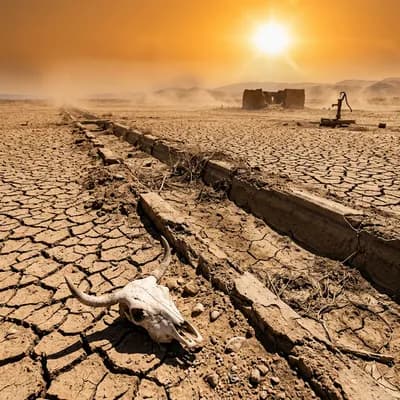
Conversely, places with long histories of cultural and ecosystem richness will undergo catastrophic desertification and collapse. The Amazon Basin, following its transition from a lush rainforest to a dry savanna due to altered hydrological cycles and AMOC disruption, may eventually become an entirely barren landscape characterized by low water levels and degraded biodiversity.57 The equatorial belt, stripped of its canopy cover and subjected to searing, relentless temperatures, will experience an almost complete collapse of complex terrestrial biodiversity, rendering it a hostile wasteland.
Human Habitability and the Shift of the Climate Niche
The ultimate, unavoidable consequence of 200 years of runaway global heating is the profound restriction of human habitability on the planet's surface. For the past 6,000 years of the Holocene, human civilization, agriculture, and economic centers have flourished within a highly specific "human climate niche." This optimal niche is characterized by a mean annual temperature of roughly 11°C to 15°C (52°F to 59°F).69 Runaway warming will force this niche to rapidly migrate to higher latitudes in unprecedented ways, resulting in a severe, unavoidable spatial mismatch between where human populations currently reside and where they can physically survive.69
Thermodynamic Limits of Human Survival: The Wet-Bulb Threshold
The habitability of a region is not dictated solely by absolute dry-bulb temperature, but by the critical combination of heat and humidity, mathematically measured as the wet-bulb temperature (Twb). The human body maintains a core temperature of roughly 37°C by dissipating metabolic heat primarily through the evaporation of sweat from the skin. However, when the ambient atmospheric wet-bulb temperature approaches human skin temperature (approximately 35°C), the thermodynamic gradient required for evaporative heat dissipation completely collapses.32
Prolonged exposure to a wet-bulb temperature of 35°C is universally fatal to humans and all other mammals, as uncompensable hyperthermia ensues. This physiological limit applies regardless of physical fitness, acclimatization, the availability of shade, or the consumption of water.32 Furthermore, recent empirical physiological studies suggest that the theoretical 35°C limit overestimates real-world adaptability; the true critical threshold for uncompensable heat stress in young, healthy adults during minimal physical activity is even lower, ranging from 30°C to 31°C in warm-humid environments.70
Historically, ambient wet-bulb temperatures have never exceeded 31°C. However, the rapidly changing climate has already breached this barrier. Since 2005, extreme humidity and heat events have pushed subtropical locations in the Arabian Gulf, South Asia, and Mexico to experience transient Twb values approaching or exceeding 35°C for short durations.33 In a runaway warming scenario reaching 7°C above pre-industrial levels, the 35°C wet-bulb threshold would be exceeded for extended periods across vast swaths of the globe, calling the fundamental habitability of entire subcontinents into question.32 If warming progresses to 11°C or 12°C by the late 23rd century—a plausible outcome under unmitigated fossil fuel combustion and activated carbon feedbacks—lethal heat conditions would spread to encompass the vast majority of the human population as it is currently geographically distributed.32
The Great Migration and State Collapse
The shifting of the optimal climate niche and the expansion of lethal wet-bulb zones will catalyze the largest mass migration in planetary history. Currently, only 0.8% of the global land surface experiences a mean annual temperature greater than 29°C (84°F). Under the RCP8.5 scenario, by the year 2070, this hyper-arid, dangerously hot zone will expand to cover 19% of the global land surface, directly and severely impacting an estimated 3.5 billion people.69 Researchers estimate that for every single degree of temperature rise, approximately one billion humans are pushed outside the optimal temperature niche.69
By the mid-to-late 21st century, projections suggest the creation of over 1.2 billion climate refugees, forcibly displaced by a combination of sea-level rise, desertification, and intolerable heat.73 As agricultural productivity collapses in the Global South and equatorial regions become physiologically unsurvivable due to uncompensable wet-bulb heat stress, entire populations will be forced to migrate poleward to survive.57
Within the United States, for example, massive demographic shifts will empty out the Southern and Gulf Coast states due to a devastating combination of 130°F heat indices, collapsing crop yields, and coastal inundation.75 The American population center of gravity will shift sharply toward the northern Midwest, the Pacific Northwest, and across the border into Canada, regions that will transition into more temperate zones.75
By the year 2200, the geopolitical map will be defined by an intense, desperate concentration of humanity in the extreme northern and southern latitudes. Regions that are currently marginal or largely uninhabited due to extreme cold, such as Siberia, Northern Canada, Greenland, and potentially the newly ice-free, greening margins of Antarctica, will become the new demographic, economic, and agricultural centers of human civilization. Conversely, the vast tropical and sub-tropical bands of the Earth will be largely abandoned, visited only by automated robotic systems or individuals wearing advanced personal protective equipment (PPE) to survive the lethal ambient heat.57
Agricultural Restructuring
in a Hothouse World
The survival of the residual human population in the 23rd century will depend entirely on a radical, technologically mediated, and unprecedented restructuring of the global food system. As global warming approaches the 7°C to 10°C range, traditional agriculture as practiced during the past 10,000 years of the Holocene will become physically impossible across most of the planet's historically arable land.27
The geographic distribution of agriculture will mirror the human population, shifting completely toward the poles. Regions like North Dakota, the Canadian prairies, and the Russian steppes, which currently experience short growing seasons, will see massive increases in temperature allowing for longer growing days, effectively becoming the new global breadbaskets.75 However, this transition will be fraught with difficulty; the soils in high-latitude regions (such as the rocky Canadian Shield or the acidic Siberian taiga) are nutrient-poor and structurally unsuited for the intense, high-yield monoculture that characterized the deep, fertile topsoils of the historical American Midwest or the Ukrainian steppes.
To compensate for the catastrophic loss of prime agricultural real estate and the continuous, compounding drag of severe heat stress on crop physiology, agriculture in the 2200s will bear little resemblance to modern farming. In the former temperate zones, such as the Midwestern United States or the Indian Subcontinent, farming will be forced to transition to "subtropical agroforestry," utilizing specialized crops like oil palms and highly heat-resistant succulents derived from arid zones.57 Because the outdoor wet-bulb temperatures will frequently be fatal to humans, manual human labor in these agricultural zones will be impossible. Instead, these vast tracts of heat-adapted crops will be entirely managed, harvested, and transported by autonomous AI drones and heavy robotic systems.57
Furthermore, to minimize the massive carbon footprint, ongoing biodiversity loss, and immense irrigation demands associated with attempting to farm in a hotter, drier world, agricultural production will likely be forced to decouple from traditional land use entirely. Controlled environment agriculture, massive vertical farming complexes, and synthetic biology (such as the precision fermentation of proteins and lab-grown cellular agriculture) will become the dominant modes of global food production, particularly in the densely packed, poleward mega-cities where the remaining population is concentrated.77
The Climate Endgame: Economic Insolvency and Geopolitical Fragmentation
The profound physical and biological transformations of a runaway Hothouse Earth scenario will precipitate a complete and catastrophic paradigm shift in macroeconomics and global geopolitics. The prevailing economic integrated assessment models utilized by policymakers in the early 21st century significantly and dangerously underestimated the systemic financial risks associated with unmitigated climate change. Standard economic models historically projected that a 3°C to 6°C temperature rise might merely shrink global GDP by a manageable 2.1% to 7.9%.21 However, these linear models fatally ignored the reality of cascading tipping points, the exponential costs of catastrophic sea-level rise, the collapse of human health, and the systemic failure of nature's critical support systems.21 Recent, more realistic assessments indicate that firms should consider a 15% to 20% contraction in global GDP as a highly plausible outcome of a severe climate and nature shock.21
Planetary Insolvency and the Freeze of Capital Markets
As the world transitions past the 3°C threshold and accelerates toward the extreme temperatures of the 22nd and 23rd centuries, the global financial system faces the imminent, systemic risk of "Planetary Insolvency".21 The primary, initiating mechanism of this financial collapse is the failure of the global insurance market. As the frequency and severity of extreme weather events—megafloods, hyper-hurricanes, and continent-wide wildfires—grow exponentially, the fundamental mathematics of actuarial risk pooling break down entirely.34 The required premiums to insure coastal infrastructure, global shipping, and agricultural yields will vastly exceed what any individual, corporation, or municipality can pay, rendering entire geographic regions fundamentally uninsurable.34
The withdrawal of insurance triggers a rapid, cascading domino effect throughout the broader financial sector. Without the guarantee of insurance coverage, properties and infrastructure cannot be mortgaged, leading commercial and central banks to immediately freeze credit markets for vast swaths of real estate and industry.34 The sudden, irreversible devaluation of coastal real estate and vulnerable agricultural land—estimated to be worth tens of trillions of dollars globally—will vaporize municipal and national tax bases.79 This will cause cascading sovereign debt crises, forcing governments into bankruptcy as they attempt, and fail, to act as insurers of last resort for their displaced populations.78 This financial contagion will mirror the 2008 Global Financial Crisis, but on a permanent, planetary scale, stripping human societies of the very capital and liquidity required to build adaptation infrastructure.21
Geopolitical Fragmentation and Global Decimation Risk
In a world defined by drastically contracting habitable zones, collapsing food systems, and financial ruin, geopolitical stability will completely disintegrate. The emerging "Climate Endgame" literature categorizes these extreme, high-warming scenarios as posing a "Global Decimation Risk" (defined as a 10% loss of the global population) or a "Global Catastrophic Risk" (a 25% loss or more), leading to the severe and permanent disruption of global critical systems.8
Climate change acts as the ultimate threat multiplier, amplifying ambiguity regarding state intentions, destroying shared international norms, and exponentially heightening the global security dilemma.3 As the Arctic ocean becomes completely ice-free year-round, fierce competition over the region's untapped mineral resources, deep-water ports, and new, highly strategic maritime routes will drive intense militarization and great-power conflict among the nations that survive the initial waves of climate disruption.3 Simultaneously, the sudden habitability, greening, and strategic value of the Antarctic continent will reignite dormant territorial claims and treaties, turning the Southern Ocean into a new, highly volatile theater of geopolitical tension.82
In the equatorial, tropical, and mid-latitude regions, the collapse of state capacity due to fiscal insolvency, lethal heat, and agricultural failure will result in massive, widespread ungoverned spaces. Dense, highly industrialized, and formerly politically stable societies will become increasingly precarious, and the knock-on effects of state failure, civil war, and economic collapse will cascade relentlessly across borders.72 The sheer logistical and economic impossibility of smoothly relocating billions of people away from inundated coastlines and uninhabitable thermal zones ensures that the human transition to a high-latitude civilization will not be peaceful. Instead, it will be marked by intense border conflicts, resource wars over dwindling freshwater and arable land, and a profound, tragic demographic contraction.8
Conclusion
The empirical evidence and predictive modeling of the Earth system dictate that the trajectory of the planet hangs in a highly precarious balance. The failure of current global climate policies to limit warming to the 1.5°C or 2.0°C thresholds risks pushing the planet past irreversible biogeophysical tipping points. Once these critical thresholds are breached, the initiation of self-reinforcing feedback loops—from the thawing of the vast Arctic permafrost and the dieback of the Amazon rainforest to the collapse of the Atlantic Meridional Overturning Circulation—will permanently sever human control over the climate system, locking the planet into an irreversible "Hothouse Earth" state.
Projecting this runaway scenario into the 200-year horizon reveals a profound and terrifying reality that defies historical precedent. By the years 2200 to 2300, an unmitigated warming of 7°C to 12°C will recreate the ice-free, highly stratified oceanic and atmospheric conditions of the Early Eocene Climatic Optimum. Sea levels will rise by up to 15 meters, completely erasing historical coastlines, drowning the world's major economic deltas, and permanently displacing billions of individuals. The optimal human climate niche will be violently forced poleward as the tropics and subtropics cross the lethal 35°C wet-bulb thermodynamic limit for mammalian survival, rendering vast swaths of the globe physically unsurvivable.
The resulting Earth of the 23rd century will be utterly alien to human history: an ocean-dominated globe with a greening, temperate Antarctica, a barren and lethal equator, and a vastly reduced, remnant human population huddled in the extreme northern and southern latitudes, sustained entirely by AI-driven, high-latitude agriculture and synthetic food production. This extreme manifestation of the Climate Endgame underscores an absolute existential imperative. Avoiding the cascade of tipping points and maintaining a "Stabilized Earth" pathway is not merely a matter of economic optimization or environmental stewardship; it is the fundamental, non-negotiable prerequisite for the continuation of complex, globally integrated human civilization.
Works Cited
- 01.Summary for Policymakers - IPCC, accessed March 4, 2026, https://www.ipcc.ch/report/ar6/syr/summary-for-policymakers/
- 02.The world is likely to exceed a key global warming target soon. Now what? - UNEP, accessed March 4, 2026, https://www.unep.org/news-and-stories/story/world-likely-exceed-key-global-warming-target-soon-now-what
- 03.How Climate Change Amplifies Arctic Tensions, But Does Not Drive It, accessed March 4, 2026, https://www.thearcticinstitute.org/climate-change-amplifies-arctic-tensions-drive/
- 04.AR6 Synthesis Report: Summary for Policymakers Headline Statements - IPCC, accessed March 4, 2026, https://www.ipcc.ch/report/ar6/syr/resources/spm-headline-statements/
- 05.Technical Summary - IPCC, accessed March 4, 2026, https://www.ipcc.ch/report/ar6/wg3/chapter/technical-summary/
- 06.Emissions pathways to 2100 - Climate Action Tracker, accessed March 4, 2026, https://climateactiontracker.org/global/emissions-pathways/
- 07.Climate change and its impact on biodiversity and human welfare ..., accessed March 4, 2026, https://pmc.ncbi.nlm.nih.gov/articles/PMC9058818/
- 08.Climate Endgame: Exploring catastrophic climate change scenarios ..., accessed March 4, 2026, https://pmc.ncbi.nlm.nih.gov/articles/PMC9407216/
- 09.Trajectories of the Earth System in the Anthropocene - PNAS, accessed March 4, 2026, https://www.pnas.org/doi/10.1073/pnas.1810141115
- 10.Planet at risk of heading towards irreversible “Hothouse Earth” state, accessed March 4, 2026, https://www.pik-potsdam.de/en/news/latest-news/planet-at-risk-of-heading-towards-irreversible-201chothouse-earth201d-state
- 11.Trajectories of the Earth System in the Anthropocene - PubMed, accessed March 4, 2026, https://pubmed.ncbi.nlm.nih.gov/30082409/
- 12.Runaway greenhouse effect - Wikipedia, accessed March 4, 2026, https://en.wikipedia.org/wiki/Runaway\_greenhouse\_effect
- 13.Abrupt climate change in the Anthropocene - Risk Frontiers, accessed March 4, 2026, https://riskfrontiers.com/insights/abrupt-climate-change-in-the-anthropocene/
- 14.Planet at risk of heading towards “Hothouse Earth” state - Stockholm Resilience Centre, accessed March 4, 2026, https://www.stockholmresilience.org/research/research-news/2018-08-06-planet-at-risk-of-heading-towards-hothouse-earth-state.html
- 15.The Causes of Climate Change - NASA Science, accessed March 4, 2026, https://science.nasa.gov/climate-change/causes/
- 16.How long will it take temperatures to stop rising, or return to 'normal,' if we stop emitting greenhouse gases? | MIT Climate Portal, accessed March 4, 2026, https://climate.mit.edu/ask-mit/how-long-will-it-take-temperatures-stop-rising-or-return-normal-if-we-stop-emitting
- 17.Impacts of 1.5°C of Global Warming on Natural and Human Systems - IPCC, accessed March 4, 2026, https://www.ipcc.ch/site/assets/uploads/sites/2/2019/02/SR15\_Chapter3\_Low\_Res.pdf
- 18.Underestimates in global warming pose major climate and financial risk | PreventionWeb, accessed March 4, 2026, https://www.preventionweb.net/news/underestimates-global-warming-pose-major-climate-and-financial-risks
- 19.Global Temperature Report for 2025 - Berkeley Earth, accessed March 4, 2026, https://berkeleyearth.org/global-temperature-report-for-2025/
- 20.Study of Ancient Climate Suggests Warming Could Accelerate as CO2 Levels Rise, accessed March 4, 2026, https://news.arizona.edu/news/study-ancient-climate-suggests-warming-could-accelerate-co2-levels-rise
- 21.Actuaries warn of severe economic impact from accelerated global warming, accessed March 4, 2026, https://corporate-adviser.com/actuaries-warn-of-more-severe-economic-impact-from-accelerated-global-warming/
- 22.Technical Summary | Climate Change 2022: Impacts, Adaptation and Vulnerability - IPCC, accessed March 4, 2026, https://www.ipcc.ch/report/ar6/wg2/chapter/technical-summary/
- 23.Half a Degree and a World Apart: The Difference in Climate Impacts Between 1.5˚C and 2˚C of Warming - WRI.org, accessed March 4, 2026, https://www.wri.org/insights/half-degree-and-world-apart-difference-climate-impacts-between-15c-and-2c-warming
- 24.Summary for Policymakers | Climate Change 2022: Impacts, Adaptation and Vulnerability, accessed March 4, 2026, https://www.ipcc.ch/report/ar6/wg2/chapter/summary-for-policymakers/
- 25.Chapter 3: Polar regions — Special Report on the Ocean and Cryosphere in a Changing Climate - IPCC, accessed March 4, 2026, https://www.ipcc.ch/srocc/chapter/chapter-3-2/
- 26.What You Need to Know About Food Security and Climate Change - World Bank, accessed March 4, 2026, https://www.worldbank.org/en/news/feature/2022/10/17/what-you-need-to-know-about-food-security-and-climate-change
- 27.Climate change cuts global crop yields, even when farmers adapt, accessed March 4, 2026, https://sustainability.stanford.edu/news/climate-change-cuts-global-crop-yields-even-when-farmers-adapt
- 28.Climate Change: Global Sea Level, accessed March 4, 2026, https://www.climate.gov/news-features/understanding-climate/climate-change-global-sea-level
- 29.Sea Level Rise Projections: 10 Cities at Risk of Flooding - Earth.Org, accessed March 4, 2026, https://earth.org/sea-level-rise-projections/
- 30.Point of no return: a hellish 'hothouse Earth' getting closer, scientists say | Climate crisis, accessed March 4, 2026, https://www.theguardian.com/environment/2026/feb/11/point-of-no-return-hothouse-earth-global-heating-climate-tipping-points
- 31.Climate Crisis: What's the Difference Between a Rise of 1.5, 2, and 3 Degrees Celsius?, accessed March 4, 2026, https://www.globalcitizen.org/en/content/the-difference-in-global-warming-levels-explained/
- 32.An adaptability limit to climate change due to heat stress - PNAS, accessed March 4, 2026, https://www.pnas.org/doi/10.1073/pnas.0913352107
- 33.Why you need to worry about the 'wet-bulb temperature' | Climate science - The Guardian, accessed March 4, 2026, https://www.theguardian.com/science/2022/jul/31/why-you-need-to-worry-about-the-wet-bulb-temperature
- 34.Climate crisis putting financial system at risk, warns insurer - The World Economic Forum, accessed March 4, 2026, https://www.weforum.org/stories/2025/04/financial-system-warning-climate-nature-stories-this-week/
- 35.Tipping points in the climate system - Wikipedia, accessed March 4, 2026, https://en.wikipedia.org/wiki/Tipping\_points\_in\_the\_climate\_system
- 36.Climate Tipping Points: Passing the Point of No Return | WorkingAbroad, accessed March 4, 2026, https://www.workingabroad.com/blog/climate-tipping-points-passing-the-point-of-no-retur/
- 37.CLIMATE CHANGE 2023 - IPCC, accessed March 4, 2026, https://www.ipcc.ch/report/ar6/syr/downloads/report/IPCC\_AR6\_SYR\_FullVolume.pdf
- 38.As Climate Change Worsens, A Cascade of Tipping Points Looms - Yale E360, accessed March 4, 2026, https://e360.yale.edu/features/as-climate-changes-worsens-a-cascade-of-tipping-points-looms
- 39.NASA Helps Find Thawing Permafrost Adds to Near-Term Global Warming, accessed March 4, 2026, https://www.jpl.nasa.gov/news/nasa-helps-find-thawing-permafrost-adds-to-near-term-global-warming/
- 40.Climate Change and the Permafrost Carbon Feedback, accessed March 4, 2026, https://cpo.noaa.gov/climate-change-and-the-permafrost-carbon-feedback/
- 41.Evidence for massive methane hydrate destabilization during the penultimate interglacial warming | PNAS, accessed March 4, 2026, https://www.pnas.org/doi/10.1073/pnas.2201871119
- 42.Based on the data we have today how probable is the Clathrate gun hypothesis? - Reddit, accessed March 4, 2026, https://www.reddit.com/r/collapse/comments/1okwleg/based\_on\_the\_data\_we\_have\_today\_how\_probable\_is/
- 43.Permafrost response and feedback under temperature stabilization and overshoot scenarios with different global warming levels - ESD, accessed March 4, 2026, https://esd.copernicus.org/articles/16/1809/2025/
- 44.Greenland, Antarctica melting six times faster than in the 1990s, accessed March 4, 2026, https://sealevel.nasa.gov/news/183/greenland-antarctica-melting-six-times-faster-than-in-the-1990s
- 45.ESA - Ice loss from Greenland and Antarctica hits new record - European Space Agency, accessed March 4, 2026, https://www.esa.int/Applications/Observing\_the\_Earth/FutureEO/CryoSat/Ice\_loss\_from\_Greenland\_and\_Antarctica\_hits\_new\_record
- 46.The Greenland and Antarctic ice sheets under 1.5 °C global warming - International Arctic Science Committee, accessed March 4, 2026, https://iasc.info/images/media/s41558-018-0305-8.pdf
- 47.Global Sea Level Rise - UNFCCC, accessed March 4, 2026, https://unfccc.int/sites/default/files/resource/Sea%20level.pdf
- 48.The long-term sea-level commitment from Antarctica - TC, accessed March 4, 2026, https://tc.copernicus.org/articles/18/4463/2024/
- 49.Pliocene and Eocene provide best analogs for near-future climates - PNAS, accessed March 4, 2026, https://www.pnas.org/doi/10.1073/pnas.1809600115
- 50.accessed March 4, 2026, https://paleonerdish.wordpress.com/2016/03/21/the-pliocene-warm-period-an-analogue-of-a-future-warmer-earth/#:~:text=The%20analysis%20of%20the%20evolution,globally%20on%20average%20than%20today.
- 51.Amplified surface warming in the south-west Pacific during the mid-Pliocene (3.3–3.0 Ma) and future implications - CP, accessed March 4, 2026, https://cp.copernicus.org/articles/19/1359/2023/
- 52.What the Pliocene epoch can teach us about future warming on Earth - Science News, accessed March 4, 2026, https://www.sciencenews.org/article/what-pliocene-epoch-can-teach-us-about-future-warming-earth
- 53.Mid-Piacenzian Warm Period - Wikipedia, accessed March 4, 2026, https://en.wikipedia.org/wiki/Mid-Piacenzian\_Warm\_Period
- 54.Early Eocene Climatic Optimum - Wikipedia, accessed March 4, 2026, https://en.wikipedia.org/wiki/Early\_Eocene\_Climatic\_Optimum
- 55.Representative Concentration Pathway - Wikipedia, accessed March 4, 2026, https://en.wikipedia.org/wiki/Representative\_Concentration\_Pathway
- 56.Climate Response at the Paleocene–Eocene Thermal Maximum to Greenhouse Gas Forcing—A Model Study with CCSM3 in - AMS Journals, accessed March 4, 2026, https://journals.ametsoc.org/view/journals/clim/23/10/2009jcli3113.1.xml
- 57.Climate projections for 2500 show an Earth that is alien to humans, accessed March 4, 2026, https://climate.leeds.ac.uk/climate-projections-for-2500-show-an-earth-that-is-alien-to-humans/
- 58.Taking the Long View: The 'Forever Legacy' of Climate Change - Yale E360, accessed March 4, 2026, https://e360.yale.edu/features/taking-the-long-view-the-forever-legacy-of-climate-change
- 59.Sea level rise - Wikipedia, accessed March 4, 2026, https://en.wikipedia.org/wiki/Sea\_level\_rise
- 60.Rapid loss of Antarctic ice after 2100 likely under current emissions | ScienceDaily, accessed March 4, 2026, https://www.sciencedaily.com/releases/2024/09/240912142344.htm
- 61.Guest post: Overshooting 2C risks rapid and unstoppable sea level rise from Antarctica, accessed March 4, 2026, https://www.carbonbrief.org/guest-post-overshooting-2c-risks-rapid-and-unstoppable-sea-level-rise-from-antarctica/
- 62.Greenland ice sheet - Wikipedia, accessed March 4, 2026, https://en.wikipedia.org/wiki/Greenland\_ice\_sheet
- 63.Which areas of the world will be most affected by sea-level rise over ..., accessed March 4, 2026, https://sealevel.nasa.gov/faq/17/which-areas-of-the-world-will-be-most-affected-by-sea-level-rise-over-the-next-century-and-after-that/
- 64.Climate change's impact on coastal flooding to increase five times over this century, accessed March 4, 2026, https://hdr.undp.org/content/climate-changes-impact-coastal-flooding-increase-five-times-over-century
- 65.Edge of Antarctica Has Grown Dramatically Greener - Yale E360, accessed March 4, 2026, https://e360.yale.edu/digest/antarctica-greening-study
- 66.Antarctica is 'greening' at dramatic rate as climate heats - The Guardian, accessed March 4, 2026, https://www.theguardian.com/world/2024/oct/04/antarctic-plant-cover-growing-at-dramatic-rate-as-climate-heats
- 67.Study challenges recent claims about rapid Antarctic "greening", accessed March 4, 2026, https://www.bas.ac.uk/media-post/study-challenges-recent-claims-about-rapid-antarctic-greening/
- 68.Antarctica faces a green and weedy future - Science News Explores, accessed March 4, 2026, https://www.snexplores.org/article/warming-antarctica-green-weedy-future
- 69.Human Climate Niche - 2020 and 2070 - NOAA's Science On a Sphere, accessed March 4, 2026, https://sos.noaa.gov/catalog/datasets/human-climate-niche-2020-and-2070/
- 70.Evaluating the 35°C wet-bulb temperature adaptability threshold for young, healthy subjects (PSU HEAT Project) - PMC, accessed March 4, 2026, https://pmc.ncbi.nlm.nih.gov/articles/PMC8799385/
- 71.How Climate Change May Make Some Places Too Hot to Live - NASA Science, accessed March 4, 2026, https://science.nasa.gov/earth/climate-change/too-hot-to-handle-how-climate-change-may-make-some-places-too-hot-to-live/
- 72.Uninhabitable Futures on a Habitable Earth - PERN, accessed March 4, 2026, https://pern.ciesin.columbia.edu/sites/default/files/content/cyberseminar/CyberseminarExpertPaper\_Kemp\_Uninhabitable\_Futures.pdf
- 73.There could be 1.2 billion climate refugees by 2050. Here's what you need to know, accessed March 4, 2026, https://www.zurich.com/insights/business/there-could-be-1-2-billion-climate-refugees-by-2050-here-s-what-you-need-to-know
- 74.Climate Change Will Drive Domestic Migration across the United States - NewAmerica.org, accessed March 4, 2026, https://www.newamerica.org/future-land-housing/reports/climate-migrations-impact-on-housing-security/climate-change-will-drive-domestic-migration-across-the-united-states/
- 75.New Climate Maps Show a Transformed United States | ProPublica, accessed March 4, 2026, https://projects.propublica.org/climate-migration
- 76.America's Great Climate Migration Has Begun. Here's What You Need to Know., accessed March 4, 2026, https://magazine.columbia.edu/article/americas-great-climate-migration-has-begun-heres-what-you-need-know
- 77.Relocating farmland to cut carbon emissions amid warming world - Harvard Gazette, accessed March 4, 2026, https://news.harvard.edu/gazette/story/2022/04/scientists-develop-a-reimagined-world-map-of-agriculture/
- 78.Insurance gap driven by climate change threatens financial stability, says WWF, accessed March 4, 2026, https://greencentralbanking.com/2025/11/10/insurance-gap-driven-by-climate-change-threatens-financial-stability-says-wwf/
- 79.The Risks of Climate Change to the United States in the 21st Century - CBO.gov, accessed March 4, 2026, https://www.cbo.gov/publication/61146
- 80.Climate change: potential to end humanity 'dangerously underexplored' say experts - University of Cambridge, accessed March 4, 2026, https://www.cam.ac.uk/stories/climateendgame
- 81.The Geopolitics of Climate Change: Scenarios and Pathways for Arctic 2050 - Belfer Center, accessed March 4, 2026, https://www.belfercenter.org/publication/geopolitics-climate-change-scenarios-and-pathways-arctic-2050
- 82.Full article: Antarctica: geopolitical challenges and institutional resilience - Taylor & Francis, accessed March 4, 2026, https://www.tandfonline.com/doi/full/10.1080/2154896X.2023.2205237