The Technosphere Shield: How SpaceX, AI, Robotics, and Solar Can Secure Survival Through the Climate Crisis
As traditional ecosystems face collapse, we analyze how a combination of global satellite communications, autonomous robotics, artificial intelligence, and decentralized solar energy can build a resilient shield for human survival.
The Necessity of a Technological Lifeboat
The environmental discussions of the past few decades have been characterized by a debate between two camps: those who advocate for a return to pre-industrial, localized agrarian lifestyles (the "soft path") and those who believe that current industrial systems can continue unchanged through minor efficiency gains (the "status quo"). However, by mid-2026, the acceleration of climate anomalies—evidenced by severe heatwaves, water insecurity, and failing agricultural yields—reveals that neither path is sufficient. The scale of the environmental changes is too large for simple manual labor to manage, while the globalized supply chains of the status quo are too fragile to survive systemic shocks.
To secure human survival through the coming climate crisis, we must look to a third path: the deployment of a resilient, high-technology lifeboat. By integrating advanced tools—specifically SpaceX's global satellite networks, artificial intelligence, autonomous robotics, and decentralized solar power—we can build localized, closed-loop survival systems. These technologies should not be viewed as consumer luxuries, but as critical components of a modern life support system. This guide explores how these systems can be integrated to secure food, power, and communications as traditional ecosystems face collapse.
---
SpaceX and Starlink: Planetary Coordination and Communication Resilience
The first vulnerability of any society during a crisis is the collapse of communications. Ground-based infrastructure—including cell towers, fiber-optic cables, and electrical distribution lines—is vulnerable to natural disasters. Hurricanes, wildfires, floods, and civil unrest can disrupt local communications, isolating communities when coordination is most needed.
Here, SpaceX’s Starlink network represents a major advancement in survival infrastructure. By deploying thousands of small, low-Earth orbit (LEO) satellites, SpaceX has decoupled global communications from ground-based vulnerability.
For a localized survival community, a Starlink terminal provides several critical capabilities:
- Information Access: During a crisis, access to data is as vital as physical resources. Starlink enables access to weather forecasts, agricultural database archives, medical guides, and technical repair manuals, allowing communities to solve complex problems locally.
- Coordination Networks: Starlink allows isolated homesteads and communities to form mesh networks, enabling the coordination of security, trade, and medical aid when local government services are unavailable.
- Early Warning Systems: Real-time access to satellite imaging and meteorological feeds allows communities to track approaching storms, wildfires, or agricultural pests, providing time to prepare or evacuate.
- The Role of Starshield: In addition to standard Starlink, SpaceX's Starshield program—specifically designed for governmental and security applications—highlights the resilience of LEO constellations. Starshield features advanced encryption, optical inter-satellite links (laser cross-talk), and dedicated hosting payloads. For community defense and high-security communication networks in collapsed regions, the technology behind Starshield ensures that communications remain operational even in the face of active electronic jamming or localized electromagnetic events.
Crucially, because Starlink terminals operate on standard DC power (typically 48V), they can be powered directly by small, local solar arrays, bypassing the public electrical grid. This direct DC integration eliminates the efficiency losses of DC-to-AC-to-DC conversion, ensuring that every watt generated by your panels goes toward maintaining your connection to the global network.
---
AI and Robotics: Automating Indoor Food Production
As outdoor temperatures rise and weather patterns become more volatile, traditional soil-based agriculture will face increasing failure rates. Heatwaves can halt plant growth, late frosts can destroy blossoms, and droughts can dry up irrigation sources. To secure food production, we must transition to controlled-environment agriculture (CEA), such as vertical farms and automated hydroponic greenhouses.
However, CEA is highly management-intensive, requiring precise control over light, temperature, humidity, and nutrient balances. Artificial intelligence and robotics can automate these complex systems, reducing the labor and expertise required:
1. AI-Driven Environmental Optimization
Operating an indoor greenhouse without synthetic inputs requires continuous adjustments. An AI system, running on local, low-power hardware, can monitor sensor arrays tracking soil moisture, humidity, leaf temperature, and nutrient levels:
- Predictive Control: The AI can predict environmental changes based on local sensor data and adjust ventilation, shading, and watering schedules before plants experience stress.
- Nutrient Management: Using machine learning algorithms, the system can identify nutrient deficiencies from camera feeds (such as leaf yellowing indicating nitrogen shortage) and adjust biological nutrient feeds (like liquid compost teas) to correct the balance.
2. Autonomous Robotics for Labor Redundancy
In a survival scenario, human labor may be needed for security, repair, and community organization. Autonomous robotic systems can handle routine agricultural tasks:
- Automated Planting and Harvesting: Robotic arms equipped with computer vision can identify ripe produce, harvest it without damage, and plant new seeds in modular trays, operating continuously.
- Pest and Disease Control: Micro-drones or small wheeled robots can patrol greenhouse aisles, using multispectral cameras to detect early signs of fungal disease or pest infestations. Once detected, the robot can apply localized organic treatments, preventing the spread of disease without the need for broad-spectrum chemicals.
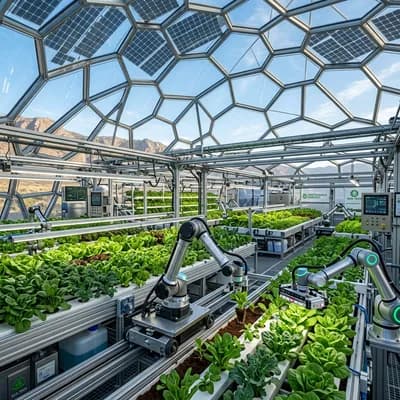
By automating these processes, a small community can maintain high-yield food production in a space the fraction of a traditional farm, fully insulated from external weather conditions.
---
Decentralized Solar and Microgrids: Powering the Life Support Systems
An automated greenhouse, a satellite terminal, and an AI system are useless without electricity. The centralized power grid—reliant on long-distance transmission lines and fossil-fueled power plants—is vulnerable to extreme weather and fuel shortages. Decentralized solar energy, combined with modern battery storage, is the only viable power source for a localized survival shelter.
To build a resilient power system:
1. Lithium Iron Phosphate (LiFePO4) Battery Storage
Traditional lead-acid batteries are heavy, have a short lifespan, and require maintenance. Modern LiFePO4 batteries are the standard for survival power:
- Lifespan: LiFePO4 batteries can undergo 4,000 to 6,000 charge cycles to an 80% depth of discharge, translating to over 15 years of daily use.
- Safety: Unlike standard lithium-ion batteries used in smartphones and EVs, LiFePO4 chemistry is stable and resistant to thermal runaway, reducing the risk of fire.
2. Building a Local Microgrid
A microgrid is a local energy system that manages generation, storage, and consumption:
- AC/DC Coupling: Route solar power through MPPT charge controllers to feed the battery bank directly. Use high-quality off-grid inverters to supply standard AC power to appliances, while running critical low-voltage systems (like LED lights and Starlink) directly on DC to minimize conversion losses.
- Smart Load Shedding: Integrate a micro-controller to manage energy consumption. If the battery bank drops below a critical level during a period of cloudy weather, the system can automatically cut power to non-essential loads (like laundry machines or secondary heating) while maintaining power to critical life support systems (like water pumps, medical devices, and greenhouse systems).
- Bifacial Solar Panels and Climate Dust: Standard solar panels only capture sunlight from the front. In climate crisis scenarios characterized by high atmospheric dust, wildfire smoke, or sandstorms, solar efficiency can drop by 50% or more. Bifacial solar panels, which generate power from both sides by capturing light reflected off the ground (albedo), offer significant advantages. Mounting bifacial panels over light-colored gravel, concrete, or reflective sheets ensures that even in hazy, low-light conditions, the system continues to generate net positive energy to support critical systems.
- Thermal Management of Battery Storage: While LiFePO4 batteries are highly stable, their chemistry is sensitive to temperature extremes. Charging a lithium battery below freezing (0°C/32°F) can cause lithium plating, permanently damaging the cell. Conversely, high heat (above 45°C/113°F) accelerates degradation. A resilient homestead microgrid must place the battery bank in a climate-controlled, earth-sheltered structure or use automated heating blankets powered by the solar array during winter nights, ensuring that the power bank operates within its optimal thermal window.
---
Integrating the Systems: The Resilient Homestead Blueprint
For the individual or community seeking to implement these technologies, the key is integration. These systems should not operate in isolation; they must form a closed-loop system where the output of one process serves as the input for another.
``` +-------------------------------------------------------------+ | Decentralized Solar | | | | | v | | Microgrid | | / | \ | | / | \ | | v v v | | Starlink AI Robotics/Greenhouse | +-------------------------------------------------------------+ ```
The Closed-Loop Integration Plan:
- 01.Energy and Water: Solar panels generate power to run a deep-well pump, lifting water to an elevated storage tank. This creates a gravity-fed water system that does not require continuous electrical power to maintain pressure.
- 02.Water and Agriculture: The water is routed through a filtration system and fed to an indoor aeroponic greenhouse. The runoff water, rich in organic nutrients, is cycled through a bio-filter where red wiggler worms and bacteria break down plant waste, returning clean, nutrient-rich water to the plants.
- 03.AI and Security: The local AI processor, powered by the solar microgrid, monitors security cameras and thermal sensors around the property. If an anomaly is detected, it alerts the household via local mesh communications and routes the information through Starlink to neighboring homesteads.
The combination of SpaceX's communications network, artificial intelligence, autonomous robotics, and decentralized solar energy offers a path to resilience during environmental change. By transitioning from consumer dependence to local production and integrating these technologies into a closed-loop system, you can build a secure lifestyle for your household and community. Focus on hardening your local infrastructure now, establishing the foundations of your technological life support system.