The AI Capability Triad: Geopolitical Arms Races, Kinetic Drone Swarms, and Sovereign Vulnerability
An intelligence briefing on the convergence of advanced compute, fully autonomous kinetic swarms, and sovereign cyber-sabotage. How the acceleration of AI warfare dismantles deterrence paradigms.
# The AI Capability Triad: Geopolitical Arms Races, Kinetic Drone Swarms, and Sovereign Vulnerability
The Escalation from Predictive Modeling to Autonomous Lethality
The geopolitical landscape has entered an irrecoverable transition phase. Over the past twenty-four months, artificial intelligence transitioned from diagnostic, predictive algorithmic models into autonomous decision-making agents capable of closed-loop operational execution. The traditional doctrine of nuclear deterrence—grounded in strategic delay, human command deliberation, and mutual assured destruction—is being actively dismantled by hypersonic decision cycles engineered to defeat human cognitive reaction times.
At the epicenter of this shift is the AI Capability Triad:
- 01.Extreme-Scale Frontier Compute: Sovereign clusters dedicated to multi-modal tactical situational awareness.
- 02.Decentralized Edge Synthesis: Lightweight, quantized reasoning engines operating aboard low-cost expendable loitering munitions.
- 03.Automated Cyber Penetration Systems: Self-evolving recursive payload generators systematically testing critical infrastructure for zero-day vulnerabilities.

Loitering Swarms and Asymmetric Anti-Access Operations
The deployment of low-cost, decentralized drone swarms along contested maritime passages and land borders has completely upended conventional force projection. Modern electronic warfare suites—once capable of jamming radio control links or spoofing GPS navigation—are rendered obsolete against swarms running localized visual-inertial odometry and onboard neural networks trained for target recognition without external telemetry.
These autonomous swarms communicate through encrypted peer-to-peer optical mesh networks. When individual units are shot down or jammed, the remaining units dynamically reallocate strike trajectories, decoys, and tactical sensor nodes within milliseconds. The financial asymmetry is stark: a \$15,000 loitering suicide drone can incapacitate a \$2.4 billion Aegis cruiser radar array or neutralize a multi-million-dollar primary transformer station, shifting the economics of warfare decisively in favor of low-cost swarms.
Kinetic Escalation and the Vulnerability of Sovereign Grids
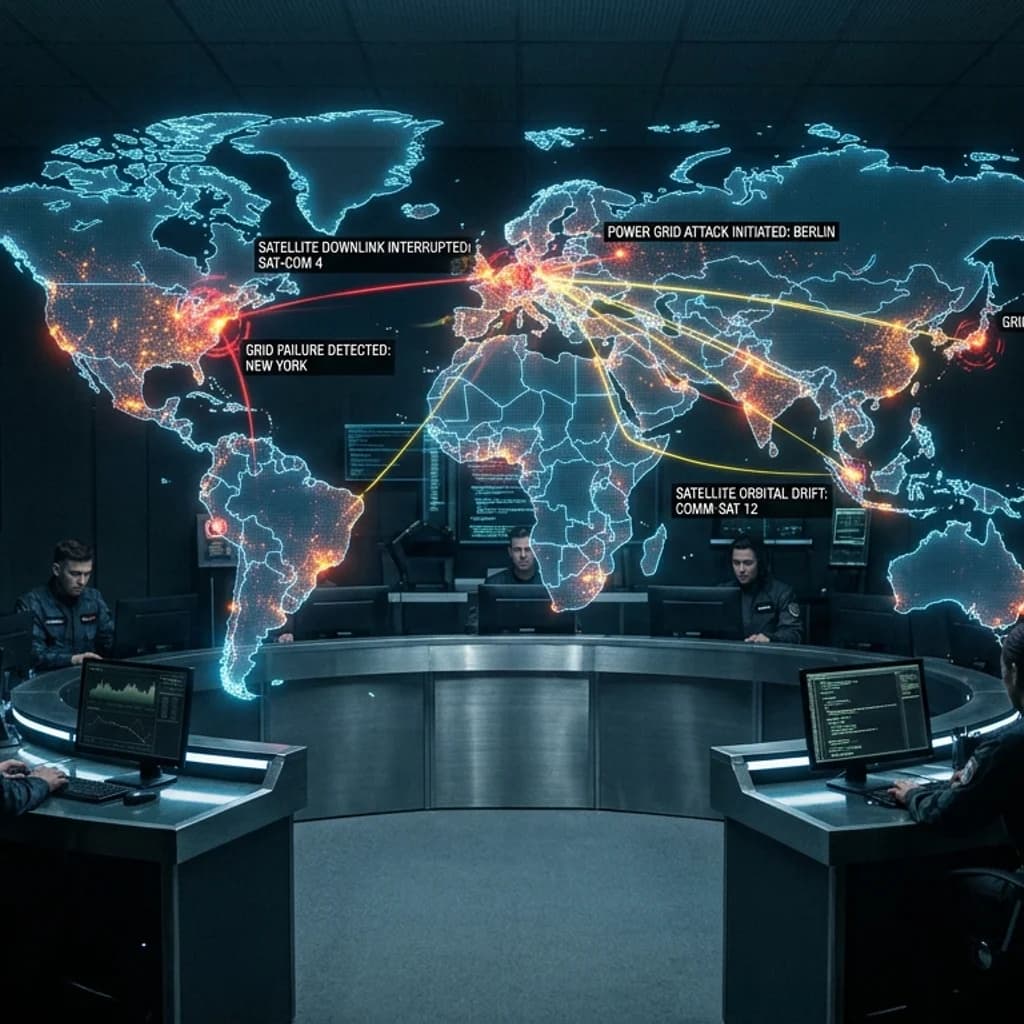
The most perilous flashpoint does not lie in battlefield skirmishes, but in the hybridization of autonomous cyber capabilities with physical kinetic attacks. Critical national infrastructure—specifically supervisory control and data acquisition (SCADA) systems controlling electrical grids, petrochemical distribution pipelines, and municipal water purification facilities—faces continuous automated probes.
As adversarial state actors deploy self-optimizing LLM agents to orchestrate coordinated multi-vector cyber offensives, the window for human defenders to respond has collapsed from hours to fractions of a second. A localized compromise of grid sub-stations can trigger rapid cascaded blackouts, leaving modern cities dark, heating systems disabled, and digital logistics paralyzed within minutes. In a zero-trust geopolitical theater, strategic parity is an illusion—speed of autonomous response is the only metric that matters.