Underground Intel: Maintaining Comms and Security from Your Bunker
A doomsday bunker is only as good as the information it receives. A deep dive into establishing an underground intelligence hub, mitigating physical footprint, and mastering offline communications.
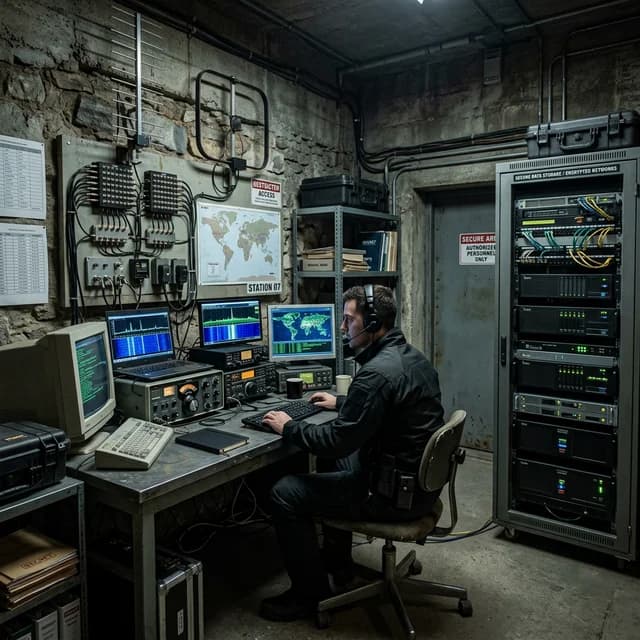
A massive misconception among survivalists is that a bunker should be an isolation chamber where you retreat and sever all ties with the outside world. In reality, going completely deaf and blind to the surface is a fatal tactical error. An effective doomsday shelter must function as a localized intelligence gathering post. You need to know when the threat has passed, when the fallout levels have dropped, or if hostile groups are operating in your sector.
The Subterranean Antenna Dilemma
The earth blocking your bunker works both ways: it stops radiation and bullets, but it firmly stops radio waves. You cannot effectively run a ham radio or intercept signals from beneath several feet of concrete and dirt.
To solve this, your bunker requires hardened, concealed feedlines running to the surface. Coaxial cables should be buried in conduit and terminate at disguised or heavily camouflaged antenna deployment areas. A common strategy involves using trees to mask the structural support of wire dipoles or deploying low-profile vertical antennas that are extremely difficult to spot from a distance. You must also implement lightning arrestors and heavy grounding—a lightning strike hitting your surface antenna will fry the critical electronics inside your shelter.
Signal Intelligence (SIGINT) for the Operator
Your bunker's communications desk should be equipped for extreme situational awareness. The goal isn't just to talk, but to listen.
- Software Defined Radio (SDR): A cheap SDR dongle plugged into a hardened laptop allows you to visually scan massive blocks of the radio spectrum to see where activity is happening, from local emergency services to unencrypted rebel comms.
- Shortwave Radios: To understand the global picture, shortwave receivers are mandatory. They can pick up broadcasts propagating off the ionosphere from thousands of miles away, giving you a macro view of the disaster.
- Mesh Networking: If there are allied local preppers, establishing an LoRa mesh network (like Meshtastic) allows for encrypted text communication that doesn't rely on cell towers or internet infrastructure.
Operational Security (OPSEC)
Emitting radio frequencies is inherently dangerous in a hostile environment; anyone with basic direction-finding equipment can triangulate your signal and uncover your bunker's location.
The rule of the bunker is simple: operate under strict radio silence unless transmission is absolutely critical. Implement "burst transmission" strategies if you must send data, keeping your on-air time to a matter of seconds. Rely entirely on passive listening for intelligence gathering. Furthermore, consider your thermal footprint. Generators and human bodies create heat, which must be vented to the surface. In a true collapse scenario, aerial drones equipped with FLIR (Forward Looking Infrared) could easily spot your exhaust vents. Baffling your vents and mixing exhaust with cooler ambient air before it breaches the surface is critical.
External Resources and Intel References
Building a proper communications rig requires study and preparation:
- ARRL - The National Association for Amateur Radio - The foundational resource for understanding RF engineering, propagation, and antenna design.
- Meshtastic Official Documentation - A guide to establishing off-grid, encrypted, low-power mesh networks.
- *The Guerrilla’s Guide to the Baofeng Radio* - A practical text on quickly standing up localized, decentralized communication networks using ubiquitous, inexpensive hardware.