The End of Cheap Oil: A Rigorous Timeline of Peak Oil and Global Reserve Depletion
When will the world's oil reserves actually run out? We dissect the math behind proven reserves, rising extraction costs, and the systemic shock of the post-petroleum era.
The Hydrocarbon Scaffold of Modernity
Modern industrial civilization is not built on capital, labor, or technology; it is built on cheap, abundant, high-density energy. Since the mid-19th century, the exploitation of fossil fuels—specifically crude oil—has enabled an unprecedented expansion of the human population, agricultural output, and technological complexity. Every facet of our daily lives, from the plastic casing of our electronics and the synthetic fertilizers that grow our crops to the international shipping lanes that deliver consumer goods, is supported by a steady flow of hydrocarbons. Crude oil is the ultimate energy source: liquid at room temperature, stable, easily transportable, and containing an extraordinary energy density (approximately 38 megajoules per liter).
Yet, despite this total dependence, the public discussion surrounding the longevity of crude oil reserves is characterized by superficial metrics and political posturing. The question "When will the oil run out?" is frequently met with simplistic, reassuring answers from energy executives and government agencies, typically pointing to a static figure of "50 years of reserves remaining." This analysis aims to look beyond these simplistic estimates, examining the thermodynamics, geology, and economics of oil extraction to outline a realistic timeline for peak oil and the subsequent transition to a lower-energy world.
---
The R/P Ratio and the Mirage of "50 Years of Oil"
The most commonly cited metric for energy resource longevity is the Reserves-to-Production (R/P) ratio. This is calculated by dividing the total volume of proven, economically recoverable reserves by the current annual global production rate. As of 2026, the global proven crude oil reserves are estimated to be approximately 1.7 trillion barrels, while global production hovers around 100 million barrels per day (or 36.5 billion barrels per year).
Dividing 1.7 trillion by 36.5 billion yields an R/P ratio of roughly 46.5 years. To the casual observer, this suggests that society can continue its current consumption patterns until around 2072, at which point the last drop of oil will be pumped, and the taps will run dry. However, this calculation is based on several unrealistic assumptions:
- Static Production Rates: The R/P ratio assumes that global consumption will remain constant at 100 million barrels per day. In reality, developing economies are seeking to increase their energy consumption, and the global population continues to grow, driving up demand.
- Geological Realities: Oil fields do not operate like water tanks. You cannot pump oil at a constant rate until the day it runs out. Instead, oil fields follow a bell-shaped production curve: output rises to a peak, plateaus, and then enters a long, gradual decline.
- Paper Reserves: A significant portion of "proven reserves" reported by OPEC nations and oil conglomerates consists of unverified paper reserves. In the 1980s, OPEC members increased their reported reserves by over 300 billion barrels without discovering major new fields, simply because their export quotas were tied to their reserve size.
Therefore, the R/P ratio is a misleading metric that obscures the operational timeline of resource depletion. The critical milestone for industrial society is not the year the last barrel of oil is extracted; it is the day global oil production reaches its peak and begins its permanent, irreversible decline. This is the concept of Peak Oil.
---
The EROI Cliff: Energy Return on Investment
To understand when oil will cease to function as the driver of the global economy, we must move from financial accounting to energy accounting. The fundamental metric here is Energy Return on Investment (EROI). EROI is the ratio of the amount of usable energy acquired from a resource to the amount of energy expended to obtain that energy.
$$\text{EROI} = \frac{\text{Energy Delivered to Society}}{\text{Energy Expended in Acquisition}}$$
When the first oil wells were drilled in Pennsylvania and East Texas in the late 19th and early 20th centuries, the oil was close to the surface and under high pressure. The EROI of this light, sweet crude was often higher than 100:1. For every barrel of oil burned to run drilling rigs and pumps, 100 barrels of oil were delivered to society. This massive net energy surplus funded the building of modern cities, road networks, and industrial systems.
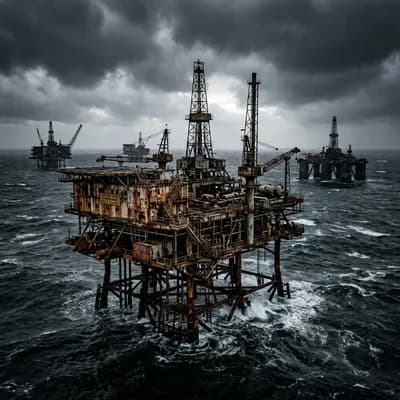
However, the laws of thermodynamics are unforgiving. Society naturally exploits the easiest, highest-quality resources first. As these super-giant, shallow oil fields deplete, energy companies are forced to seek oil in more challenging environments:
- 01.Ultra-Deepwater Drilling: Drilling through thousands of feet of water and miles of ocean floor, requiring complex, energy-intensive offshore platforms.
- 02.Tight Oil and Fracking: Injecting high-pressure water, sand, and chemicals to fracture deep shale formations, requiring continuous drilling of new wells to offset rapid decline rates.
- 03.Oil Sands and Bitumen: Scraping up clay-sand mixtures and heating them with natural gas to separate viscous bitumen, which must then be chemically upgraded into synthetic crude.
While these unconventional sources have increased total production volumes, they come with a steep thermodynamic cost. The EROI of tight oil from the Permian Basin ranges from 15:1 to 10:1, while the EROI of Canadian oil sands is even lower, hovering between 6:1 and 3:1.
This drop in EROI is often described as the "net energy cliff." As EROI declines toward 1:1, the net energy delivered to society shrinks rapidly.
| Energy Source | Estimated EROI Range | Economic Viability Category | | :--- | :--- | :--- | | Early Conventional Oil (1930s) | 100:1 | Hyper-abundant surplus | | Modern Conventional Oil (Saudi Arabia) | 30:1 to 20:1 | Highly viable, primary scaffold | | Tight/Shale Oil (US Fracking) | 15:1 to 10:1 | Moderate viability, capital-intensive | | Heavy Oil / Tar Sands | 6:1 to 3:1 | Marginal viability, high emissions | | Corn Ethanol | 1.3:1 to 0.8:1 | Net energy sink, economically unviable |
Climatologist and energy analyst Charles Hall has demonstrated that a modern high-energy society requires a minimum EROI of around 10:1 to maintain its complex social systems, education, healthcare, and infrastructure. If the average EROI of the global energy mix falls below this threshold, society must dedicate an increasing portion of its energy output just to extracting more energy, leaving fewer resources to support the rest of the economy. The oil will not "run out" in a physical sense; rather, it will become energetically and economically unviable to extract.
---
The Production Decline Curve: Hubbert’s Peak and the Real Timeline
The pattern of oil depletion was first mapped by geophysicist M. King Hubbert in 1956. Hubbert observed that the production curve of an individual oil field, and by extension a nation, follows a roughly symmetrical bell-shaped curve. Output rises as new wells are drilled and technology improves, reaches a peak when approximately half of the recoverable oil has been extracted, and then declines as pressure drops and water intrusion increases.
Using this model, Hubbert predicted that US oil production would peak in the early 1970s. Despite widespread skepticism, US conventional oil production did peak in 1970, initiating a long decline that was only temporarily reversed decades later by the fracking boom.

At the global scale, conventional oil production reached a plateau around 2005-2008, hovering around 73-75 million barrels per day. The subsequent growth in liquid fuel production has been driven almost entirely by unconventional sources, particularly US shale oil and Canadian oil sands.
The fracking boom has postponed the day of reckoning, but shale wells deplete quickly, often losing 70-80% of their initial output within the first three years of operation. To maintain production, operators must continually drill new wells, creating a capital-intensive cycle often called the "red queen's race."
By late 2026, many of the sweet spots in the Permian Basin are showing signs of depletion, with gas-to-oil ratios rising and decline rates accelerating. When shale oil production peaks—projected between 2027 and 2030—global oil production will enter its final, permanent decline phase, dropping at an estimated rate of 3% to 5% annually.
---
Preparing for the Energy Descent: Tactical Resilience Strategies
The transition to a post-peak oil world will not be marked by a sudden, clean switch to renewable energy. Solar panels, wind turbines, and electric vehicles are secondary technologies; their components are mined, manufactured, and transported using fossil-fueled machinery. Instead, the energy descent will likely manifest as economic volatility, resource nationalism, and localized supply chain disruptions.
To prepare for this shift, individuals and communities must focus on reducing their dependence on high-energy, globalized systems:
1. Hardening Local Food Production
Our modern food supply is essentially "oil converted into calories." To decouple from this system:
- Soil Biological Restoration: Move away from petroleum-derived synthetic fertilizers (nitrogen fertilizers require natural gas; phosphorus requires diesel-intensive mining). Focus on building soil biology using compost, green manures, and animal integration.
- Localization: Transition to consuming foods grown within your local region. Build relationships with nearby farmers, food co-ops, and community-supported agriculture (CSA) networks.
- Perennial Cultivation: Plant perennial food crops (fruit trees, nut trees, berry bushes) that require less seasonal tillage and machinery input than annual grains.
2. Developing Mechanical and Low-Tech Skills
As complex machinery becomes more expensive to maintain due to spare parts shortages and fuel costs:
- Tool Redundancy: Acquire and learn to use high-quality hand tools for woodworking, metalworking, and agriculture. A well-maintained hand saw, scythe, and brace drill do not require fuel or electricity.
- Basic Mechanics: Master the maintenance of simple engines and mechanical systems. Learn how to clean carburetors, repair bicycles, and maintain small diesel engines, which can run on filtered biofuels if necessary.
- Improvised Infrastructure: Learn how to build basic systems, such as gravity-fed water setups, wood-burning stoves, and solar cookers.
3. Transitioning to Localized, Low-Energy Transportation
- Active Transport: Invest in cargo bicycles, trailers, and walking gear. Bicycles are the most energy-efficient transport machines ever created and can be maintained with basic tools.
- Living Near Essentials: Design your life to minimize daily travel distances. If possible, relocate to a walkable community or a homestead where your livelihood and daily needs are close by.
- Biofuel Capacity: If you must run machinery, investigate small-scale biofuel production (such as filtering waste vegetable oil for use in older, mechanical diesel engines).
The end of the cheap oil era is a physical reality dictated by the laws of thermodynamics. By shifting your lifestyle from consumption to production and building localized support networks, you can navigate the energy descent with resilience and independence. Focus on securing your basic needs now, before the global extraction curves reach their peak.