Analog Sovereignty: Surviving in an AI Surveillance

A tactical operational security guide for preserving personal autonomy, digital privacy, and cryptographic defense against ubiquitous AI biometrics, synthetic media fraud, and automated state surveillance.
# Analog Sovereignty: Surviving in an AI Surveillance and Deepfake Era
The Collapse of Digital Verifiability
We have crossed into an era where digital signals—video footage, voice recordings, signed electronic documents, and biometric scans—can no longer be presumed authentic, accelerating the collapse of epistemic trust. Hyper-realistic neural audio synthesizers can replicate a family member or business partner’s voice with three seconds of clean audio sample. Concurrently, computer vision models deployed across urban smart-city camera grids perform continuous facial and gait identification without legal warrants or individual consent—dynamics examined in our guide to surviving the digital panopticon.
When trust in the digital layer disintegrates, survival depends on cultivating Analog Sovereignty grounded in EFF Surveillance Self-Defense guides and CISA cybersecurity best practices: decoupling critical communications, personal identity verification, and asset control from vulnerable cloud infrastructures, as detailed in our analog countermeasures field guide.

Defeating Synthetic Voice and Deepfake Extortion
Targeted kidnapping scams and financial coercion schemes utilizing AI-generated voices—documented in FBI scams and synthetic fraud advisories—have proliferated. To protect your family and operational unit against cognitive manipulation:
1. The Pre-Shared Verbal Duress Protocol
Establish an offline, analog challenge-response system within your immediate household or survival team:
- The Safeword Matrix: Create a list of three unrelated dictionary words memorized exclusively in person (never written on digital devices or transmitted via SMS).
- Duress Inversion: Choose one word that sounds like an innocuous greeting or agreement, but secretly signals that the speaker is under physical coercion or that a deepfake attack is underway.
- Callback Verification: Mandate a rule that any urgent financial or security request received by phone or video call must be confirmed via a secondary, air-gapped physical or analog channel before any action is taken.
2. Physical Sensor Neutralization
Software "mute" toggles and permissions are fundamentally untrustworthy against zero-click exploits. For mobile hardware that must be carried:
- Use physical camera sliding shutters.
- Desolder internal microphone leads on sensitive field devices, replacing them with detachable external 3.5mm TRRS microphones plugged in strictly during active, consented communications.

Building Verified Faraday Enclosures
To prevent remote geo-location tracking, automated telemetry pinging, and wireless firmware manipulation, every operational kit must include a verified Faraday cage enclosure:
- Materials: Galvanized steel ammo cans, solid copper or aluminum mesh (minimum 30 mesh per inch), and high-tack conductive copper tape.
- The Double-Layer Rule: Place devices inside an inner conductive pouch lined with non-conductive cardboard or neoprene, then enclose that assembly inside a sealed, outer conductive container. The inner layer prevents RF leakage caused by devices touching the conductive outer walls.
- Testing Protocol: Place a smartphone inside the sealed container and attempt to call it. Then scan for active 2.4 GHz, 5 GHz Wi-Fi, and Bluetooth low-energy beacons. Total attenuation must exceed -80 dB across all bands.
Air-Gapped Workstations and Offline Survival Archives
Sovereignty requires the ability to compute, store data, and access reference knowledge without network connection:
- 01.Hardware Configuration: Repurpose dedicated older laptop hardware (such as ThinkPad X220/T430) with physically extracted Wi-Fi, Bluetooth, and cellular modem cards, adhering to NIST hardware-rooted security principles.
- 02.Operating System: Boot amnesic operating systems (such as Tails OS from The Tor Project) or compartmentalized hypervisors (Qubes OS) from write-protected hardware USB media.
- 03.The Offline Knowledge Vault: Maintain compressed local mirrors of the entire Wikipedia library (Kiwix), medical surgery handbooks, agricultural farming compendiums, and open-source mapping data (OpenStreetMap) stored on multi-terabyte encrypted solid-state drives inside EMP-proof ammunition cases—an architecture detailed in our guide to building an offline survival data archive.
Real-time geospatial feed aggregating USGS M5.0+ earthquakes, NASA EONET wildfires, volcanoes, severe storms, UN/EC GDACS alerts, and NOAA geomagnetic status.
Related Reports & In-Depth Intel
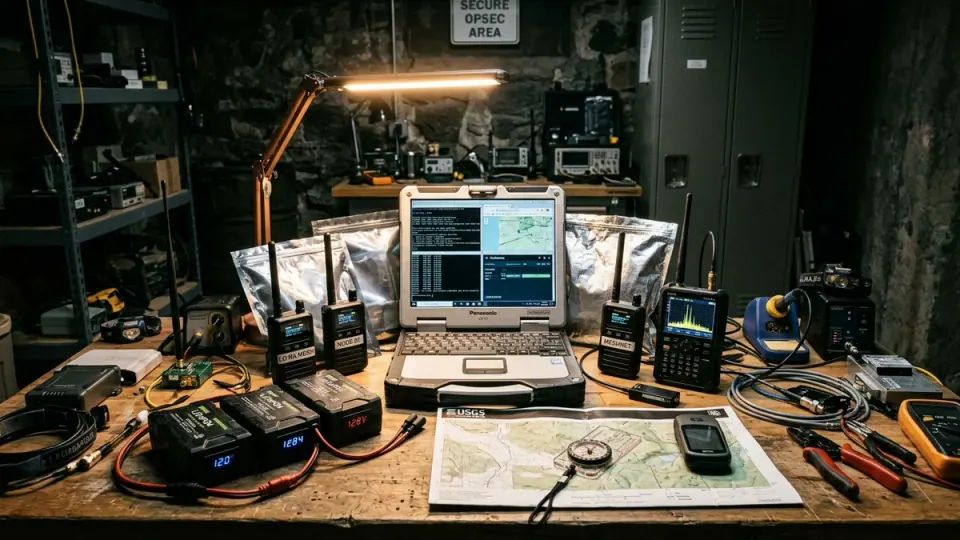
Hardened Off-Grid Mesh Networking
When cellular towers go dark and the central internet collapses, community resilience depends on hardened, decentralized digital radio mesh networks. Here is the operational field manual for deploying autonomous, unjammable local communications.

The Technosphere Shield
As traditional ecosystems face collapse, we analyze how a combination of global satellite communications, autonomous robotics, artificial intelligence, and decentralized solar energy can build a resilient shield for human survival.

Machine-Speed Siege: FBI Advisory ARTEX, Three-Hour Autonomous Intrusions
Two watershed November 2026 cybersecurity disclosures—the FBI FLASH warning on autonomous ARTEX penetration agents and Forescout's 90-hour AI bug-hunting benchmark—prove that the defensive human patching cycle has been structurally outpaced by weaponized machine intelligence.

The Collapse of Patching Windows
As automated static analysis audits nine months of C/C++ network code in 90 hours for $935, defenders are witnessing the permanent death of traditional 6-month vulnerability grace periods—triggering Google Project Zero's 'Full X' mandate and federal AI-FORTS grid mobilization.