Living Off the Land
As state-sponsored operators replace noisy malware with native administrative credentials across power and water SCADA systems, the insurance market is quietly dropping critical infrastructure coverage. We analyze the financial and strategic unraveling of the grid.
# Living Off the Land: Geopolitical Infiltration of Global Utilities and the $10 Trillion Cyber Debt Cliff
For over two decades, the corporate risk model for critical infrastructure rested on a comfortable dogma: install perimeter firewalls, mandate employee security training, and purchase commercial cyber insurance policies to absorb catastrophic balance-sheet shocks. In late 2026, that entire edifice of manufactured security has collapsed. The shift by nation-state actors from opportunistic zero-day grid extortion to deep, persistent "Living off the Land" (LotL) footholds inside operational technology (OT)—a campaign profile flagged repeatedly across CISA Industrial Control Systems guidance—has rendered conventional defensive doctrines obsolete.
Simultaneously, the global reinsurance market has taken decisive evasive action. Major underwriting syndicates in London, Zurich, and Bermuda have implemented strict, non-negotiable war and infrastructure exclusion clauses. Western economies are now operating atop an estimated ten-trillion-dollar uninsurable cyber liability deficit—a silent financial cliff waiting to be detonated by geopolitical confrontation.
The Asymmetry of Native Credential Warfare
The fundamental challenge of LotL methodology—exemplified by advanced state-level threat clusters such as Volt Typhoon and Sandworm and documented in U.S. DOE CESER operational security programs and the NIST Computer Security Resource Center—is that it generates zero traditional indicators of compromise (IoCs). Instead of compiling custom trojans that trigger endpoint detection heuristics, hostile actors harvest legitimate domain administrator credentials, access programmable logic controllers (PLCs), and use native command-line binaries (PowerShell, WMI, netsh) already integrated into utility server stacks.
To an automated security operations center, the command sequence that opens a high-voltage transmission breaker or overrides chemical dosing pumps in a water treatment reservoir appears indistinguishable from routine maintenance executed by a certified municipal technician, creating the exact conditions for cascading SCADA grid breaches and municipal water collapse. This shifts the strategic balance entirely toward the attacker:
| Metric | Traditional Ransomware Attack | State-Sponsored LotL Infiltration |
|---|---|---|
| Primary Objective | Immediate financial extortion via data encryption | Long-term dormant pre-positioning for wartime disruption |
| Dwell Time | 4 to 14 days before detonation | 18 to 36 months undetected persistence |
| Detection Complexity | Low (antivirus / file integrity signatures) | Extreme (behavioral anomalies of authorized admin tools) |
| Reinsurance Coverage | Partial commercial recovery | Explicitly excluded under systemic warfare riders |
| Downstream Impact | Business office IT downtime | Physical destruction of multi-ton turbine assets |
The Uninsurable Sovereign Deficit
Insurance is predicated on the mathematical pooling of uncorrelated risks. A hurricane in the Caribbean does not cause an earthquake in Tokyo; insurers can balance claims across diversified asset classes. However, a coordinated cyber campaign that simultaneously targets transmission interconnects, regional natural gas pipeline compressor valves, and municipal water treatment plants is a systemic, perfectly correlated event.
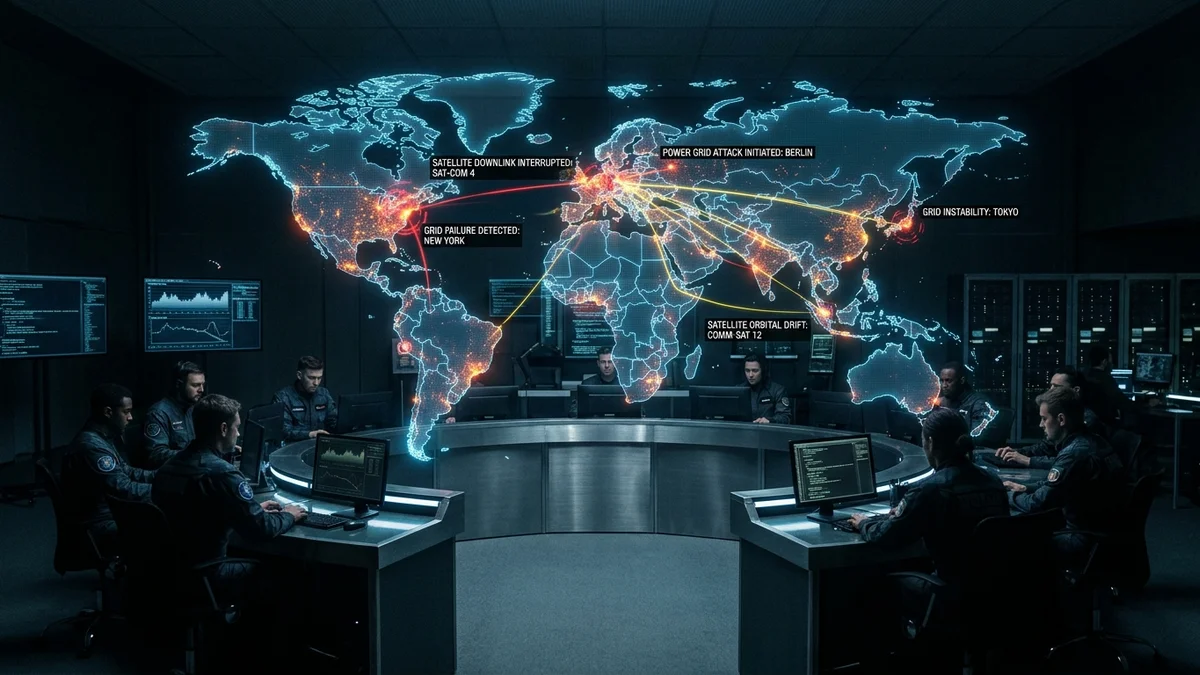
When Swiss Re, Munich Re, and Lloyd's syndicates excised state-backed infrastructure outages from standard policies—a systemic risk boundary also tracked by the European Union Agency for Cybersecurity (ENISA)—they effectively transferred the ultimate financial liability to sovereign balance sheets. Yet no national treasury possesses the liquidity reserve required to backstop multi-month electrical grid reconstitutions. If three regional balancing authorities operating under FERC electric reliability standards collapse under malicious control logic alongside substation cyber warfare and undersea cable sabotage, replacement hardware costs, business interruption claims, and physical asset replacements would wipe out years of industrial GDP.
Strategic Realignment: The Decentralization Mandate
The strategic conclusion facing energy analysts and corporate risk committees in late 2026 is inescapable: centralized, internet-connected SCADA infrastructure cannot be fully secured against well-resourced state adversaries. The only viable long-term mitigation is physical decoupling—implementing air-gapped OT hardening and analog failsafes, manual centrifugal governor valves, and islandable microgrids that can operate independently when the hyper-connected bulk power system fractures into a black-sky grid and communications collapse.
Until that painful, multi-decade capital recapitalization is completed, modern industrial societies remain held hostage by the silent, pre-positioned commands lurking within their own municipal wires.
Real-time geospatial feed aggregating USGS M5.0+ earthquakes, NASA EONET wildfires, volcanoes, severe storms, UN/EC GDACS alerts, and NOAA geomagnetic status.
Related Reports & In-Depth Intel
The Three-Carrier Stalemate
With the USS Theodore Roosevelt entering the theater alongside two forward carrier groups after IRGC drone strikes on Bahrain's Al-Rifaa base, markets face a treacherous 'no-war, no-peace' energy chokepoint that neither Washington nor Tehran can cleanly unwind.
The Nitrogen Trap
As natural gas feedstocks tighten and Middle Eastern ammonia export terminals face blockade risks, global synthetic nitrogen prices have surpassed historic peaks. We model the 2027 agricultural deficit and the return of food nationalism.
Strategic Assessment: The Moscow-Tehran Axis and Western Energy
A comprehensive geostrategic evaluation of the deepening Moscow-Tehran military-economic alignment, the weaponization of Middle Eastern maritime chokepoints, and the resulting multi-year Western energy deficit.

Analysis of the 2026 Middle East War
The 2026 conflict between the US, Israel, and Iran has triggered a systemic global economic shock, closing the Strait of Hormuz and disrupting energy, semiconductor, and food supply chains.