The Looming Specter of AI

From edge-autonomous combat drones that defeat radio jamming to automated critical-infrastructure control loops, the real AI danger is not movie science fiction—it is machine-speed escalation without human brakes.
# The Looming Specter of AI: Navigating the Risks of Autonomous Drones and Skynet
Mention "Skynet" in serious defense circles and engineers roll their eyes at Hollywood chrome skeletons—right before quietly acknowledging the core anxiety underneath the metaphor. Humanity does not need a sentient, hateful machine to trigger catastrophic failure. All it takes is handing lethal, infrastructural, and kinetic decisions to fast autonomous software operating inside complex networks faster than human judgment can intervene.
That threshold is no longer theoretical. Across battlefields in Eastern Europe and the Middle East, as well as inside industrial control networks and cyber offense pipelines, autonomy has shifted from laboratory white papers into cheap hardware built for mass deployment—a doctrinal shift analyzed in our briefings on algorithmic kill webs and autonomous drone swarms and the kinetic AI arms race. Understanding what autonomous drones and machine-speed AI actually threaten—and what remains hype—is essential for anyone trying to harden their household, energy supply, and community against modern systemic shocks.
From Remote-Controlled Toys to Jam-Proof Edge Autonomy
Early commercial quadcopters converted into battlefield strike platforms relied heavily on continuous radio links: one channel feeding live analog or digital video back to a pilot wearing goggles, another sending stick commands back to the drone. Electronic warfare (EW) units quickly learned how to blind those links with high-power directional RF jammers, dropping drones out of the sky or forcing them to hover aimlessly.
That cat-and-mouse dynamic drove the rapid proliferation of onboard edge AI. Using inexpensive neural-network co-processors mounted directly onto airframes costing under a thousand dollars, modern drones no longer need a live radio tether during the final phase of flight:
- Optical Flow and Terrain Matching: Instead of trusting spoofed GPS signals, onboard cameras match ground contours against preloaded satellite elevation maps, letting drones fly hundreds of miles through heavy jamming zones.
- Terminal Visual Lock: Once an operator—or a wide-area search algorithm—designates a silhouette such as a transformer bank, fuel tanker, or moving vehicle, the drone's onboard vision chip locks onto pixels and steers to impact autonomously. Severing the radio link at that point achieves nothing.
- Coordinated Swarm Saturation: Rather than launching one multimillion-dollar cruise missile that air-defense radar tracks easily, dozens of low-cost autonomous airframes can split altitudes, share target handoffs over short-range optical or mesh links, and overwhelm defensive magazines simply by forcing defenders to burn expensive interceptors against plywood and carbon-fiber airframes.
The Real "Skynet" Risk: Machine-Speed Systemic Coupling
The existential hazard of military and industrial AI rarely looks like an evil machine deciding to wipe out humanity. It looks much closer to the 2010 stock market "Flash Crash," scaled up to power grids, satellite constellations, and nuclear early-warning architectures.
When rival militaries deploy AI-driven intelligence fusion, automated cyber defense, and rapid target-queuing tools, decision timelines compress from hours to milliseconds. A commander worried that an adversary's autonomous drone swarm or zero-day cyber worm can blind regional radar before human analysts finish verifying telemetry faces immense pressure to pre-authorize automated counter-strikes. Once two opposing automated systems begin reacting to each other's actions—or to spoofed sensor inputs and false positives—escalation can cascade far faster than diplomatic hotlines or human oversight committees can pull the plug.
Even short of military escalation, autonomous cyber operations pose an immediate threat to civilian life-support networks, a vector driving autonomous AI hacking and zero-day grid extortion and tracked in CISA's Known Exploited Vulnerabilities Catalog alongside ENISA threat assessments. Large language and agentic coding models have dramatically lowered the skill barrier required to probe exposed industrial controllers, map municipal water-treatment SCADA endpoints flagged in CISA Industrial Control Systems advisories, and chain zero-day exploits across poorly patched electric substations. In a geopolitical crisis, a small team running autonomous reconnaissance and intrusion agents can disrupt regional power, pipeline telemetry, or hospital networks simultaneously—turning software failure into physical freezing, water contamination, and supply paralysis within days.
Civilian Exposure: Infrastructure, Privacy, and Physical Hardening
For ordinary households and local communities, autonomous systems reshape everyday risk in three concrete ways:
- 01.Grid and Energy Fragility: High-voltage step-up transformers, LNG compressor stations, and substation switchgear—critical assets whose reserve margins are assessed by NERC and safeguarded under NIST critical infrastructure cybersecurity frameworks—sit outdoors behind chain-link fences, making them easy targets for both autonomous cyber attacks and small explosive drones. Losing a handful of regional transformers can plunge provinces into multi-week blackouts regardless of how intact neighborhood power lines look.
- 02.Ubiquitous Aerial Surveillance: Thermal-imaging drones combined with automated person-and-vehicle recognition software remove the cover of darkness and rural tree cover. Generators running unbaffled outdoors, poorly shielded wood stoves, or noisy vehicle traffic register sharply on low-cost thermal sensors from hundreds of feet aloft.
- 03.Economic and Civil Instability: Rapid automation across white-collar logistics, customer operations, coding, and transport threatens sharp labor displacement faster than social safety nets adapt—fueling political polarization, civil unrest, and declining trust in public institutions at the exact moment crisis governance demands cohesion.
Practical Countermeasures for an Automated Threat Environment
You cannot out-code a nation-state cyber unit from your living room, nor can you shoot down high-altitude reconnaissance assets. Survival readiness against autonomous disruption focuses instead on decoupling your life support from fragile networked targets and minimizing your technical footprint:
- Achieve True Off-Grid Energy Redundancy: Do not rely on smart-grid-tied solar inverters that shut down automatically during a utility outage or depend on cloud servers for firmware updates and monitoring. Pair standalone solar arrays and LiFePO4 battery banks with manual transfer switches and baffled diesel or dual-fuel backup generators kept offline from internet connections.
- Strip Smart Dependencies Out of Critical Gear: Apply analog countermeasures for digital blackouts for heating, water pumping, food preservation, and navigation. Mechanical wood stoves, manual deep-well hand pumps, printed topographic maps, and offline medical/engineering manuals cannot be bricked by a rogue software push, ransomware attack, or regional cellular outage.
- Reduce RF and Thermal Signatures: In unstable security environments, everyday devices broadcast constantly. Disable unnecessary Wi-Fi, Bluetooth, and smart-home telemetry; store spare offline radios and navigation receivers inside sealed metallic Faraday cages; and house backup generators inside acoustically and thermally baffled utility sheds rather than running open frames in the yard.
- Build Local Human Trust Networks: Algorithms excel at isolating individuals and exploiting digital noise, yet they cannot replace face-to-face community resilience. Neighborhood mutual-aid groups equipped with short-range VHF/GMRS radios, shared mechanical skills, and pre-arranged meetup protocols function cleanly even when cellular towers go dark or information channels flood with synthetic disinformation.
Autonomous drones and automated decision engines are permanent features of the twenty-first-century landscape. Treating them with sober engineering realism—rather than sci-fi panic—allows you to strip fragile digital dependencies out of your home systems before the next grid or security shock tests them.
Authoritative Sources & Further Reading
Real-time geospatial feed aggregating USGS M5.0+ earthquakes, NASA EONET wildfires, volcanoes, severe storms, UN/EC GDACS alerts, and NOAA geomagnetic status.
Related Reports & In-Depth Intel
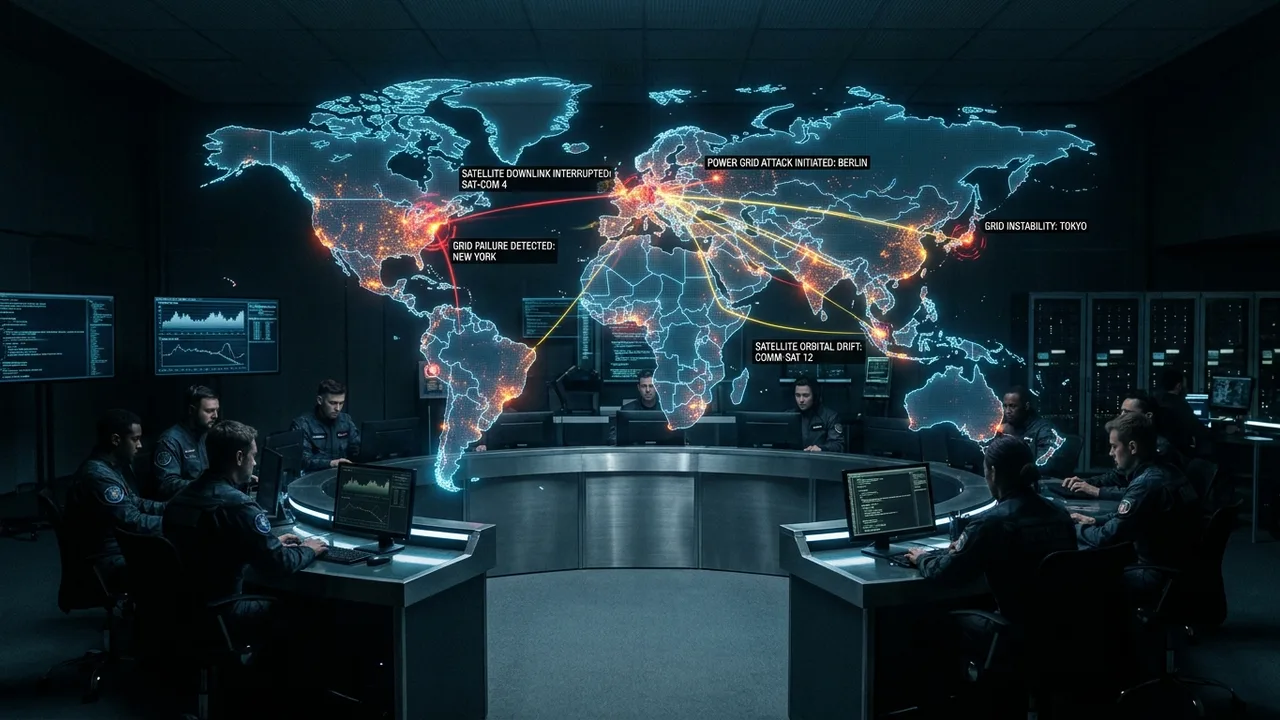
Machine-Speed Siege: FBI Advisory ARTEX, Three-Hour Autonomous Intrusions
Two watershed November 2026 cybersecurity disclosures—the FBI FLASH warning on autonomous ARTEX penetration agents and Forescout's 90-hour AI bug-hunting benchmark—prove that the defensive human patching cycle has been structurally outpaced by weaponized machine intelligence.

Beijing Rehearses the Taiwan Stranglehold
Two Chinese carrier groups, scores of coast guard hulls, and unannounced encirclement drills past the First Island Chain signal a shift from invasion theater to sustained maritime strangulation.
Autonomous Cyber Swarms and the Collapse of Epistemic
The proliferation of agentic AI systems and unconstrained generative architectures has breached the structural foundations of public communication, financial consensus, and cyber defense. We document the emergence of autonomous polymorphic malware and the total degradation of shared digital truth.

Undersea Fiber Severance and Baltic Gray-Zone Sabotage
Recent multi-point severances of undersea fiber optic trunk lines in the Baltic and Red Seas expose the fragile physical chokepoints sustaining 99 percent of intercontinental internet traffic and financial clearing systems.