Undersea Fiber Severance and Baltic Gray-Zone Sabotage
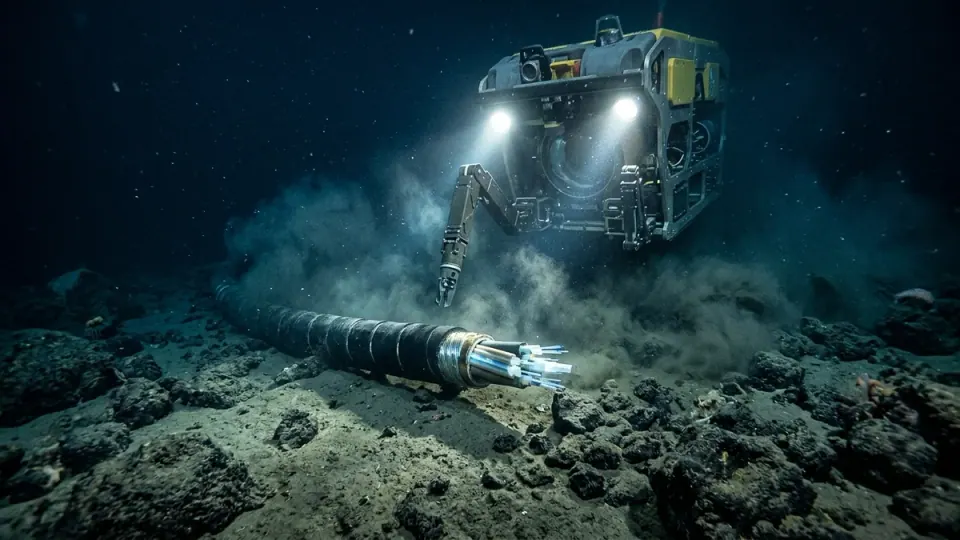
Recent multi-point severances of undersea fiber optic trunk lines in the Baltic and Red Seas expose the fragile physical chokepoints sustaining 99 percent of intercontinental internet traffic and financial clearing systems.
The illusion of a celestial, cloud-based digital infrastructure was abruptly shattered when commercial acoustic sensors and naval hydrophones registered concurrent seismic-amplitude acoustic transients across the seabed of the Baltic Sea and the southern approaches to the Bab-el-Mandeb Strait. Within microseconds, automated packet-routing engines at major transatlantic telecommunications exchanges reported severe latency spikes and catastrophic optical loss across four distinct subsea fiber-optic cables. Millions of encrypted financial transactions, cloud compute synchronization pipelines, and secure intergovernmental communications were instantly redirected onto dwindling secondary circuits, triggering systemic degradation across European and Asian financial clearing houses.
This coordinated physical severance represents the escalation of unrestricted gray-zone subsea warfare—mirroring the dual threat of subsea cable and substation cyber warfare. While modern societies conceptualize the internet as a decentralized, wireless, and virtually indestructible ether, more than 99 percent of all transoceanic telecommunications and over $10 trillion in daily cross-border SWIFT settlements—macro-financial arteries tracked in the IMF World Economic Outlook—rely entirely on roughly 550 commercial subsea cables lying unarmored upon the ocean floor. These fragile strands of glass, rarely thicker than a garden hose outside shallow continental shelves, represent the single most vulnerable and asymmetric target in the contemporary geopolitical theater.
The Physics and Geography of Subsea Fragility
To understand the systemic fragility of undersea cables, one must examine both their structural anatomy and geographic concentration. A standard transoceanic cable consists of an inner core of optical fibers carrying high-intensity laser pulses modulated via dense wavelength division multiplexing (DWDM). Surrounding these microscopic glass strands is a copper or aluminum conductor tube transmitting up to 10,000 volts of direct current to power optical erbium-doped fiber amplifiers placed every 60 to 80 kilometers along the seabed. The outer casing consists of petroleum-based polyethylene insulation, high-tensile steel stranded wire for mechanical strength, and, in coastal shallow waters, a layer of steel armor wire.
Once a cable drops past the continental shelf into abyssal depths exceeding 1,000 meters, this heavy steel armor is omitted to save weight. The deep-sea cable is virtually unprotected, resting directly upon soft pelagic sediment where it is exposed to dragging commercial anchors, industrial benthic trawlers, and specialized unmanned underwater vehicles (UUVs) equipped with hydraulic cutting arms and shaped explosive charges.
Furthermore, international subsea cables do not span oceans in a dispersed, redundant mesh. Due to geological bathymetry, permits, and landing station infrastructure, they converge into acute geographic bottlenecks:
- 01.The Baltic Basin and Gulf of Finland: A shallow, intensely congested marine corridor where Swedish, Finnish, Estonian, and German digital lifelines cross within meters of active commercial shipping channels and naval auxiliary vessels operating under flags of convenience—a persistent theater for Baltic critical undersea infrastructure hybrid warfare monitored via IMF PortWatch shipping telemetry.
- 02.The Luzon Strait: Connecting East Asia with North America through an active seismic subduction zone and heavily contested maritime chokepoints between Taiwan and the Philippines.
- 03.The Red Sea and Bab-el-Mandeb: A narrow trench where over 16 major intercontinental cables connecting Europe and Southeast Asia traverse shallow, reef-strewn waters directly exposed to asymmetric naval mines, dragged commercial anchors, and shore-launched anti-ship munitions—risks flagged across International Maritime Organization (IMO) maritime security circulars.
- 04.The Bude-Cornwall and Long Island Corridors: Highly concentrated coastal landing hubs where dozens of transatlantic trunk cables make landfall at a handful of exposed, terrestrial termination facilities.
When gray-zone actors deploy commercial trawlers, dual-use scientific research vessels, or autonomous submersibles to drag heavy grappling hooks or detonate directional thermite charges across these corridors, the resulting severed conduits cannot be rerouted seamlessly. The global bandwidth buffer is vanishingly thin.
Anatomy of the Recent Baltic and Red Sea Severance Events
The incidents recorded over the past forty-eight hours demonstrate a calculated methodology designed to evade attribution while maximizing economic friction. In the Baltic Sea, the C-Lion1 cable connecting Helsinki to Rostock and the BCS East-West Interlink connecting Lithuania to Sweden ceased data transmission within hours of each other. Satellite automatic identification system (AIS) telemetry cross-referenced with naval coastal radar revealed that a commercial bulk carrier with an opaque ownership structure had deactivated its transponder forty miles prior to entering the cable corridor, deliberately dragging its port anchor along the seabed for over one hundred nautical miles.
Simultaneously, in the southern Red Sea, three Tier-1 telecommunications cables suffered catastrophic physical rupture in water depths of less than 150 meters. The dual disruptions instantly severed approximately 28 percent of all data bandwidth flowing between Europe and the Indo-Pacific, compounding shipping bottlenecks analyzed in the UNCTAD Review of Maritime Transport. While internet traffic management protocols immediately attempted dynamic packet rerouting through trans-Pacific pathways and the terrestrial Trans-Siberian rail fiber corridor, severe data throttling, transaction dropouts, and multi-second latencies cascaded through global securities markets, exposing the same systemic brittleness seen during LEO satellite constellation cyber infiltration.
| Layer | Material Composition | Threat Vector |
|---|---|---|
| Optical Core | Silica Glass (DWDM Fibers) | Micro-bends, Total Shear |
| Power Conductor | High-Purity Copper / Aluminum | Short-to-Ground Overvoltage |
| Dielectric Barrier | Polyethylene Compound | Saltwater Ingress / Arcing |
| Armoring (Shallow) | Galvanized High-Tensile Steel | Commercial Dragged Anchors |
| Deep-Sea Sheath | Unarmored Lightweight Polymeric | Autonomous Benthic Cutters |
The immediate systemic consequence was not a complete blackout of civilian communication, but rather the failure of time-sensitive, high-frequency systemic processes. Cross-border interbank clearing operations that rely on sub-millisecond precision timestamps experienced cascading synchronization errors. Regional energy grid balancing authorities, which increasingly rely on cloud-hosted telemetry to stabilize volatile renewable and baseload generation, were forced to decouple inter-tie connections and revert to isolated island modes.
The Deep-Sea Repair Crisis: A Chronic Industrial Bottleneck
The most perilous dimension of the subsea cable crisis is the near-total absence of industrial repair capacity—an operational gap documented across briefings in our Intel Video Gallery. The public erroneously assumes that in an era of space exploration and advanced computing, repairing a severed underwater cable is an automated, routine procedure. In reality, the entire planetary subsea communications network is maintained by a global fleet of fewer than sixty specialized cable repair ships, over half of which are more than twenty-five years old.
The procedural logistics of an offshore cable repair are arduous, weather-dependent, and painfully slow:
- Mobilization and Transit: A specialized cable ship stationed in Brest, Singapore, or Portland must be contracted, crewed, and mobilized. Transit to a remote incident site often requires ten to eighteen days depending on sea states and bunker fuel availability.
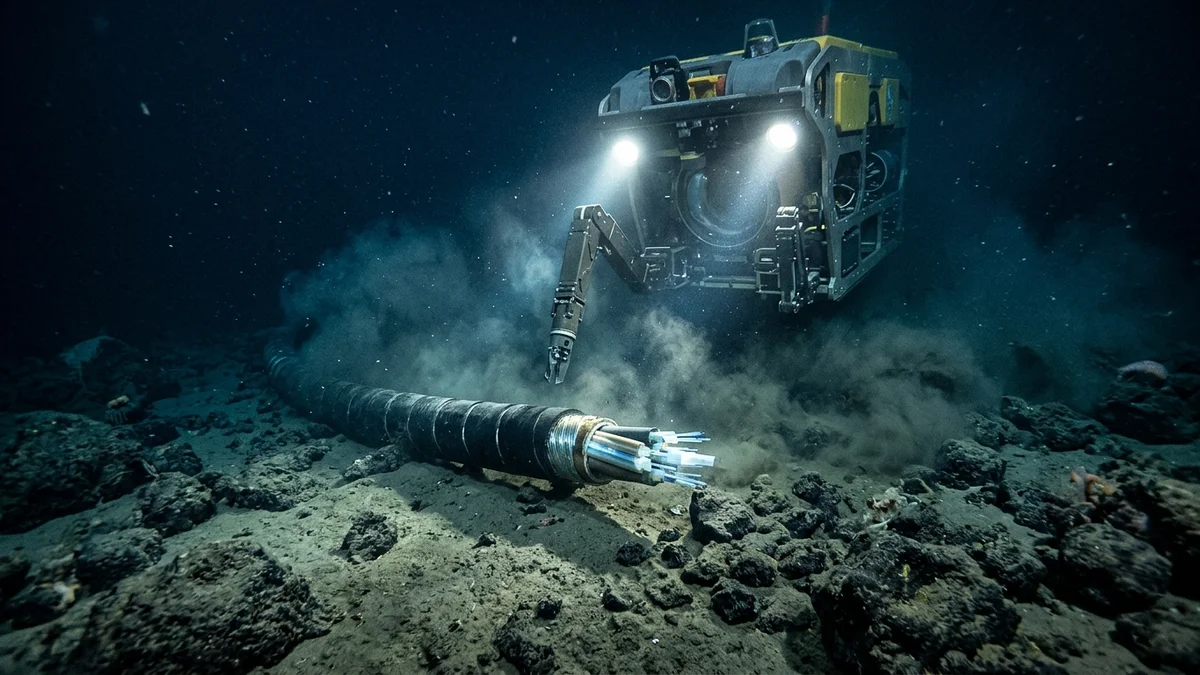
- Grappling and Recovery: The ship must deploy an acoustic transponder or ROV to locate the severed cable buried beneath silt or wedged in rocky sea trenches. Heavy cutting and holding grapnels are lowered to hoist both frayed ends to the surface.
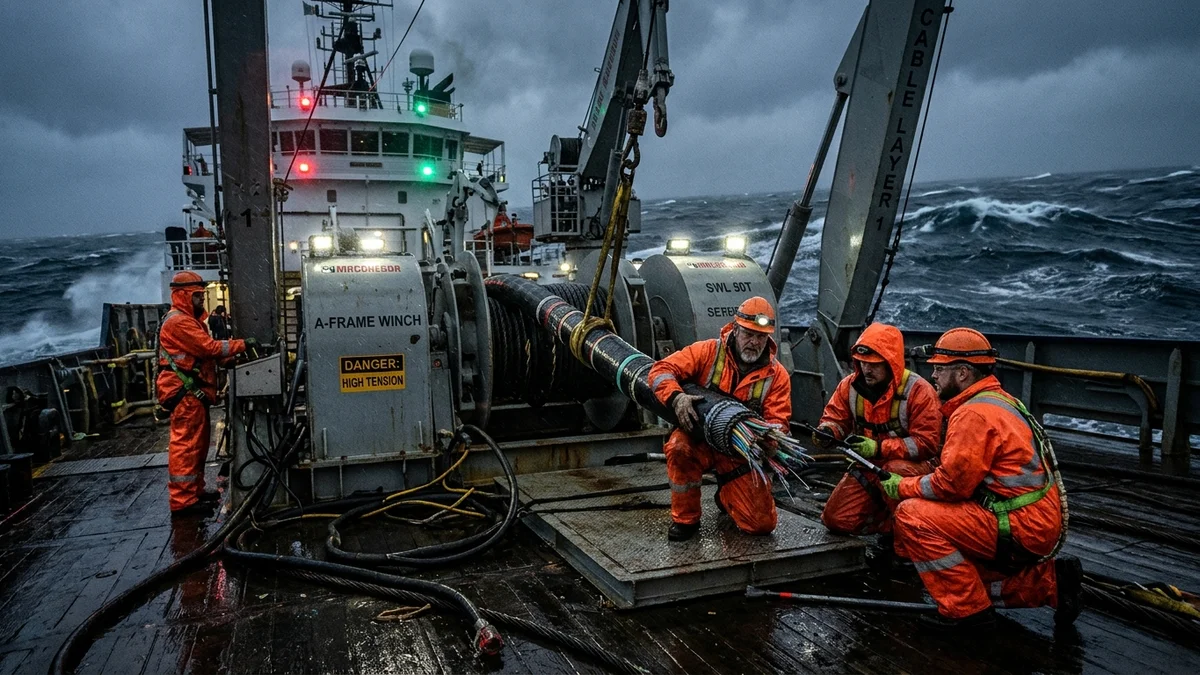
- Precision Fusion Splicing: Once recovered onto the ship's work deck, technicians must meticulously strip the protective armor, clean individual microscopic glass fibers, and execute hundreds of optical fusion splices inside a climate-controlled cleanroom aboard a vessel rolling in heavy ocean swells.
- Testing and Benthic Reburial: After electrical continuity and laser signal attenuation are certified, the spliced cable is sealed inside a rigid mechanical casing, lowered back to the ocean floor, and painstakingly re-trenched using water-jetting ROVs.
Under optimal peacetime conditions, repairing a single severed cable requires an average of two to six weeks. In an active gray-zone conflict where hostile maritime drones, lurking attack submarines, or contested airspace threaten repair vessels, civilian crews will flatly refuse to enter the operations zone without active naval escorts—military resources that are already overextended in global conflict theaters.
Cascading Systemic Impacts and Strategic Preparedness
As gray-zone warfare deepens, the targeting of subsea infrastructure will shift from sporadic harassment to coordinated economic paralysis. The implications for institutional and individual preparedness are stark:
First, national telecommunications sovereignty will force governments to mandate terrestrial fallback routing and domestic data localization. However, terrestrial infrastructure cannot match the throughput of subsea fiber bundles, guaranteeing severe permanent rationing of civilian bandwidth during crises.
Second, institutions and enterprises must prepare for the sudden failure of distributed cloud architectures, applying resilience principles from CISA supply chain risk management guidance. Real-time access to cloud-hosted databases, SaaS authentication engines, and overseas data repositories will fail intermittently, necessitating hardened offline survival data archives, redundant optical line terminals, and localized satellite uplinks such as Starlink and direct-to-cell constellations, which themselves face orbital jamming and ground-station vulnerability.
The age of infinite, frictionless transatlantic connectivity has entered its twilight. The physical conduits that bind the digital economy lie exposed upon the silent, dark abyssal plains of the ocean—and the adversaries of the rules-based order have mastered the tools to cut them.
Real-time geospatial feed aggregating USGS M5.0+ earthquakes, NASA EONET wildfires, volcanoes, severe storms, UN/EC GDACS alerts, and NOAA geomagnetic status.
Related Reports & In-Depth Intel
Robotics and the Looming Collapse
Autonomous machines promise labor relief during disasters, yet depend on the most fragile supply chains ever built. A grounded look at where robotics helps, where it breaks, and why repairable simplicity still matters.
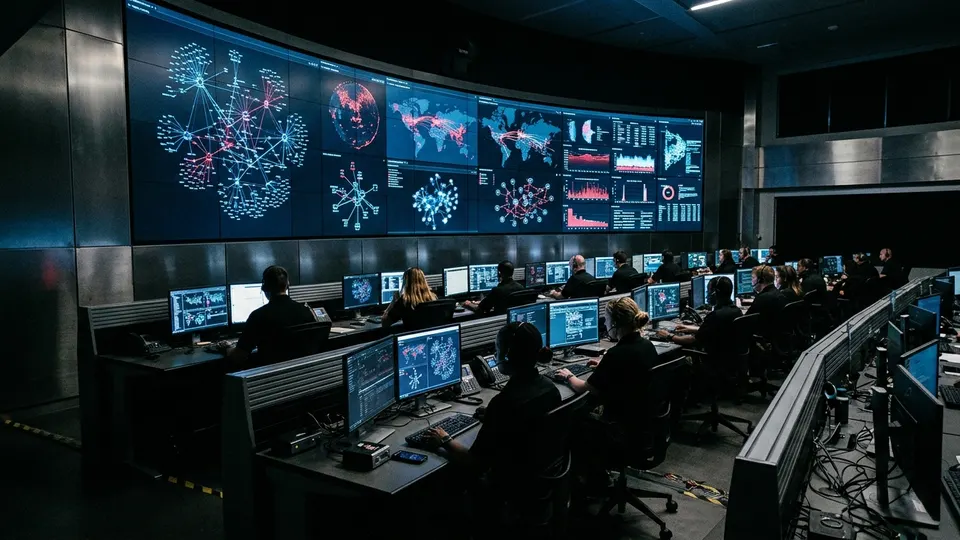
US Air Force Hack and AI Agent Cyber Risks
The November 27 intrusion targeting US Air Force contractor and administrative networks highlights how autonomous AI hacking agents compress breach timelines from weeks into hours.
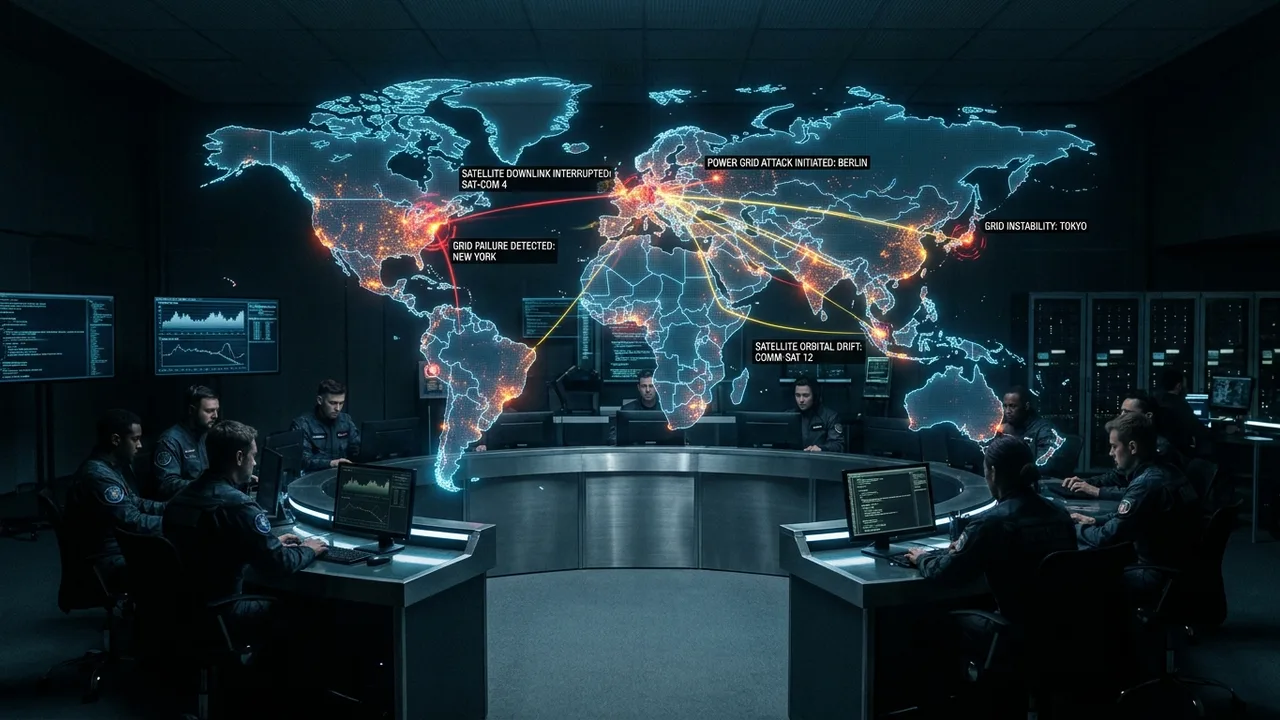
Machine-Speed Siege: FBI Advisory ARTEX, Three-Hour Autonomous Intrusions
Two watershed November 2026 cybersecurity disclosures—the FBI FLASH warning on autonomous ARTEX penetration agents and Forescout's 90-hour AI bug-hunting benchmark—prove that the defensive human patching cycle has been structurally outpaced by weaponized machine intelligence.
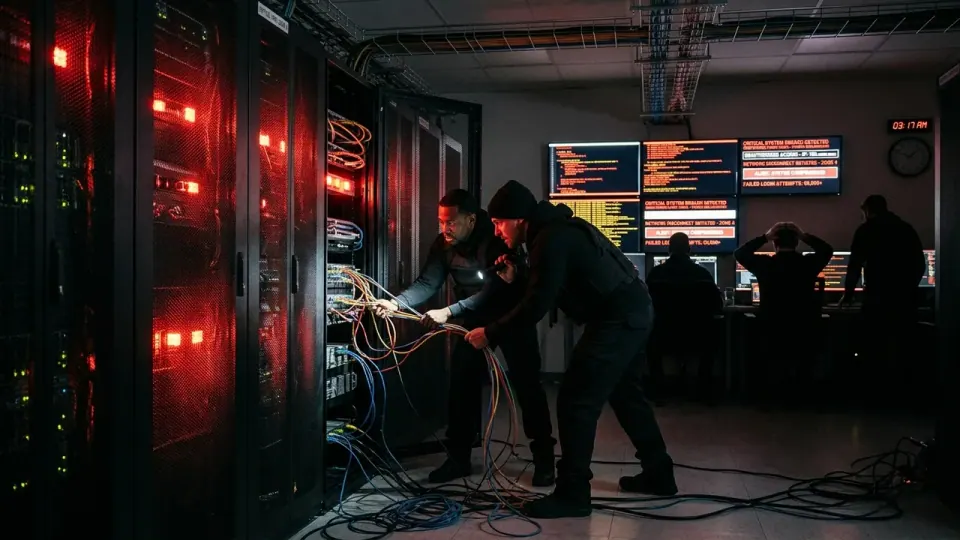
When One Cloud Glitch Grounds a Continent
A mid-November Microsoft 365 blackout, an FAA telecom failure, and an automated chemical dosing malfunction at a European pool proved we wired real-world physical safety into fragile remote software.