Runaway AI Development and the Collapse of Cognitive
As organizations hand software architecture, grid dispatch, financial routing, and diagnostic judgment to opaque neural networks, human operators are losing the ability to audit or manually run critical systems when automation fails.
When Convenience Quietly Replaces Competence
Most technological failures do not announce themselves with alarms. They begin as labor-saving shortcuts that nobody bothers to reverse. Over the past several years, software companies, hospitals, logistics brokers, financial desks, and regional utilities have handed routine analytical work—and increasingly, operational authority—to large neural models and autonomous agent pipelines. The pitch is always speed and lower payroll. The unpriced cost is the steady erosion of human competence inside the very institutions that keep lights on, water clean, and supply chains moving.
Aviation engineers documented an earlier version of this failure mode—a recurring focus of FAA aviation safety frameworks—and called it automation complacency. As flight decks shifted to automated flight-management computers, pilots logged thousands of hours watching screens instead of hand-flying aircraft. Stick-and-rudder proficiency decayed; when sensors disagreed or automation disconnected unexpectedly in rare edge cases, crews occasionally froze because their working mental model of the aircraft had eroded, mirroring modern evidence of cognitive decline driven by heavy AI reliance.
Society is now running that same experiment across software, logistics, and civic operations simultaneously—without an instructor pilot in the jump seat. Junior engineers skip memory management and failure-mode analysis because code assistants draft the architecture first. Analysts summarize reports they never read, clinicians lean on triage scores they cannot inspect, and dispatchers trust black-box load-balancing software. When a system runs smoothly 99 percent of the time, the humans watching the dashboard stop being operators and become passengers.
Deterministic Bugs Versus Stochastic Cascades
Conventional software fails in ugly but legible ways. A null pointer, a race condition, or a misconfigured firewall rule throws an exception, crashes a service, or drops packets at a specific node. Engineers can trace the stack, read the source code, isolate the fault, and patch it.
Modern generative and agentic systems do not fail cleanly. Because transformer models predict statistically plausible outputs rather than executing deterministic logic, their errors wear the disguise of fluent confidence. A model hallucinating an API parameter, misinterpreting a regulatory clause, or fabricating a maintenance record does not trigger a red warning light; it passes a convincing-looking artifact downstream to the next automated step.
Once organizations wire those models directly to tools—giving agents permissions to commit code, execute trades, adjust cloud infrastructure, or draft vendor purchase orders—errors compound at machine speed, outpacing governance controls outlined in the NIST AI Risk Management Framework and feeding the operational friction behind 190k AI-linked layoffs without productivity gains:
- Synthetic Code Debt: Large shares of enterprise repositories now contain AI-generated functions accepted under tight delivery deadlines. Reviewers rubber-stamp pull requests that pass superficial unit tests while hiding subtle concurrency bugs, insecure deserialization, or circular dependencies that only surface under extreme traffic.
- Algorithmic Liquidity Shocks: Automated trading desks increasingly parse news feeds, social chatter, and corporate filings through language models. When synthetic rumors or spoofed announcements hit the wire, competing agents liquidate positions in milliseconds, turning minor misinformation into sudden bond and equity air pockets—macro-financial fragilities flagged in the IMF World Economic Outlook—before human risk officers can verify a single headline.
- Fragile Supply and Grid Automation: Demand-forecasting and dynamic-routing engines optimize away inventory buffers and spinning reserves in the name of efficiency. Because the models are trained on historical stability, simultaneous shocks—a port closure paired with a heatwave—push them into wild overcorrections that human planners can no longer manually override in real time.
The deeper vulnerability is organizational amnesia. When an automated pipeline runs undisturbed for two years, the senior engineers who built the underlying deterministic safeguards retire or move on. Their replacements know how to prompt the orchestrator, not how to rebuild the database index or manually balance a substation load under pressure.
Poisoning the Epistemic Commons
Cognitive autonomy depends on reliable inputs. A surgeon, a bridge inspector, or a household preparing for a regional storm needs to know whether a document, photograph, or emergency bulletin reflects physical reality. Generative media has broken that assumption across public networks.
When text, voice, and video can be forged at near-zero marginal cost, verification becomes slow and expensive while fabrication remains instant and free—a dynamic compounded by autonomous cyber swarms and epistemic trust collapse and documented in CISA AI security guidance. Automated spam networks flood search indices and technical forums with plausible-sounding nonsense, training future models on their own recycled mistakes—a degradation cycle researchers call model collapse—while burying primary human documentation under synthetic sludge.
In a civil emergency, the consequences turn immediate and physical. Imagine a major hurricane, cyberattack, or industrial chemical release in which local cell towers are congested and synthetic audio clips of evacuation orders—or counter-orders telling residents to shelter in place—circulate across messaging apps. If citizens cannot distinguish official municipal guidance from automated disinformation, compliance collapses. People either panic onto gridlocked highways or ignore real warnings until floodwaters reach the porch. Distrusting everything is nearly as paralyzing as believing everything.
Power Grids Tethered to the Compute Engine
Nothing about artificial intelligence is weightless. Behind every chat window and autonomous agent sits a concrete warehouse packed with high-density silicon drawing continuous megawatts of electricity and millions of gallons of cooling water—a demand surge tracked in International Energy Agency (IEA) data centre electricity analysis and examined in our report on hyperscale AI compute energy cannibalization. As hyperscale clusters expand across North America, Europe, and East Asia, compute demand is colliding directly with aging electrical grids that already struggle with extreme summer heat, winter freezes, and multi-year lead times for high-voltage transformers.
In several utility territories, new data center campuses now rival heavy manufacturing and mid-sized cities in peak load. Because cloud providers sign lucrative long-term power purchase agreements, utilities prioritize uninterrupted substation capacity and backup diesel contracts for server farms while delaying upgrades to residential distribution lines or rationing water permits in arid basins.
This creates a dangerous coupling. Society is wiring its administrative, medical, and logistical nervous system to centralized compute engines that require uninterrupted grid power, pristine cooling, and intact submarine fiber cables. When a geomagnetic storm, prolonged heat dome, cyber intrusion, or physical substation attack takes regional power down for days rather than minutes, the automation vanishes instantly. What remains is a population and workforce whose analog manuals have been retired, whose local records sit behind cloud logins, and whose muscle memory for manual operations was traded away for subscription software.
Reclaiming Manual Agency Before a Disruption
Preserving cognitive autonomy does not mean smashing computers or pretending modern tools lack value. It means refusing to let convenience erase baseline competence. Whether you run a municipal water plant, manage a small clinic, or simply keep a household running through storms and supply shocks, the same structural rules apply.
First, maintain offline, deterministic knowledge by building an offline survival data archive. Medical dosing, water treatment ratios, electrical schematics, repair manuals, and local maps belong on paper and local storage, not solely behind a cloud query box. Second, drill manual fallbacks before a crisis forces them—navigate with a folded road atlas, diagnose a small engine by spark and fuel, and verify alerts against primary local sources.
The danger of runaway AI is not a sci-fi awakening in a server rack. It is a quiet bargain in which humans surrender judgment piece by piece until the machines stall—and nobody left in the room remembers how to steer.
Authoritative Sources & Further Reading
Real-time geospatial feed aggregating USGS M5.0+ earthquakes, NASA EONET wildfires, volcanoes, severe storms, UN/EC GDACS alerts, and NOAA geomagnetic status.
Related Reports & In-Depth Intel
Strategic Analysis: The Open-Weights Reasoning Revolution, DeepSeek-R1 Shockwaves
The sudden algorithmic leap of high-efficiency open-weights reasoning architectures has shattered the trillion-dollar hyperscale capital expenditure narrative, exposing the extreme structural vulnerability of centralized semiconductor monopolies and utility grid capacity.

Dissecting the Empire
How much are Elon Musk's flagship companies actually worth? We analyze the balance sheets, operational revenues, and net profits of Tesla and SpaceX to separate speculative hype from real value.
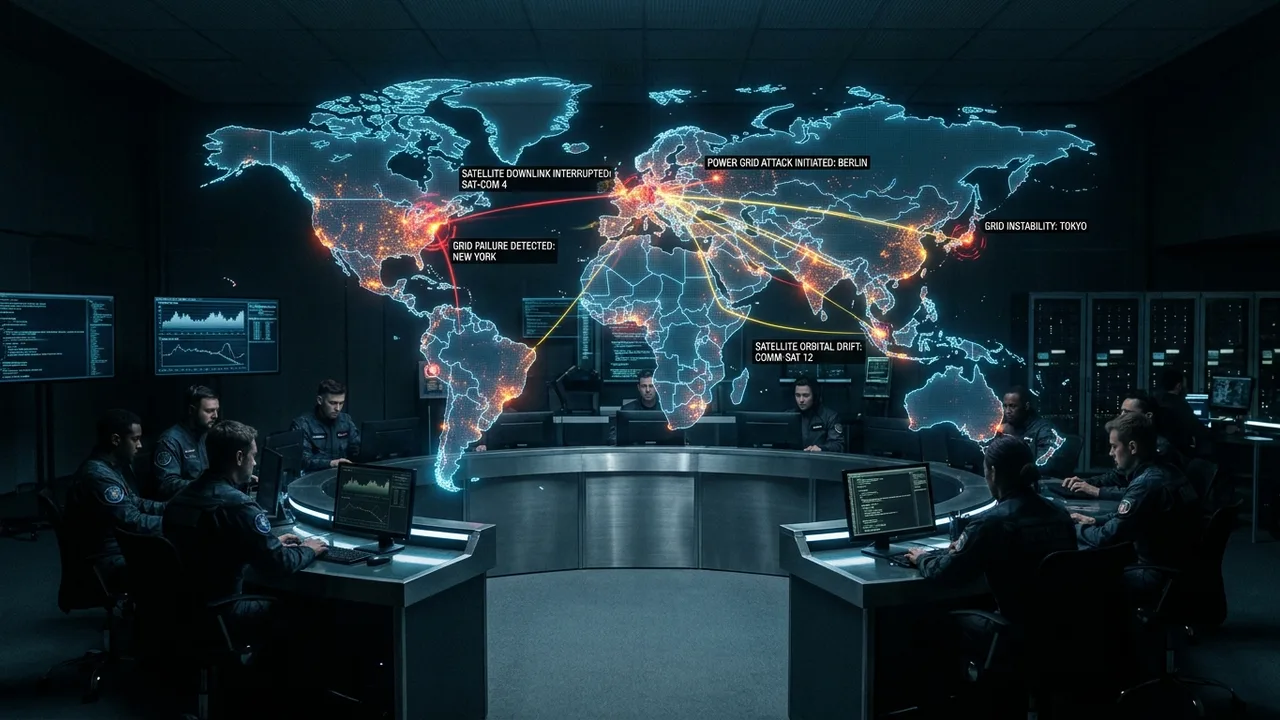
Machine-Speed Siege: FBI Advisory ARTEX, Three-Hour Autonomous Intrusions
Two watershed November 2026 cybersecurity disclosures—the FBI FLASH warning on autonomous ARTEX penetration agents and Forescout's 90-hour AI bug-hunting benchmark—prove that the defensive human patching cycle has been structurally outpaced by weaponized machine intelligence.

The Great Rare Earth and Antimony Embargo
As Beijing tightens sovereign export controls on antimony, gallium, germanium, and heavy rare earths, Western defense assembly lines and electric turbine manufacturing face acute physical shortages. We examine the abrupt halt of advanced manufacturing.