The Looming Water Crisis
Municipal taps depend on continuous grid electricity, intact chemical supply chains, and overdrawn aquifers. How water infrastructure fails during crises and how to build reliable home storage and multi-stage purification.
Seventy-Two Hours From the Tap
Most households treat running water as an automatic law of nature rather than a fragile industrial service. Turn a chrome handle, and pressurized, treated water flows endlessly into sinks and showers. Yet behind that faucet sits an energy-intensive chain of electric lift pumps, aging cast-iron mains, automated chlorine feeders, and regional aquifers—and almost none of it keeps working for long when grid power fails or maintenance collapses.
You do not need an imaginary wasteland to lose your municipal tap. Recent multi-day water collapses in Jackson, Mississippi, prolonged winter pipe-burst outages across Texas, and cascading SCADA breaches at municipal water plants have demonstrated how rapidly modern cities drop to boil-water advisories—or dry pipes altogether. Without incoming pressure, municipal mains lose positive pressure and allow surrounding groundwater and sewage seepage to siphon backward into distribution lines. Humans can endure weeks without food; without safe hydration, cognition degrades inside twenty-four hours and dehydration turns lethal within roughly three days.
Structural Pressures Beneath the Surface
Two slow-moving crises are tightening the margin around clean water long before acute disasters strike, trends tracked daily via our planetary hazard and climate telemetry radar and the USGS National Water Dashboard.
First is physical groundwater mining. Major agricultural and urban regions—from the Ogallala Aquifer beneath the American Great Plains to California's Central Valley and deep basins across North Africa, Northern India, and Northern China, where satellite gravimetry documented by NASA Earth Observatory reveals persistent aquifer depletion—are pumping fossil groundwater far faster than seasonal rain and snowpack recharge it. Falling water tables force municipalities and rural wells to drill deeper, concentrate dissolved salts and arsenic, and burn more electricity per gallon lifted.
Second is deferred infrastructure and chemical supply coupling, a vulnerability monitored across the CISA Water and Wastewater Systems Sector. Treatment plants depend continuously on rail and truck deliveries of aluminum sulfate, chlorine gas, and sodium hypochlorite. During severe pandemics, rail strikes, or refinery disruptions, utilities have publicly warned of thinning chemical inventories. Pair aging distribution pipes with extreme heatwaves or hard freezes, and single-point breaks turn routine weather events into county-wide water emergencies.
Matching Treatment to the Actual Threat
Buying one trendy pocket filter and calling yourself prepared is a dangerous mistake. Safe water treatment requires matching your method to what actually contaminates local sources. Open creeks, floodwaters, and stagnant urban pools carry three distinct biological hazards—plus invisible chemical risks:
- Protozoa (*Giardia*, *Cryptosporidium*): Larger single-celled cysts (roughly 3 to 15 microns) that resist standard chlorine doses well, requiring fine mechanical filtration or heat.
- Bacteria (*E. coli*, *Salmonella*, *Cholera*): Smaller pathogens (0.2 to 5 microns) responsible for rapid, life-threatening diarrheal illness.
- Viruses (Norovirus, Hepatitis A, Rotavirus): Microscopic particles (0.02 to 0.1 microns) that slip straight through standard 0.1-micron backpacking filters, demanding boiling, chemical disinfection, UV light, or ultra-fine 0.02-micron purifier membranes.
- Chemical and Heavy-Metal Contamination: Fuel runoff, agricultural pesticides, PFAS, lead, and nitrates are not killed by boiling or bleach—boiling actually concentrates heavy metals and salts by driving off pure steam.
Multi-Stage Purification That Works Without Power
Resilient household water plans layer simple steps—detailed in our essential water purification techniques and ranked water purification methods guide—rather than trusting one gadget.
Always begin with clarification. Murky pond or floodwater clogs expensive filter membranes in minutes and shields pathogens from UV light or chlorine. Let silt settle undisturbed in a bucket for several hours, then decant the clearer upper layer through a clean cotton t-shirt or coffee filter before disinfecting.
Once clear, choose from four proven purification paths aligned with CDC emergency water safety guidance:
- 01.Boiling (Thermal Disinfection): Bringing water to a full rolling boil for one minute (or three minutes above 6,500 feet elevation) reliably kills bacteria, viruses, and protozoan cysts. Let water cool in a covered clean pot and shake between containers to restore flat taste. Keep dedicated stove fuel budgeted purely for boiling if you rely on thermal treatment.
- 02.Hollow-Fiber and Ceramic Filtration: Reliable gravity filters remove sediment, bacteria, and protozoa down to 0.1 or 0.2 microns with zero electricity. Always protect wet hollow-fiber elements from freezing temperatures—ice crystals inside the microscopic tubules crack the filter silently, letting untreated water bypass without visible damage. Add activated carbon stages if dealing with chemical taste or mild organic runoff.
- 03.Chemical Disinfection: Unscented household liquid bleach (sodium hypochlorite at 5.25% to 8.25% concentration—avoid splash-less, scented, or gel formulas) disinfects stored drums and emergency water cheaply. Using standard 6% unscented bleach, add roughly 8 drops (about 1/8 teaspoon) per gallon of clear water—double if slightly cloudy—stir, and wait 30 minutes; a faint chlorine smell should remain. Because Cryptosporidium resists dilute bleach, keep chlorine dioxide tablets in emergency bags for questionable surface water.
- 04.Distillation: Boiling water and condensing pure steam down a clean coil—or building an improvised unit from our solar pyrolysis still field guide—leaves behind dissolved salts, heavy metals, radioactive fallout particles, and every biological pathogen. Though fuel-hungry, a simple stovetop distiller or solar still handles brackish or chemically suspect water no filter can touch.
Household Storage and Hidden Reserves
Never wait until store shelves empty of bottled cases to start storing water. Every household should maintain a baseline reserve of at least one gallon per person per day for a minimum of two weeks—rising toward two gallons daily in hot climates, for nursing mothers, or for medical hygiene.
Skip thin disposable grocery jugs, whose seams split after twelve months on garage shelves, and never reuse containers that held milk, juice, or household cleaners. Store municipal tap water inside rigid, opaque, food-grade high-density polyethylene (HDPE, recycling code #2) containers—ranging from manageable five-gallon stackable jerrycans to fifty-five-gallon drums kept off bare concrete on wooden pallets out of direct sunlight. Rotate stored water every six to twelve months, or stabilize clean tap water according to EPA emergency drinking-water disinfection guidance when sealing long-term drums.
Do not overlook water already sitting inside your walls. When a city boil-water order hits or main pressure drops, shut off your home's main street-side supply valve immediately so contaminated backflow cannot drain into your pipes. Your water heater holds thirty to eighty gallons of clean reserve once power or gas to the heater is switched off and the upper pressure-relief valve is cracked to allow draining from the bottom spigot.
Finally, protect your clean water with strict sanitation discipline. Dig emergency latrines at least two hundred feet downhill from any well, spring, or creek, wash hands strictly with dedicated rinse basins, and reserve graywater from laundry or dishwashing strictly for toilet flushing and non-edible irrigation. Water shortages turn survivable blackouts into public health disasters overnight—yet unlike grid transformers or global shipping, two weeks of clean water takes less space than a broom closet and costs almost nothing to secure today.
Authoritative Sources & Further Reading
Real-time geospatial feed aggregating USGS M5.0+ earthquakes, NASA EONET wildfires, volcanoes, severe storms, UN/EC GDACS alerts, and NOAA geomagnetic status.
Related Reports & In-Depth Intel
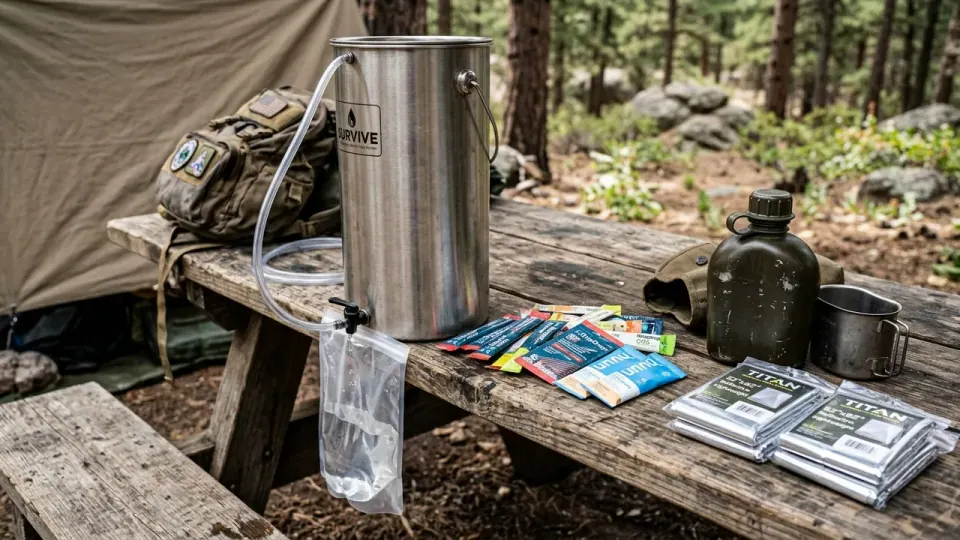
Cutting Nanoplastics Out of Your Kitchen
From the 5-minute hard-water boil-and-filter protocol that strips 90% of nanoplastics to reverse osmosis, non-plastic cookware, and indoor dust control—practical countermeasures that work today.
The Ultimate 72 Hour Emergency Kit Checklist
A technical and detailed checklist for assembling a three day emergency survival kit, covering water, nutrition, first aid, shelter, and tools.
Batteries in the Dark
When the electrical grid fails for weeks instead of hours, battery chemistry, cold-weather charging limits, and DC load math decide what keeps running. A field guide to survival energy storage.
Grid Down: The First 72 Hours
The first 72 hours of a major grid failure are a race against falling water pressure, dead cell towers, food spoilage, and carbon monoxide hazards. Here is a practical hour-by-hour response checklist for households.